


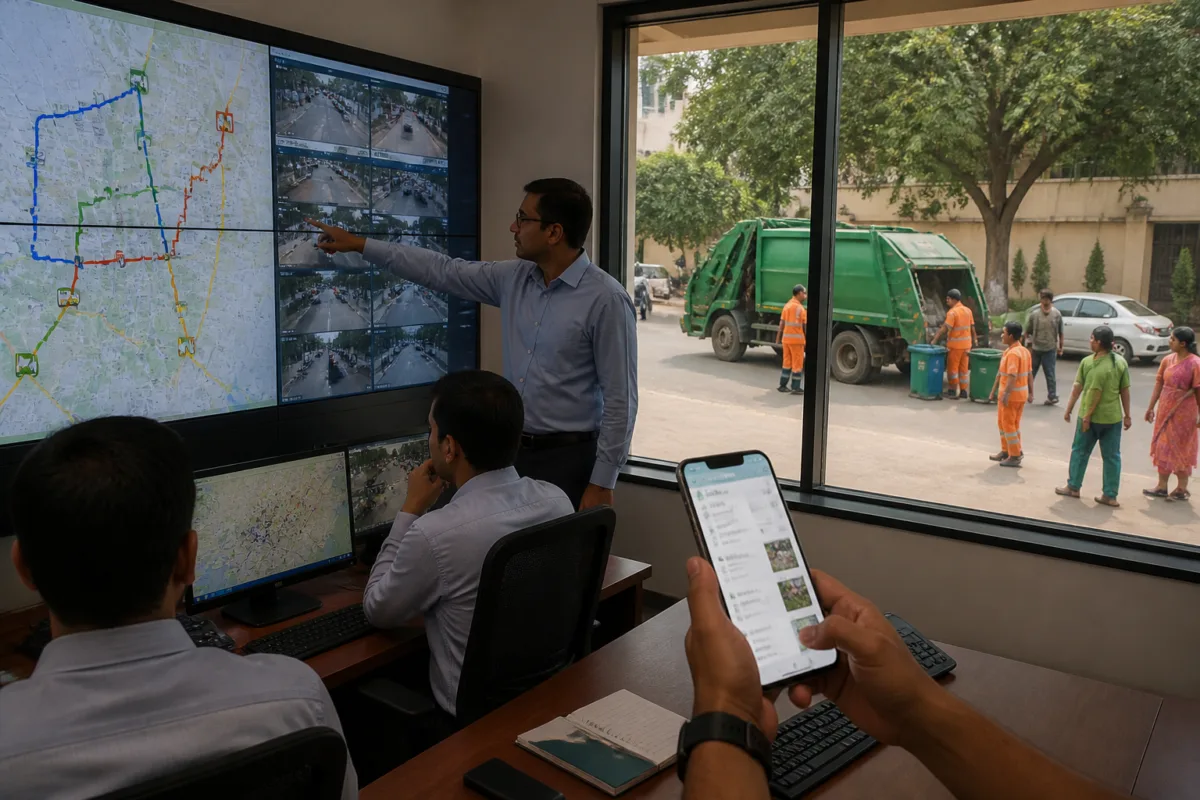
Indore Municipal Corporation has launched two AI-based cleanliness-monitoring systems that will track door-to-door garbage collection vehicles in real time and allow residents to identify and rate the sanitation worker assigned to their area. The civic body also held a workshop for bulk waste generators as the city prepares to implement revised waste-disposal requirements.
Mayor Pushyamitra Bhargava and Municipal Commissioner Kshitij Singhal inaugurated the systems at the Brilliant Convention Centre in the presence of Additional Commissioner Prakhar Singh and other officials, according to a report by the Times of India.
The first system is a live vehicle-tracking dashboard for the corporation’s door-to-door garbage collection fleet. Vehicle movement had previously been monitored manually. The dashboard will provide real-time information on the location and movement of each vehicle, allowing municipal teams to supervise collection operations more directly.
The second initiative is the “Know Your Safai Mitra” module on the Indore-311 mobile application. Residents will be able to view details of the sanitation worker assigned to sweep their house and street, including whether the worker is on duty, on leave or absent. They can also submit feedback on the worker’s performance through the application.
Singhal said feedback submitted through the module would reach the concerned department directly. The civic body has described the feature as a way to create a direct line between residents and sanitation workers while improving transparency and accountability in the sanitation system.
Under the module, users must select “Know Your Safai Mitra” on the Indore-311 app’s home page and then use the “Submit Feedback” option. The corporation has not provided details in the supplied report on the performance indicators that will be used to assess feedback or how complaints will be escalated.
The municipal corporation also organised a one-day capacity-building workshop for representatives of bulk waste generators in association with Feedback Foundation Charitable Trust. Feedback Foundation CEO Ajay Sinha conducted the training. The workshop was intended to help institutions understand their responsibilities under the revised waste-management requirements.
Singhal said the Solid Waste Management Rules, 2026, make such training mandatory for bulk waste generators. The revised requirements apply to institutions with a built-up area of at least 20,000 square metres, daily water consumption of 40,000 litres or more, or daily solid-waste generation of at least 100 kg.
These institutions must process their wet waste on their own premises, while the corporation will collect only dry waste from them. They must also obtain permission from the Central Pollution Control Board and register with the Pollution Control Board.
More than 220 institutions in Indore have registered so far, the report said. To support on-site wet-waste processing, the corporation has selected eight vendors through an Expression of Interest. These vendors will supply processing plants to the institutions covered by the revised requirements.
The two dashboards and the bulk-waste workshop place digital monitoring alongside institutional compliance in the city’s sanitation system. The corporation’s next operational steps will involve using the vehicle dashboard, processing resident feedback through Indore-311 and supporting registered bulk waste generators with wet-waste treatment equipment.

