


Indonesia’s first Indonesia-China Bridge Forum linked a proposed 1,000-home project for low-income families with investment in precast manufacturing, aluminium formwork and 3D concrete printing, according to a report by NBM&CW. The forum was held on October 29 at the Renaissance Bali Uluwatu Resort & Spa.
The event brought together more than 1,000 participants from Indonesia, China, Singapore and Hong Kong, including government representatives, investors, developers, construction companies, real estate professionals and business media. It was supported by Indonesia’s Regional Representative Council, known as DPD RI, and the Indonesian Chamber of Commerce and Industry, or KADIN Indonesia. BIG BALI GROUP organised the forum, with China Construction Group as its general partner.
A contract was signed by KADIN Indonesia, China Construction Group and BIG BALI GROUP for the construction of the first 1,000 urban houses for low-income families, the report said. The project is linked to Indonesian President Prabowo Subianto’s national programme to build 2 million homes for low-income households.
The proposed housing model, called Urban Farming Houses, is intended to combine social housing with urban gardens where residents can grow fruits and vegetables. The report did not provide a project location, construction schedule, financing structure, unit specifications or details on how the homes will be allocated.
The housing announcement was made alongside a proposed investment of more than US$20 million in what the participating companies described as Indonesia’s first and largest factory for precast concrete and ceramic panels. China Construction Group, BIG BALI GROUP and Fang Zheng Jing Dao are developing the facility, which is intended to strengthen local manufacturing of construction materials.
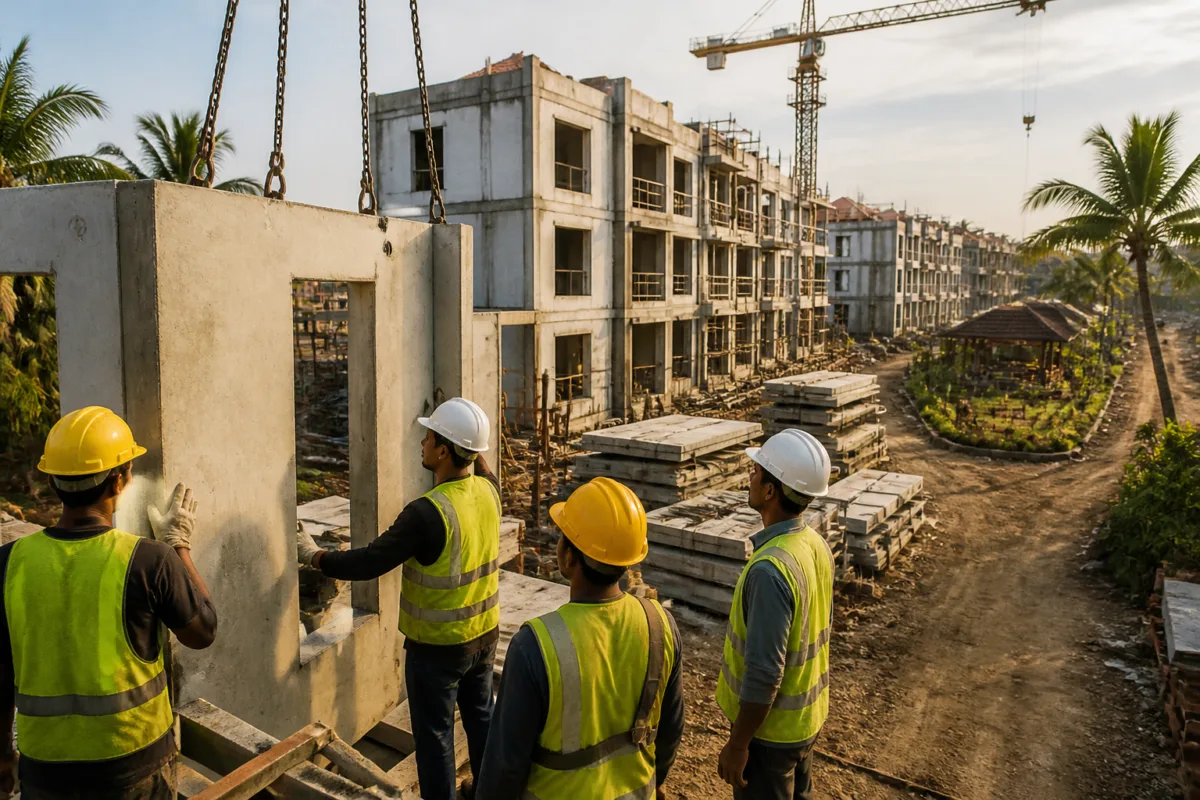
The investment reflects an effort to connect housing delivery with industrialised construction. Precast components and formwork systems can shift some construction activity from the site to controlled manufacturing environments, although the report did not provide independently assessed productivity, cost or environmental data for the proposed facility.
LEGENDS 3D presented a 3D Concrete Printing system that uses robotics and artificial intelligence to print structures with concrete, organic clay and recycled plastic. The company said the technology can support complex architectural forms while reducing construction time, material waste and costs. These benefits remain company claims in the forum report and were not supported by project-level performance data.
Fang Zheng Jing Dao presented a Chinese aluminium formwork system. The company said the system can enable construction of a villa’s structure, including mechanical, electrical and plumbing networks, in four days compared with a usual 30 days. The report did not specify the basis of comparison, the construction conditions or whether the claimed duration applies to completed homes or a particular construction stage.
The technologies are also being used or proposed for private developments in Bali. BIG BALI GROUP presented ICONIC LIVING Resort, a proposed five-star wellness project on a 3.5-hectare ocean-cliff site. The plan includes 400 apartments and 80 villas across four phases. Its first phase, Manta Livin Uluwatu, is described as being under construction near Nyang Nyang Beach in southern Uluwatu, with 25 villas and 85 apartments and penthouses.
The report said LEGENDS 3D is supplying architectural elements for the first phase, marking the technology’s first demonstration in Indonesia. The proposed resort would include wellness, medical-spa, fitness, dining and smart-space facilities. These private development plans are separate from the announced low-income housing project, and the report did not establish whether the same delivery model, materials or financing arrangements will be used for the housing programme.
The forum also included presentations on sustainable architecture using earth and natural materials, renewable energy, waste-to-energy systems, interior finishing and international investment. Cosmo Home, described as a supplier of home and finishing materials, presented kitchen and furniture packages and its first showroom in Bali.
Government and industry participants included DPD RI Chairman Sultan Baktiar Najamudin, Special Envoy of the President for MSMEs, Creative Economy and Digital Affairs Ahmad Ridha Sabana, and Dr Aris Marsudiyanto, identified in the report as head of the Development Control and Special Investigation Agency. Representatives from KADIN Indonesia, Bali senators, Bogor Regency and Semarang City also attended.
The forum’s significance lies in the attempt to connect public housing objectives with domestic construction-material production and newer construction systems. For the 1,000-home proposal to become a measurable contribution to Indonesia’s housing programme, further public information will be needed on land, approvals, beneficiaries, funding, procurement, construction standards and completion targets. The report provides no confirmed timetable for those next steps.

