


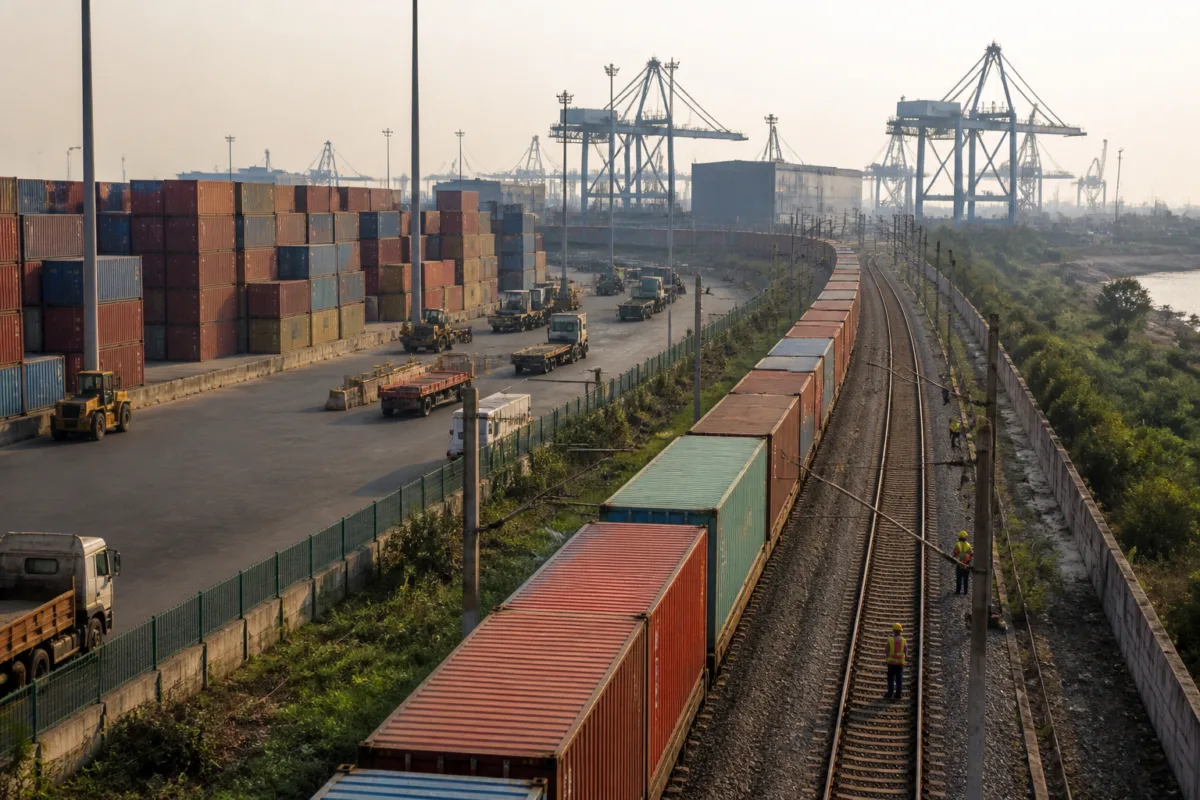
India’s transport recovery is showing a widening gap between strong export-import container activity and weaker rail container movement and domestic air travel, according to a November sector update by JM Financial.
Rail container volumes stood at 7.9 million metric tonnes in October, down 3.3 per cent year-on-year, the brokerage said. This marked the eighth consecutive month of year-on-year decline in rail container movement.
The weakness persisted even as overall container activity, measured in twenty-foot equivalent units, increased 26.8 per cent year-on-year during the month. At Jawaharlal Nehru Port Trust, container evacuation through rail rose 6.8 per cent year-on-year to 107,000 TEUs. JM Financial said this improvement remained modest compared with the growth in overall container handling.
The contrasting figures point to a logistical bottleneck between port activity and inland rail movement. Stronger container handling at ports has not translated into a comparable increase in rail evacuation, based on the data cited in the report. The source does not identify a single cause for the divergence.
Aviation demand also remained subdued. Organic passenger movement declined 3.9 per cent year-on-year in October 2026, with domestic passenger traffic falling by around 5 per cent. International passenger traffic recorded a marginal increase of around 1 per cent.
JM Financial said passenger traffic at key domestic airports remained under pressure, reflecting continued weakness in domestic travel demand. It expects some improvement after December 2026 because of a favourable base effect, while remaining watchful of sustained weakness at certain airports.
The data suggests that recovery across India’s transport and logistics network is not moving uniformly. Port and EXIM container activity have strengthened, but the rail volumes needed to move containers inland have remained weak. At the same time, domestic aviation has faced declining passenger movement, limiting the recovery in another major transport mode.
For infrastructure planners and logistics operators, the figures underline the importance of assessing transport performance across connected modes rather than relying on port or trade growth alone. The JM Financial report, however, does not provide a detailed explanation of the causes behind the rail and aviation weakness or outline specific corrective measures.

