


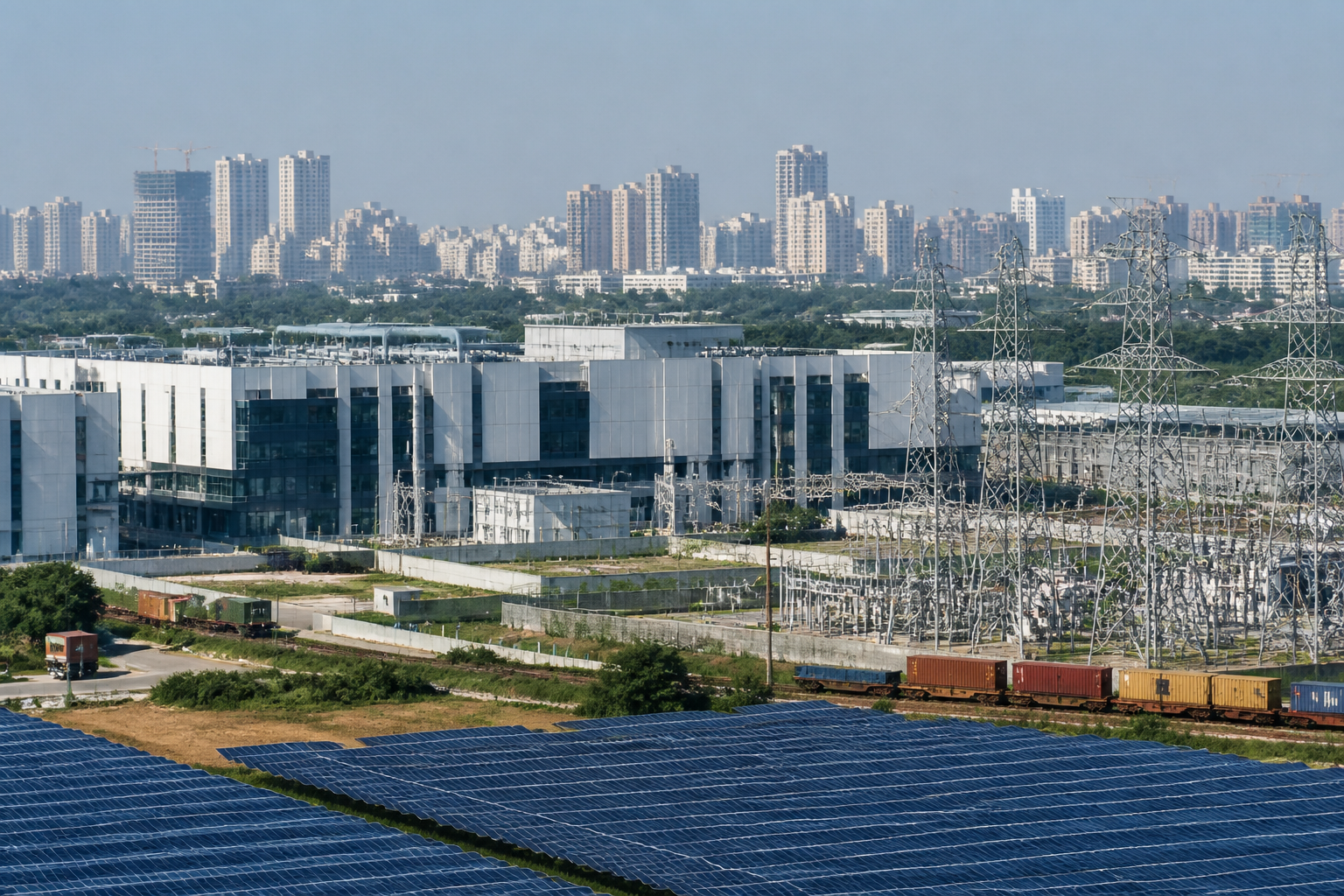
India’s industrial expansion is moving beyond services and final assembly. A Jefferies report, as reported by NDTV Business, identifies semiconductors, data centres, space systems, solar equipment, electronics and aerospace components as parts of a wider technology-led manufacturing transition. The shift is being supported by domestic demand, private investment and government incentives, but it also brings a more demanding urban question: whether India’s infrastructure, power systems, industrial land and skilled workforce can scale at the same pace.
The report describes the moment as a “new industrial revolution”. That phrase is broad, but the sectors cited point to a specific change in the country’s economic geography. India is attempting to build more of the technologies it has historically imported or assembled, while also positioning itself as a supplier to global production networks. This means that factories, logistics corridors, power-intensive facilities, research capabilities and specialised industrial clusters will become increasingly important to the way cities and regions develop.
The significance is not limited to manufacturing output. Advanced industrial projects require reliable electricity, high-quality transport links, water, cooling systems, digital connectivity and access to land. They also generate demand for construction, engineering, maintenance, warehousing and technical services. The Jefferies assessment therefore describes not one industry, but a connected industrial ecosystem whose success will depend on how effectively public policy and urban infrastructure work together.
The first sector highlighted is space. According to the report cited by NDTV Business, India’s space economy could expand fivefold to reach $40 billion-$45 billion by 2030. The report points to private companies including Skyroot, Pixxel and Agnikul as examples of firms moving towards commercial launches and space-related activity.
That transition changes the spatial requirements of the sector. Space companies need testing facilities, precision manufacturing, specialised suppliers, secure communications and access to launch infrastructure. Their growth can create demand in established aerospace centres while also supporting new industrial locations. The supplied material does not establish how many jobs or facilities will result, but it indicates that space is increasingly being treated as a commercial industrial segment rather than only a public research and launch programme.
Semiconductors represent another major test. India has spent years seeking a larger role in chip manufacturing, but fabrication and packaging require unusually complex infrastructure. The Jefferies report, as summarised by NDTV, says about $20 billion has already been committed to the sector, with a fabrication plant under construction and several packaging and testing projects having begun production. It also refers to a proposed $13 billion incentive plan.
The distinction between fabrication, packaging and testing matters. A chip ecosystem is not created by one plant alone. It requires suppliers, clean power, water systems, logistics, equipment maintenance, skilled workers and dependable industrial services. The report’s emphasis on extending the ecosystem beyond high-profile fabrication suggests that the next stage of India’s semiconductor strategy will be measured by the depth of local manufacturing, not merely by the announcement of individual projects.
Data centres bring the infrastructure challenge into sharper focus. The report says India’s data-centre capacity has grown to about two gigawatts, roughly five times its level five years ago, and could reach 10 gigawatts within the next five years. Jefferies estimates a $45 billion opportunity across power, cooling, construction and networking.
Unlike many conventional industrial facilities, data centres are closely tied to the reliability and cost of electricity, the availability of cooling and the quality of digital networks. Their expansion can influence land demand around major metropolitan areas and connectivity corridors. It can also increase pressure on power generation, transmission and water-management systems, depending on the cooling technologies used. The supplied material does not provide city-level capacity, water-use figures or the geographic distribution of facilities, so the national projections cannot by themselves show how individual urban regions will be affected.
The wider electronics industry shows a different dimension of the same transition. India has become a major mobile-phone assembly base, but the report says domestic value addition in mobile components remains below 20 per cent. Jefferies expects that figure to approach 50 per cent within six years. If achieved, the change would move more economic activity into component manufacturing, tooling, testing, materials and specialised logistics.
This is important because assembly-led growth and component-led growth place different demands on industrial regions. Component production generally requires deeper supplier networks and more specialised skills. It can also increase the need for industrial estates that provide reliable utilities and efficient links between manufacturers. The report does not establish whether the projected increase will be evenly distributed across states or concentrated in existing electronics clusters. That question will shape the local employment and infrastructure impact of the transition.
Solar manufacturing is presented as another pillar of the expansion. India is described as the world’s second-largest solar photovoltaic manufacturer, with about 35 gigawatts of cell capacity already operational and another 100 gigawatts under construction. Jefferies expects 90 per cent of the solar value chain to be built domestically by 2030.
The scale of these figures points to a manufacturing strategy that extends beyond installing renewable-energy projects. Domestic production of cells and other equipment can support exports, reduce dependence on imported components and create industrial demand in locations with suitable power and transport infrastructure. At the same time, the figures refer to capacity rather than completed output, utilisation or export performance. Those distinctions will be necessary when assessing whether planned facilities translate into sustained industrial activity.
Aerospace links this domestic manufacturing push directly to global supply chains. Boeing and Airbus are reported to source $1.4 billion-$1.6 billion worth of parts from India each year. The stated advantages are cost competitiveness and engineering capability, while global aircraft demand is creating pressure across aerospace supply networks.
Aerospace supply chains tend to reward consistency, certification and precision over low-cost production alone. Indian firms supplying major original equipment manufacturers and Tier-1 companies therefore become part of a system that depends on quality control, dependable transport and a stable base of specialised vendors. The material supplied does not identify the cities or firms involved, but the purchasing figures indicate that India’s role is already larger than a future aspiration in at least part of the sector.
Across all six areas, government incentives are a central part of the story. The report attributes India’s industrial growth to a combination of private investment, a large consumer market and policies designed to attract new industries. Incentives can reduce the initial cost of setting up factories, but they do not replace the underlying systems required to operate them. Industrial land, electricity, water, roads, ports, airports, broadband networks and technical education remain practical conditions for investment.
This places state governments, municipal bodies and infrastructure agencies inside what is often presented as a national industrial policy. A semiconductor project may be approved nationally but depend on local land assembly, utility connections and transport access. A data centre may require metropolitan planning decisions as well as grid capacity. Electronics and aerospace suppliers may rely on industrial corridors, freight links and nearby housing for workers. The effectiveness of the national strategy will therefore be visible in local implementation.
The numbers cited by Jefferies also reveal a common pattern: projected capacity is rising faster than the public information available about delivery. The space economy is projected to reach $40 billion-$45 billion by 2030. Data-centre capacity could rise from about two gigawatts to 10 gigawatts within five years. Solar-cell capacity is described as 35 gigawatts in operation and another 100 gigawatts under construction. Mobile-component value addition is expected to rise from below 20 per cent to around 50 per cent within six years.
These projections are useful indicators of ambition, but they are not equivalent to completed facilities, operating output or realised employment. They should be tracked against construction progress, commissioning, utilisation, domestic sourcing and export performance. The supplied report does not provide those measures in detail, nor does it explain how the estimates were calculated. That limits what can be concluded about the pace and distribution of the transformation.
The larger urban question is whether India’s cities and industrial regions are being prepared for a more infrastructure-intensive economy. Technology manufacturing and digital facilities can generate high-value activity, but they also consume land, power, water and transport capacity. They can intensify competition between industrial, residential and agricultural uses, while creating demand for workers with specialised skills.
The evidence presented by NDTV Business and attributed to Jefferies confirms that India is seeking a deeper position in technology and advanced manufacturing. It also shows that the transition is being measured through large investment commitments, capacity projections and growing links with global companies. What remains uncertain is how evenly the gains will be distributed, which locations will absorb the infrastructure burden and how much of the projected capacity will become productive output. Those are the indicators that will determine whether the industrial expansion becomes a broad urban-economic transformation or a collection of highly capital-intensive projects.
