


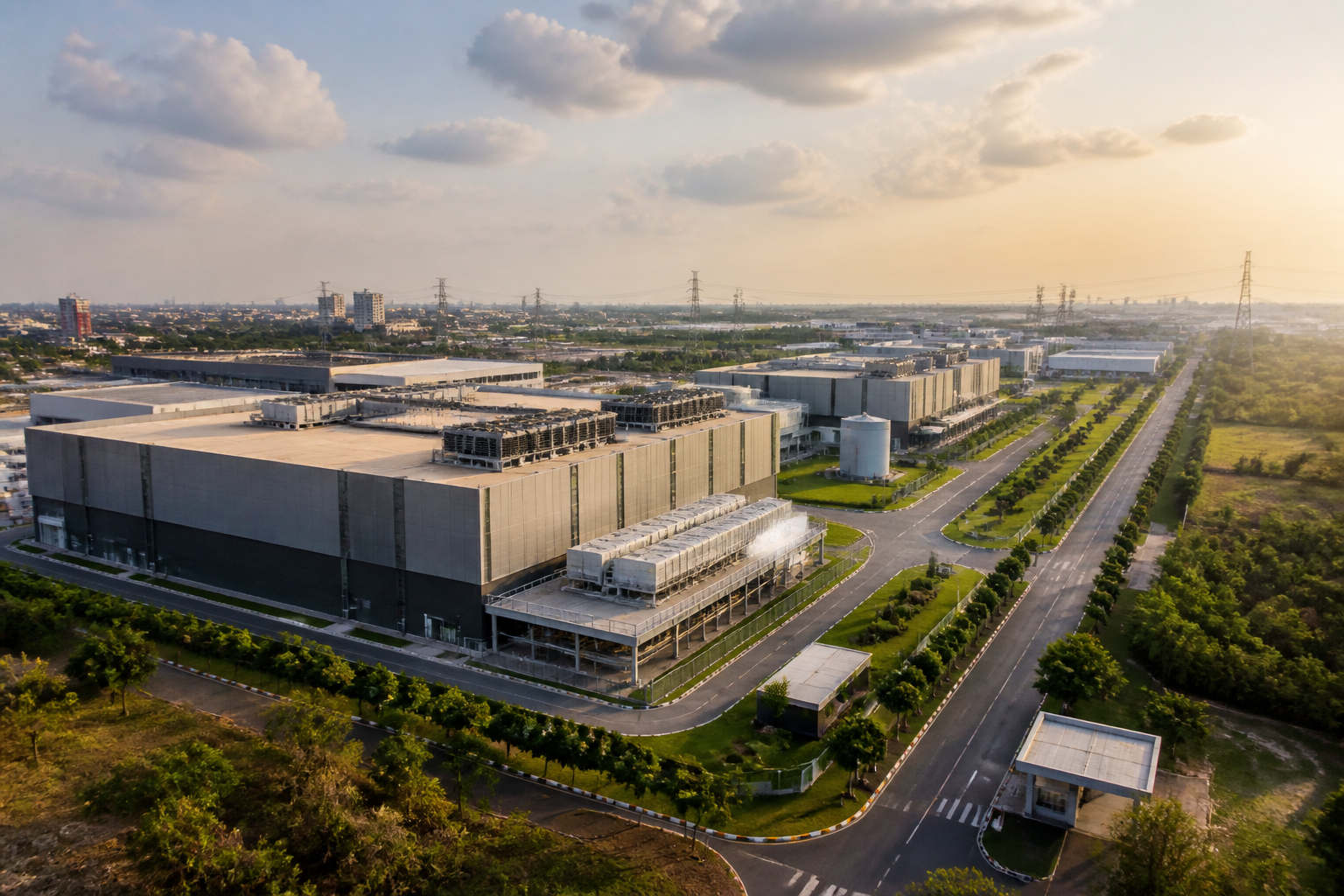
The proposed Telangana AI data centre park is being presented as a major addition to Hyderabad’s emerging digital-infrastructure corridor. Fortune Hospitality and Infra has announced an initial investment of Rs 60,000 crore for a 170-acre campus in Kandukur Mandal, in Ranga Reddy district, within the Hyderabad Metropolitan Region. At full build-out, the company says cumulative capital deployment could reach Rs 1 trillion.
The scale of the proposal is significant not only because of the money involved, but because of the infrastructure systems required to support artificial-intelligence computing. The campus is planned to accommodate an IT load of 1,200-1,600 MW across four independently operable hyperscale modules. Each module could support up to 400 MW for AI, cloud, colocation and high-performance computing workloads. The announcement therefore points to a model of urban growth in which computing capacity, electricity supply, water management, fibre connectivity and transport access are developed together.
The project is being led through Sudeeksha Estates LLP, a special purpose vehicle of Fortune Hospitality and Infra LLP, in partnership with global data-centre operators and hyperscalers. The company says the campus will be supported by a sanctioned power capacity of 2,000 MVA from TGTRANSCO. It also says the site is located less than 500 metres from POWERGRID’s 765/400 kV infrastructure and next to TGTRANSCO’s 400/220 kV substations.
These details explain why the location has been selected. Large data centres need reliable, high-capacity electricity, redundant connections and rapid access to national and international digital networks. The proposed park is expected to have direct connectivity to NH-765, Hyderabad’s Outer Ring Road and Rajiv Gandhi International Airport. Dedicated road links and a planned carrier-neutral fibre backbone are also part of the proposal.
The location places the project within a wider development geography around Hyderabad and Bharat Future City. According to the source material, Telangana has seen announcements this year from TCS-HyperVault for a 1 GW AI data-centre campus in Hyderabad, Amazon for a data centre at Bharat Future City, and UPC-Volt, among others. These projects could collectively involve around Rs 1.5 trillion in investment, although the supplied material does not establish how much of that announced capacity has secured approvals, financing or construction schedules.
That distinction matters. A data-centre announcement can describe a long-term development intention rather than an immediately deliverable facility. In Fortune’s case, the stated investment, power capacity, employment and environmental systems describe the proposed full project. The company has not, in the supplied material, provided a construction start date, commissioning date, phase-wise expenditure schedule or details of the operators expected to occupy the modules.
The project’s power requirement is central to its urban implications. A planned IT load of up to 1,600 MW would make the campus a large and continuous electricity consumer. The reference to 2,000 MVA of sanctioned capacity indicates the scale of the electrical infrastructure being considered, but the announcement does not provide projected annual electricity consumption, the precise delivery schedule for grid connections, or details of backup generation. It also does not establish how the proposed park will affect wider regional power planning.
For Telangana, the data-centre strategy is tied to an effort to position the state as a global AI and digital-infrastructure hub. Industries and IT Minister D Sridhar Babu said the state was pursuing that objective while remaining committed to environmental and net-zero goals. The announcement therefore combines an industrial-development proposition with a sustainability claim. Whether the two can be achieved together will depend on how electricity, water and land systems are governed during implementation.
Water is the most visible environmental issue addressed by the developer. Fortune says the campus will use treated greywater for cooling and other non-potable requirements. It also plans to deploy water-efficient, closed-loop cooling systems for high-density AI computing, supported by recycling, reuse and continuous monitoring. The company expects the park’s freshwater requirement to be substantially lower than that of a conventional industrial park of comparable scale.
That comparison, however, is not quantified in the supplied material. There is no stated freshwater volume, wastewater-recycling target, source of treated greywater, discharge standard or monitoring framework. The proposal identifies the intended design approach, but the evidence available does not yet show how the system will perform once the campus is operational. Those details will become important as authorities assess environmental permissions and local utility capacity.
The power strategy similarly relies on future arrangements. Fortune plans to procure renewable electricity through long-term solar and wind power-purchase agreements and to evaluate round-the-clock renewable-energy solutions as development progresses. This suggests that the project’s energy profile will not be determined solely by its physical location near transmission infrastructure. It will also depend on contractual procurement, grid availability and the ability to match high-density computing demand with renewable supply.
The proposed park is expected to generate 4,000-5,000 direct and indirect employment opportunities, including approximately 1,000 high-skilled technical, engineering and operational positions. These numbers indicate that the project is expected to create a specialised employment base rather than a large labour-intensive industrial workforce. The wider economic effect will depend on whether local education and training systems can supply the required skills and whether related firms cluster around the campus.
The proposal also shows how data centres are changing the meaning of industrial infrastructure. Unlike conventional offices or factories, hyperscale facilities may occupy relatively limited land while demanding substantial electricity, cooling, network redundancy and security systems. Their economic value is linked less to the number of people using the site every day than to the digital services processed there. This creates a different relationship between land consumption, employment and infrastructure demand.
Hyderabad’s emerging corridor around the Outer Ring Road and Bharat Future City is consequently being shaped by more than residential expansion, logistics or conventional commercial development. The addition of large computing facilities brings a new category of anchor infrastructure. It can strengthen the region’s position in cloud and AI services, but it can also intensify pressure on power transmission, water systems, roads and land-use planning.
The institutional structure will be important because several systems are involved. TGTRANSCO is referenced in relation to power capacity, while POWERGRID infrastructure is identified as a nearby asset. Local planning and land authorities will be relevant to the 170-acre site, and environmental and statutory approvals will determine whether the proposed cooling, water and energy systems can be implemented as described. The supplied material does not specify the full approval list or the status of permissions.
Fortune has separately submitted a proposal to acquire 300 acres in Sanand, Gujarat, for another data-centre park. That proposal remains at a preliminary stage and is subject to land allotment and statutory approvals. Its inclusion indicates that the company is pursuing a broader data-centre platform, but it should not be treated as evidence that the Telangana project has reached the same stage of development as an operating facility.
The Telangana announcement therefore confirms an important direction in regional infrastructure planning, while leaving several delivery questions open. The stated investment and capacity are substantial, and the project is aligned with the state’s effort to attract AI-oriented infrastructure. At the same time, the announcement does not establish a construction timetable, final operator agreements, actual water demand, renewable-energy delivery model or the status of all statutory approvals.
The next stage will determine whether the proposal becomes a functioning hyperscale campus or remains an announced capacity target. Key milestones include land and statutory approvals, formal power-connection arrangements, construction commencement, operator commitments and the publication of measurable water and energy-performance parameters. Until those details emerge, the project is best understood as a major proposed addition to Hyderabad’s digital-infrastructure geography rather than an operational data-centre park.
