


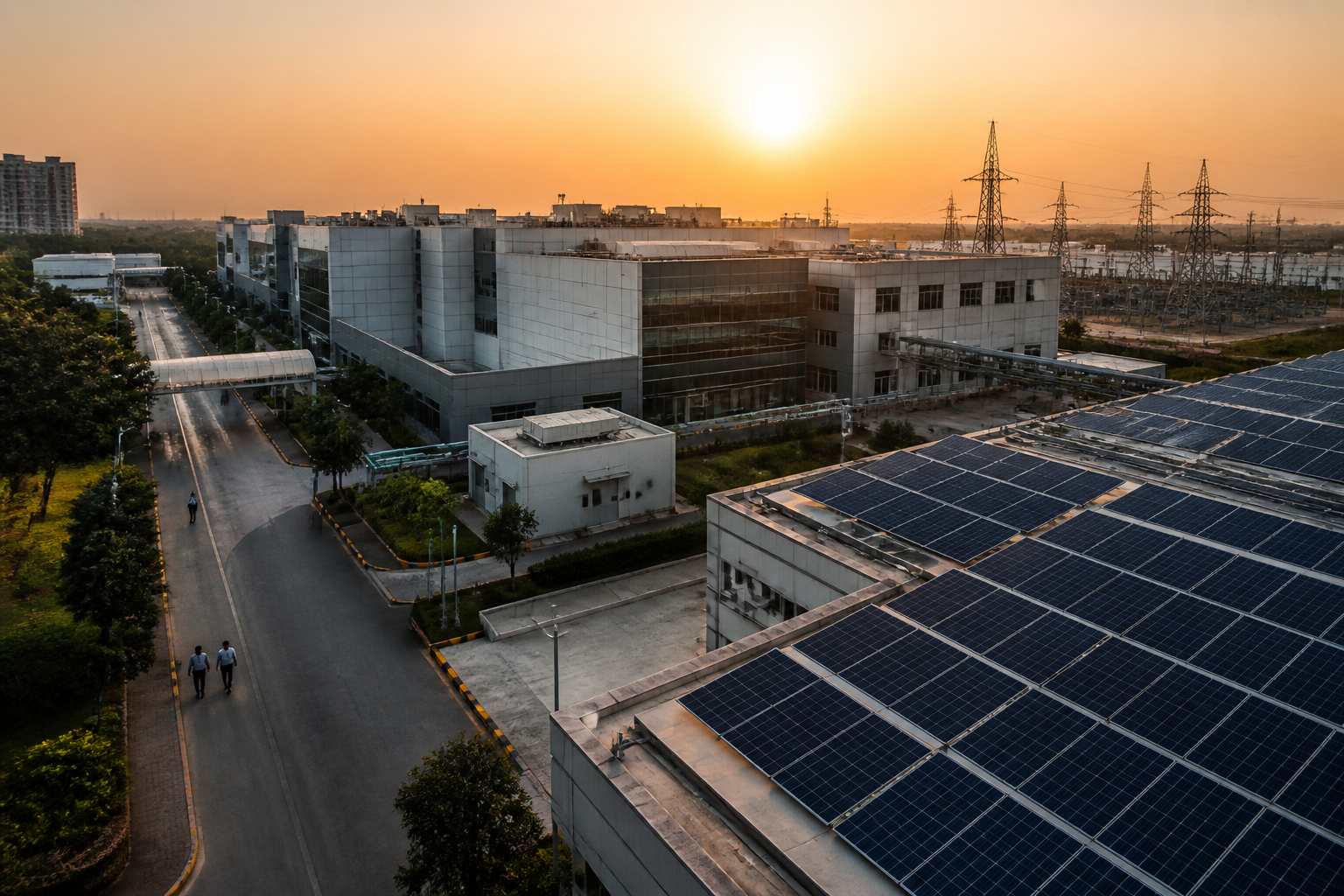
India’s industrial expansion is moving beyond the familiar story of software services and mobile-phone assembly. A Jefferies report, as reported by NDTV Business, describes a broader shift involving semiconductor plants, data centres, solar equipment, satellites, aerospace components and advanced engineering. Taken together, the sectors point to a new question for Indian cities: whether infrastructure, utilities, construction capacity and industrial planning can keep pace with the country’s ambition to build more of the technology it consumes.
The report characterises this phase as a “new industrial revolution”, powered by manufacturing, technology, infrastructure, private investment and government incentives. Its central claim is not that India is starting from zero. Rather, it is that several industrial systems are expanding at the same time, creating a potential technology ecosystem whose requirements extend well beyond factories. Such an ecosystem needs land, reliable power, cooling, transport links, specialised buildings, skilled workers and administrative capacity.
That makes the development relevant to the built environment. A semiconductor facility is not simply a production unit; a data centre is not merely a warehouse filled with servers. Each requires a supporting network of utilities, construction contractors, equipment suppliers, connectivity and logistics. The Jefferies account suggests that India’s next industrial phase will be measured not only by the value of goods produced, but also by how effectively cities and industrial regions provide the physical systems needed to produce them.
The space sector illustrates the change. According to the report, India’s space economy could grow fivefold to reach $40-45 billion by 2030. The report also identifies private companies including Skyroot, Pixxel and Agnikul as participants in a shift towards commercial launches and space-related activity. The supplied material does not provide a detailed breakdown of the forecast or specify how the projected value would be distributed across launch services, satellites, components and related businesses. It does, however, present space as an expanding industrial field rather than an activity limited to public-sector missions.
That distinction matters for urban and regional planning. Commercial space activity requires testing facilities, specialised manufacturing, research capacity, transport infrastructure and access to engineering talent. The report does not identify particular cities or industrial clusters that will capture this growth. It does show, however, that the spatial question is becoming more significant: industrial expansion in advanced sectors will depend on where these capabilities are located and how they connect to existing infrastructure.
Semiconductors represent an even more demanding test. Jefferies says around $20 billion has already been committed to the sector, with a chip fabrication plant under construction and several packaging and testing projects having started production. The report also refers to a proposed $13 billion incentive plan. These figures indicate an effort to build multiple layers of the semiconductor value chain, rather than focusing only on the most visible fabrication plants.
For the built environment, the distinction between fabrication, packaging and testing is important because each activity brings different facility, utility and supply-chain requirements. The supplied report does not provide details on locations, water consumption, power demand, construction schedules or the status of individual projects beyond its broad description. Those gaps prevent a complete assessment of implementation. They also identify the next level of scrutiny required if India’s semiconductor ambitions are to be understood through an infrastructure lens.
Data centres provide the clearest link between technology growth and physical infrastructure. The report says India’s data-centre capacity has grown to about two gigawatts, roughly five times its level five years ago, and could reach 10 gigawatts within the next five years. Jefferies estimates a $45 billion opportunity across power, cooling, construction and networking.
This is not only a digital-economy story. Data centres convert demand for computing into demand for land, buildings, electricity, cooling systems, fibre networks and construction services. The report’s figures suggest that capacity expansion could be substantial, but the supplied material does not specify how much of the projected growth is already contracted, where it will occur or how local power and water systems will respond. Those questions are central to urban governance because data-centre development can affect land-use decisions, utility planning and the competition for reliable electricity.
The same pattern appears in electronics manufacturing. India’s role has historically been associated with assembling phones from components made elsewhere. The report says domestic value addition in mobile components is currently below 20 per cent and could reach about 50 per cent within six years. If achieved, that would shift more economic activity into component production, supplier networks and engineering services.
The change would also alter the physical geography of manufacturing. Assembly plants require industrial space and logistics, but deeper component production can create demand for a wider range of factories, testing facilities, warehouses and specialised suppliers. The report does not state how many jobs, buildings or industrial sites the transition would generate. Its significance lies in the direction of travel: the country is attempting to retain more value within the domestic production system instead of concentrating primarily on final assembly.
Solar manufacturing adds another dimension. Jefferies identifies India as the world’s second-largest solar photovoltaic manufacturer and says around 35 gigawatts of cell capacity is already operating, with another 100 gigawatts under construction. By 2030, the report expects 90 per cent of the solar value chain to be built within India.
These numbers describe a major manufacturing expansion, but they should not be confused with installed renewable-power capacity or actual electricity generation. The supplied material refers to solar cells and the value chain, not to the total amount of solar power being deployed. That distinction is important when assessing the relationship between manufacturing growth and climate or energy outcomes. What the report clearly establishes is the scale of India’s stated manufacturing ambition and the construction activity associated with new capacity.
Aerospace shows how Indian production is already connected to global supply chains. The report says Boeing and Airbus purchase between $1.4 billion and $1.6 billion worth of parts from India each year. It attributes this position to India’s cost advantage and engineering talent, while noting that Indian firms are supplying major original-equipment manufacturers and Tier-1 companies.
Unlike the projected space, data-centre and solar figures, this aerospace point describes an existing annual supply relationship. It indicates that India’s industrial transformation is not based solely on future projects. Some domestic firms are already integrated into international manufacturing networks. The supplied material does not identify the companies, locations or categories of parts involved, so it cannot establish which cities or industrial corridors benefit most from this activity.
Across the six sectors, the report presents a common industrial logic. India’s large consumer market creates demand; private investment provides capital; government incentives seek to attract new industries; and infrastructure determines whether these industries can operate at scale. The sectors are different, but each depends on an ecosystem rather than an isolated facility. Semiconductor plants need suppliers and utilities. Data centres need power, cooling and networks. Solar manufacturing needs component capacity. Aerospace suppliers need precision production and logistics. Space companies need specialised engineering and testing capabilities.
This is where the policy landscape becomes decisive. The report refers to government incentives for new industries and specifically mentions a proposed $13 billion semiconductor incentive plan. It does not provide the scheme’s final design, eligibility rules, funding schedule or implementation authority. Nor does it explain how central, state and local institutions will coordinate land, approvals, utilities and transport. Those details remain outside the supplied evidence.
The same limitation applies to the question of geographic concentration. The report describes national growth but does not identify whether new capacity is being distributed across multiple regions or concentrated in a small number of industrial centres. That information would determine how the expansion affects housing demand, worker mobility, municipal services and local infrastructure investment. Without it, the urban consequences can be identified as questions but not measured as outcomes.
The available figures nevertheless show why this industrial push should be read as an infrastructure story. Data-centre capacity is reported at two gigawatts and projected to reach 10 gigawatts. Solar-cell capacity is described at 35 gigawatts, with 100 gigawatts under construction. The space economy is projected at $40-45 billion by 2030, while aerospace parts exports to Boeing and Airbus are placed at $1.4-1.6 billion annually. These figures cover different measures and cannot be added together. Their value is comparative: they show the number and scale of industrial systems expanding simultaneously.
The transition also has an urban-economy dimension. Deep-tech manufacturing and advanced engineering can create demand for skilled labour, specialised services and new forms of industrial construction. At the same time, these sectors may place pressure on energy systems, land markets, transport networks and local administrative capacity. The supplied report does not quantify those pressures or establish whether cities are prepared for them. It does make clear that industrial policy will increasingly intersect with urban planning.
The evidence supports a cautious conclusion. India is building a wider technology and manufacturing base across space, semiconductors, data centres, electronics, solar equipment and aerospace components, according to the Jefferies findings reported by NDTV Business. The strongest measurable signals are the reported investment, capacity and value-addition targets. What remains uncertain is how quickly projects will be completed, where the activity will be concentrated, how incentives will be implemented and whether supporting infrastructure will expand at the same pace. Those are the questions that will determine whether India’s technology ambitions become a durable industrial system or remain a collection of high-value projects.
