


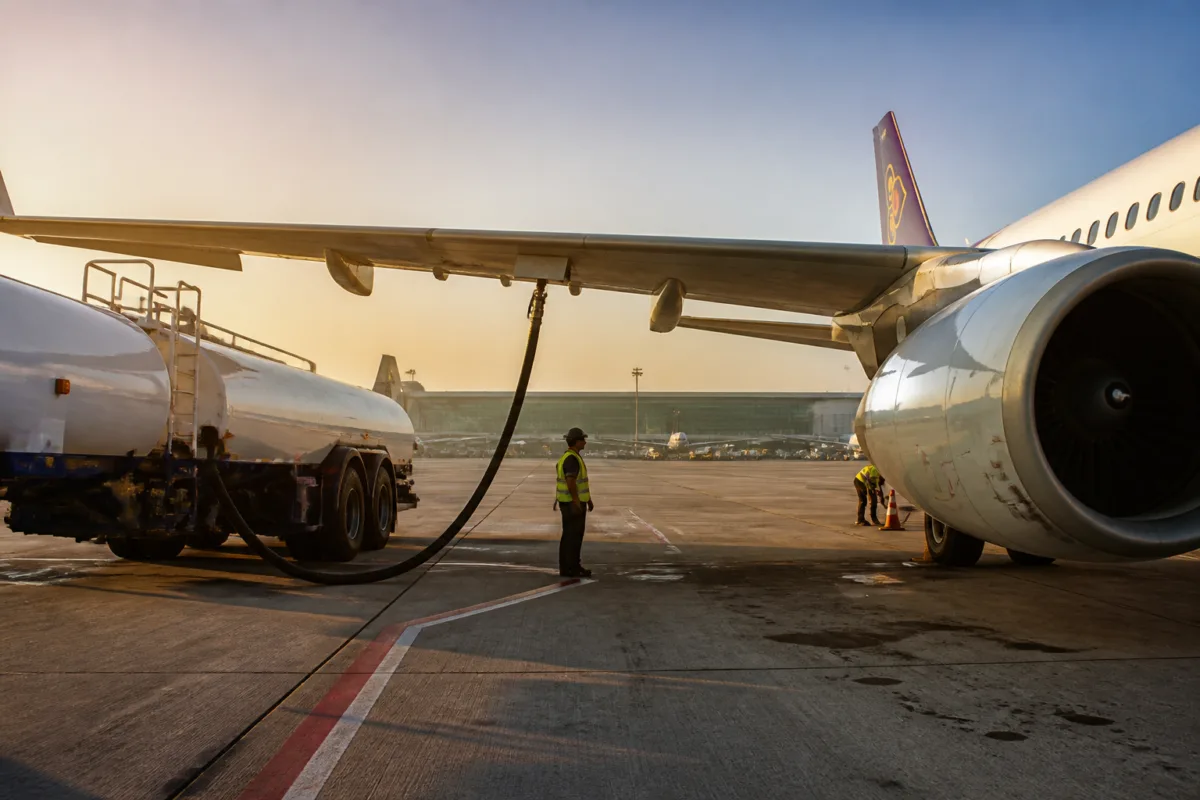
India’s proposed sustainable aviation fuel mandate is not simply an aviation emissions policy. It is also a test of how the country will coordinate airlines, airports, fuel suppliers and oil marketing companies as aviation attempts to reduce carbon emissions without replacing its existing aircraft and engine fleet.
The Ministry of Civil Aviation has circulated a draft policy proposing that sustainable aviation fuel be blended with aviation turbine fuel for international flights from January. The initial requirement is set at 1%, with the proposed mandate rising to 5% by 2030 and 20% by 2040. The draft was reported by the Economic Times, which said it had seen a copy of the document.
The proposal places sustainable aviation fuel, or SAF, within the existing aviation fuel system rather than treating it as a separate aircraft technology. According to the report, SAF is a liquid fuel that can be blended with aviation turbine fuel without requiring new planes or engines. The draft therefore approaches decarbonisation through fuel supply and procurement obligations, while leaving the existing aircraft fleet operationally unchanged.
That distinction is important for implementation. A requirement to use SAF can be written into policy relatively quickly, but meeting it depends on the availability, price and distribution of the fuel. Airlines have told the government that reducing the production cost of SAF will be necessary if the industry is to meet the proposed emissions targets. The cost issue is therefore not a secondary commercial concern; it is central to whether the proposed percentages can move from a regulatory schedule to actual fuel use.
The draft sets out a two-phase roadmap. The first phase would raise blending to 5% by 2030 after beginning at 1%. The second would take the requirement to 20% by 2040. This gives airlines and fuel suppliers a long implementation horizon, but it also creates a sequence of compliance milestones. Each increase would require the aviation fuel supply chain to provide a larger quantity of SAF and would require airlines and oil marketing companies to demonstrate that the required blend has been supplied and used.
The policy is linked to a wider international aviation objective. In October 2022, member states of the International Civil Aviation Organisation agreed to a long-term aspirational goal of net-zero carbon dioxide emissions from aviation by 2050. The Economic Times report describes SAF as the industry’s fastest route to reducing emissions and says it can potentially reduce carbon emissions by up to 80%. The word “potentially” matters: the scale of reduction depends on the fuel and its production pathway, while the draft itself, as described in the report, focuses on blending requirements rather than setting out a complete production framework.
The proposal also addresses where airlines obtain aviation turbine fuel. Under the draft, domestic and international airlines would be required to uplift nearly 90% of their annual ATF needs from international airports in India. The stated purpose is to prevent what the Centre calls “economic tankering”. This occurs when airlines carry additional fuel from another airport to avoid buying fuel at a destination where it is more expensive.
Economic tankering links fuel policy to airport operations. When an aircraft carries extra fuel, it can affect fuel demand at the destination airport and alter the quantity of fuel that needs to be supplied there. The draft’s proposed 90% requirement would therefore seek to make fuel purchasing more closely track the airport network through which airlines operate. It would also add another compliance obligation to the SAF proposal, requiring airlines to manage both the composition of fuel and the location from which most of their annual ATF is uplifted.
This is where the policy becomes an institutional coordination exercise. The Ministry of Civil Aviation would establish the policy framework, airlines would have to meet the proposed blending and uplift requirements, and oil marketing companies would be part of the compliance system because the draft also proposes penalties for OMCs that fail to meet the SAF blending requirements. The arrangement would make fuel availability a shared responsibility rather than an issue left only to individual airlines.
The proposed penalties are significant because they indicate that the draft is not designed as a voluntary sustainability programme. The policy would create an enforceable obligation for both airlines and fuel suppliers. At the same time, the report does not specify the proposed penalty amounts, the exact compliance calculation, the body responsible for enforcement or the process for handling shortages and other operational constraints. Those details will determine how the mandate works in practice if the draft moves forward.
The numbers in the roadmap show the scale of the proposed change. A 1% requirement from January would be the entry point. The target would then rise to 5% by 2030, a four-percentage-point increase from the initial level, before reaching 20% by 2040. The final target is four times the 2030 target and twenty times the starting mandate. The schedule is therefore gradual in percentage terms, but the cumulative requirement would expand substantially as the aviation sector’s fuel demand grows.
The proposal also creates a difference between regulatory ambition and physical supply. A mandate can define how much SAF airlines must use, but it cannot by itself establish production capacity or guarantee that the fuel will be available at every airport where it is required. The report does not identify the number of SAF producers, planned production volumes, eligible feedstocks, supply contracts or airport-level distribution arrangements. Without those details, the draft establishes a demand signal but does not yet demonstrate that the supply system is ready for the later stages of the roadmap.
The cost question runs through each of these stages. Airlines have indicated that high production costs could make the targets difficult to achieve. If SAF remains more expensive than conventional ATF, the mandate could affect airline fuel procurement and operating costs. The supplied report does not establish how those costs would be distributed between airlines, fuel suppliers and passengers, nor does it specify whether the government is considering subsidies, tax measures or other financial support. Those questions remain outside the details currently available in the draft as reported.
The 90% uplift proposal adds another layer to the economics. Airlines would need to obtain most of their annual ATF requirements from international airports in India, even as they manage the cost and availability of SAF. The provision is intended to curb economic tankering, but its practical effect will depend on how fuel prices, supply and airport operations are treated under the final policy. The draft’s combination of blending and uplift requirements suggests that the government is attempting to regulate both what fuel airlines use and how they source it.
For cities and airports, the policy’s importance lies in this operational dimension. Aviation emissions are often discussed through aircraft technology and international targets, but fuel logistics are managed through airport infrastructure, storage, blending and supply arrangements. The proposed mandate would make airports part of the country’s climate transition infrastructure. The available report does not provide airport-specific capacity details, so it is not yet possible to determine how evenly the requirement could be implemented across India’s international airports.
The draft also shows the limits of a percentage-based climate target. The percentages are clear, but the environmental outcome will depend on the type of SAF used, how it is produced and whether the promised emissions reduction is achieved across its lifecycle. The report states that SAF can potentially reduce carbon emissions by up to 80%, but it does not provide a fuel-specific assessment or establish that every SAF supply would deliver the same reduction. The final policy will therefore need to connect the blending mandate with standards for eligible fuel and emissions accounting.
What the evidence confirms is that India is proposing a phased, enforceable SAF framework for international flights, supported by an additional rule on domestic fuel uplift. What it does not yet establish is how much SAF can be produced, what it will cost, how supplies will reach airports, how compliance will be measured or what penalties will apply. The next decisive stage will be the treatment of these implementation details as the draft policy moves through consultation and finalisation. The 1% starting point may be modest, but the proposed 5% and 20% milestones will test whether India’s aviation fuel system can scale a climate obligation without leaving the cost and supply questions unresolved.

