


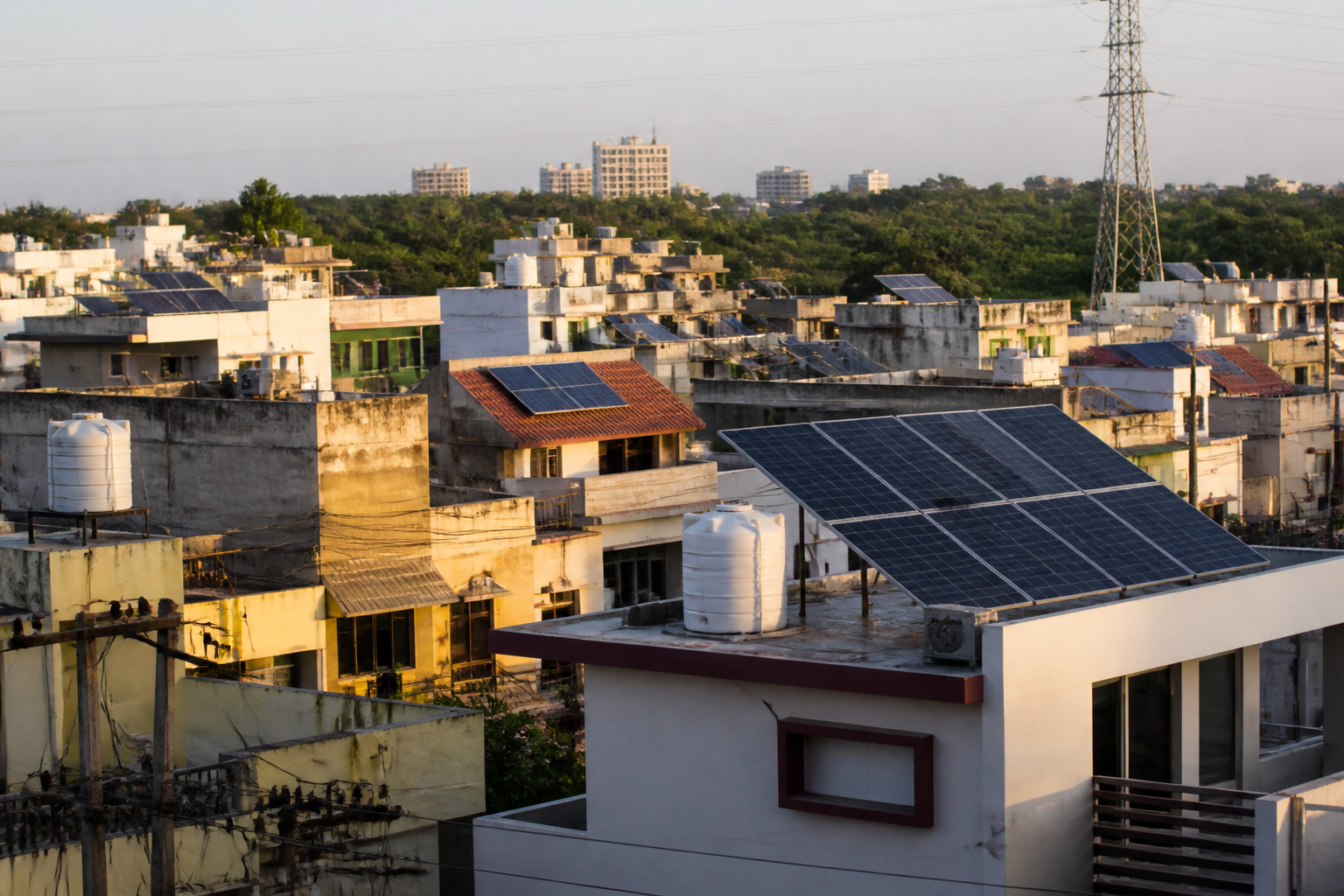
Subheadline: Uttar Pradesh and Maharashtra are driving residential installations under PM Surya Ghar, but the gap between applications and completed systems shows that scale is only one measure of the scheme’s progress.
Standfirst: India’s residential rooftop solar programme crossed a significant capacity threshold in August, with more than 16,000 MW installed under the PM Surya Ghar: Muft Bijli Yojana. Uttar Pradesh and Maharashtra led monthly installations, while Andhra Pradesh also recorded a substantial addition. The numbers show a programme expanding rapidly across households, supported by subsidies and the promise of up to 300 units of free electricity a month. They also reveal a more complicated implementation picture. Applications continue to outnumber installations by a wide margin, and monthly installed capacity declined from July to August even as the broader programme reached millions of households. The emerging question is not simply how quickly rooftop solar is being added, but how effectively the programme is converting demand into functioning systems and reshaping the relationship between households and electricity distribution networks.
The latest figures place India’s residential rooftop solar expansion at an important point. According to data reported by The Hindu BusinessLine and compiled by JMK Research & Analytics, pan-India installed residential rooftop capacity under PM Surya Ghar stood at 16,185.48 MW, covering 54,65,417 households, as of August. The same source separately reported that cumulative installations had reached 16,369 MW, covering roughly 55.28 lakh households, against more than 80.62 lakh applications. The difference between the reported figures reflects the different reference points and measures presented in the source material, but both indicate the scale now reached by the programme.
The headline state-level pattern is clear. Uttar Pradesh led residential rooftop solar installations during August with 228.95 MW, followed by Maharashtra with 212.51 MW and Andhra Pradesh with 192.39 MW. These figures do more than identify the largest contributors for one month. They show that the national programme is being translated through state-level markets, administrative systems and electricity distribution networks, where the pace of applications, approvals, installations and subsidy release determines how quickly the national target becomes household infrastructure.
Uttar Pradesh recorded 89,901 applications during August and 73,709 installations. Maharashtra received 79,679 applications and reported 61,110 installations. Andhra Pradesh recorded 22,557 applications against 14,648 installations. In each of the three leading states, installations were lower than applications during the month. That difference is not, by itself, evidence that applications will not eventually become completed systems. It does, however, show that demand and execution are moving at different speeds.
The national numbers make that implementation gap more visible. More than 80.62 lakh applications had been received for residential rooftop solar plants, compared with over 46.44 lakh installations, according to the reported PM Surya Ghar portal data. The programme had released more than ₹30,885 crore in subsidies. The figures point to strong household interest, but they also establish that the application pipeline is substantially larger than the installed base. The next phase of the programme will therefore be measured not only by new applications, but by how much of that pipeline is converted into commissioned systems.
Monthly capacity additions also show why a single milestone cannot describe the entire trajectory. Residential rooftop capacity added under the scheme fell by roughly 11.6 per cent month-on-month, from 1,592 MW in July to around 1,407 MW in August. A monthly decline does not reverse the programme’s larger expansion, but it does complicate the picture of uninterrupted acceleration. The programme is growing at scale while its monthly output can still vary.
At the same time, the installation pace has increased sharply over the longer period described in the source. The number of daily installations rose from 5,038 in October 2025 to nearly 16,328 a day in July 2026, a rise of about 3.2 times over three quarters. The programme is also reported to be benefiting roughly one lakh households every six days. Taken together, these indicators describe a system moving from early expansion towards mass delivery, even if the pace is not identical across months or states.
This combination of acceleration and uneven monthly performance is central to understanding rooftop solar as a public programme. Large national totals can conceal the operational work required at the household level: applications must move through the relevant process, systems must be installed, generation must begin and, where applicable, surplus power must be exported to the distribution network. The supplied data does not establish where delays occur or how they vary between states. It does establish that the process has not yet converted every application into an installation.
The scheme’s design links rooftop solar to household electricity consumption. Households can obtain up to 300 units of free electricity every month, depending on system capacity, generation and consumption. Where applicable, surplus electricity can be exported to the distribution network, allowing households to derive additional value from their systems. This arrangement introduces the idea of the “prosumer”, described in the source as a citizen who is both a consumer and producer of electricity.
That model changes the infrastructure relationship between a household and its electricity provider. A conventional consumer draws power from the distribution network. A household with rooftop solar still depends on that network, but can also generate electricity on site and potentially send excess power back into it. The practical value of that arrangement depends on system performance, household consumption, the applicable process for exporting surplus electricity and the ability of the distribution system to accommodate two-way flows. The source confirms the intended mechanism, but does not provide state-wise data on exported electricity, household savings or system performance.
The state rankings also underline that rooftop solar is not only a technology question. Uttar Pradesh’s leading position was accompanied by the highest number of applications and installations among the states listed. Maharashtra reported a larger number of applications than installations, while Andhra Pradesh had a smaller but still significant installation total and a wider gap between applications and completed systems. These differences could reflect varying levels of demand, processing capacity, installer availability or distribution-network conditions, but the supplied material does not identify the causes. What it does show is that national programme performance is assembled from different state-level implementation experiences.
The subsidy architecture is another important part of the programme’s growth. More than ₹30,885 crore had been released, according to the report. The subsidy makes rooftop solar more accessible to households by reducing the upfront financial burden, while the electricity benefit creates an ongoing incentive to participate. Yet the relationship between subsidy release, application processing and completed installations is not detailed in the supplied information. Without those links, the national subsidy figure demonstrates public financial support but cannot by itself measure efficiency or household outcomes.
The rooftop programme is also part of a wider expansion of India’s renewable-energy capacity. The source cites data from the Institute for Energy Economics and Financial Analysis showing that India added 35.13 GW of net new power-generation capacity in the first half of 2026, a 54 per cent year-on-year increase. Renewables accounted for more than 87 per cent of those additions, or 30.58 GW, while solar power added 26.34 GW. These figures concern the broader power system rather than residential rooftops alone, but they place the household programme within a larger shift in the composition of new generation capacity.
The distinction matters. Utility-scale solar and other large generation projects add capacity to the national or regional system, while rooftop solar distributes generation across individual buildings. The PM Surya Ghar figures therefore represent more than an addition to total capacity. They represent an attempt to place part of electricity generation closer to the point of consumption, with households participating in the system through their own roofs. The available evidence supports that interpretation of the programme’s design, but not a conclusion about how much network demand has already been reduced.
The most important evidence in the current numbers is consequently the relationship between scale, speed and conversion. The programme has crossed 16,000 MW, reached more than 55 lakh households by the measures reported, attracted over 80 lakh applications and released more than ₹30,885 crore in subsidies. Installations have accelerated significantly compared with October 2025. At the same time, August capacity additions were lower than in July, and applications remained well ahead of installations.
For policymakers and distribution companies, that creates a monitoring challenge. A programme can show strong demand and rising installation rates while still carrying a large queue of applications. The data supplied here does not say whether the queue is temporary, concentrated in particular states or associated with specific administrative stages. Those are among the issues that future portal data and official disclosures would need to clarify.
For households, the scheme’s significance rests on whether the promised benefits materialise in practice: installed capacity that generates electricity, eligibility for up to 300 free units depending on system conditions, and the possibility of receiving value from surplus generation. For the power system, the significance lies in managing a growing number of small generating units connected through residential buildings. For cities and towns, rooftop solar adds an energy layer to the built environment, making homes part of the infrastructure that produces and distributes electricity.
The evidence confirms that PM Surya Ghar has moved beyond a limited demonstration phase. It is now a large residential infrastructure programme with rapid installation growth and strong application demand. It also confirms that progress is uneven across months and states, and that the installed base remains smaller than the application pipeline. The developments to monitor are therefore straightforward: whether applications continue to convert into installations, whether monthly capacity additions regain or exceed previous levels, how state-level gaps evolve and how households and distribution networks manage the prosumer model as rooftop generation expands.

