


Subheadline: Festive demand is spreading beyond metros and groceries as online shoppers combine deal-seeking, aspiration and faster delivery with increasingly AI-led discovery.
Standfirst: India’s festive e-commerce season is entering a more complex phase. Consumers are expected to spend, but higher prices are making them more selective. Premium electronics are likely to coexist with aggressive bargain-hunting, while quick commerce is moving into categories such as fashion, electronics and beauty. At the same time, non-metro markets are contributing a growing share of online orders and direct-to-consumer demand. The evidence cited by industry participants and the Infisum report points to a retail system being reshaped on several fronts at once: the geography of demand is broadening, the shopping calendar is moving earlier, and artificial intelligence is becoming part of product discovery. The central question is no longer whether online retail will grow, but how different formats, cities and consumer groups will divide that growth.
India’s festive shopping season is expected to produce healthy value growth, but the pattern of consumption is becoming more selective. Shubham Nimkar, a research analyst at Counterpoint Research, said consumers remained willing to spend, while higher prices were encouraging them to time purchases carefully and compare offers. Premium consumer electronics could perform well, even as value-conscious shoppers remain strongly driven by discounts.
That tension between aspiration and restraint is important for understanding the next phase of India’s online retail market. Growth in spending does not necessarily mean a uniform increase in the number of products purchased. A consumer may postpone a smartphone purchase until a major sale, trade up to a better product within a fixed budget, or shift between platforms depending on the urgency and category of the purchase. Nimkar also said rising smartphone prices, partly linked to higher memory costs, could make consumers more deliberate about when they buy.
The resulting market is not being defined by a single retail format. Traditional e-commerce remains better positioned for categories that require product discovery, broad assortment and price comparison. Quick commerce, by contrast, has historically been associated with immediacy and everyday grocery purchases. Its expansion into electronics, fashion and beauty suggests that the boundary between urgent replenishment and planned shopping is becoming less rigid.
Devendra Meel, chief business officer at Zepto, said brands were introducing festive-specific stock-keeping units for different occasions and regions, including smaller festivals such as Ekadashi and Teej. The development indicates that quick-commerce platforms are not simply extending delivery speed to existing products. They are also attempting to adapt inventory and merchandising to a more varied festive calendar.
The distinction between quick commerce and conventional online retail remains significant, however. Nimkar said consumers were becoming more comfortable using quick commerce for consumer electronics and urgent purchases, while categories requiring discovery, assortment and price comparison would continue to favour traditional e-commerce. The formats may therefore compete in some categories while serving different shopping occasions in others.
This division is also visible geographically. Achint Setia, chief executive officer of Snapdeal, described quick commerce as largely solving for immediacy in metro India. He said non-metro consumers were more likely to shop with intent and compare value, suggesting that the expansion of online retail outside the largest cities is not simply a smaller version of metro consumption.
Setia said more than 80 per cent of Snapdeal’s sales came from non-metro regions. Meesho reported that 73 per cent of its orders during Rakhi originated in non-metro markets, while seller participation increased 72 per cent year on year. The Infisum report cited in the report found that 66 per cent of new direct-to-consumer orders now came from Tier II and Tier III cities.
These figures point to a redistribution of online demand. Non-metro consumers are not being presented only as a future opportunity; they are already contributing a substantial share of orders and seller activity on several platforms. Their shopping behaviour, as described by Setia, is centred on quality at a sensible price rather than on brand premium alone. Consumers may still trade up, but the upgrade has to remain within a defined budget.
That form of consumption differs from premiumisation in the conventional metro sense. Setia described it as aspiration within a value frame: buyers seek better quality or more aspirational products, provided the price remains reasonable. The distinction matters because it challenges the assumption that rising online demand outside metros will follow the same product and brand preferences seen among affluent urban consumers.
The growth opportunity is reflected in the longer-term projections cited by Infisum. India’s e-commerce market is projected to rise from USD 125 billion in 2024 to USD 345 billion by 2030, implying a compound annual growth rate of 18.4 per cent. By the end of the decade, e-commerce is expected to account for 10-12 per cent of retail spending and serve 420-440 million online shoppers.
Those projections are not a guarantee of outcomes, but they frame the scale of the change being anticipated. Even if the market grows unevenly across categories and regions, the expected increase would require platforms, sellers, warehouses and logistics networks to handle a substantially larger volume of transactions. It would also make the differences between metro and non-metro demand more important to inventory planning and fulfilment.
The festive season itself is changing. Ragini Varma, chief business officer at Fynd, said the demand window was moving earlier rather than simply becoming more concentrated around Diwali. Fynd’s data showed that pre-Navratri direct-to-consumer order volumes were already 16 per cent higher year on year in August 2025. The company reported that direct-to-consumer gross merchandise value around Diwali grew 47 per cent year on year in 2025, compared with 34 per cent in 2024.
Fynd expects direct-to-consumer Diwali GMV growth of 35-40 per cent in 2026. The figures suggest that festive retail planning is becoming a longer process, with brands and platforms competing for attention and orders before the traditional peak. For sellers, this may require earlier inventory commitments and marketing decisions. For logistics operators, it can spread demand across a longer period while still producing sharp peaks around major sale events.
Artificial intelligence is becoming another layer of this retail transition. Setia said 76 per cent of Snapdeal’s orders were influenced by AI in some form, citing the platform’s Snap & Shop image-based search tool. A Meesho spokesperson said AI-led discovery systems were being used to personalise recommendations and identify hyperlocal trends, while creator-led video content was expected to play a larger role during the season.
The cited Infisum report projected that artificial intelligence and machine learning could improve retail productivity by 35-37 per cent by 2030 through conversational commerce, virtual try-ons and voice-enabled shopping. These applications address different parts of the purchase journey: helping consumers discover products, narrowing choices, visualising products and completing transactions through alternative interfaces.
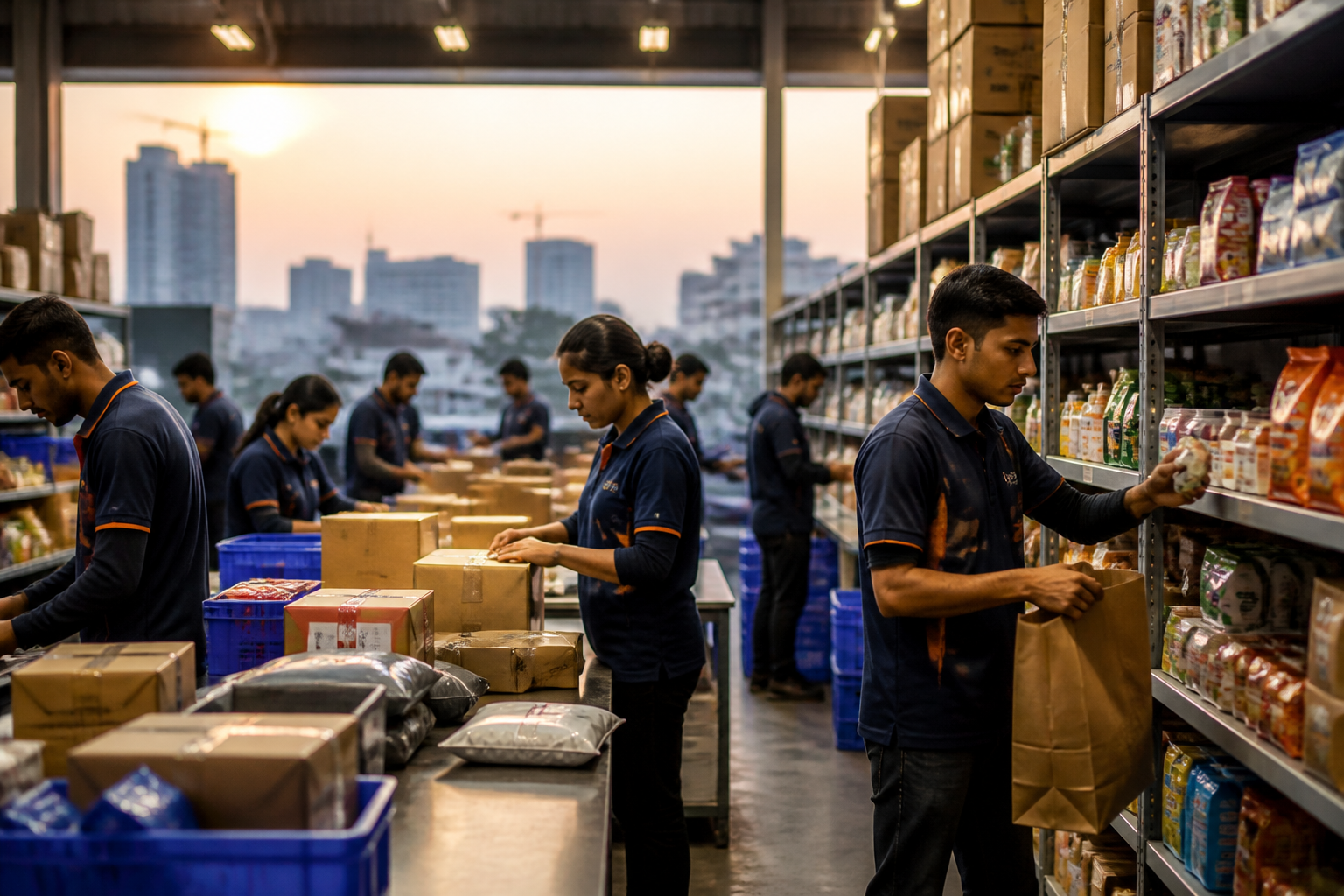
The urban significance of this shift extends beyond online storefronts. Retail growth depends on a physical system of sellers, packaging, warehousing, delivery networks and workers. Amazon India said it had created more than 1.6 lakh seasonal work opportunities across operations spanning more than 400 cities, including tens of thousands of roles in its Amazon Now quick-commerce network.
Meesho expects to enable more than 10 lakh indirect seasonal job opportunities, including about 6.5 lakh across its seller network and 3.75 lakh across logistics. The company said roughly 1.3 lakh sellers were expected to hire seasonal workers for packaging, manufacturing and warehousing. Zepto’s chief operating officer, Vikas Sharma, offered a different employment model, saying the company focused on a stable permanent workforce, including during peak demand, with an emphasis on training and upskilling.
The contrast shows that the expansion of online retail is also an institutional question about work. Seasonal demand can create short-term opportunities across fulfilment and logistics, but platforms differ in how they structure staffing and whether they rely on temporary or permanent workers. The supplied evidence does not establish which model is more effective, but it does show that festive commerce creates employment effects well beyond the digital transaction.
It also suggests that the geography of retail work is broadening alongside the geography of consumption. As non-metro sellers and shoppers contribute more to online platforms, packaging, manufacturing, warehousing and delivery activity becomes connected to a larger network of cities. The market is therefore not only about faster deliveries in major metros; it is also about integrating smaller urban centres into national retail and logistics systems.
The evidence points to a retail landscape with several simultaneous shifts: value growth without necessarily equivalent volume growth, quick commerce entering new categories, non-metro consumers contributing a large share of demand, and AI influencing how products are found and selected. No single trend explains the entire market. Their interaction is more important.
The festive season will show how these changes perform under pressure. Consumers may bring forward purchases to take advantage of discounts, followed by a softer December-January period. Nimkar said such a slowdown could represent normalisation rather than a structural fall in consumption, particularly for smartphones and appliances where replacement and upgrade needs remain relevant.
What the evidence confirms is that India’s online retail market is becoming more distributed across locations, platforms and shopping occasions. What remains uncertain is how much of the projected growth will be sustained after promotional periods, how quickly quick commerce can expand into categories requiring comparison and discovery, and whether employment models will converge or remain platform-specific. The next milestones will be the scale of festive orders, the performance of non-metro markets and the extent to which earlier demand, AI-led discovery and quick-commerce expansion become permanent features of India’s retail system.
