


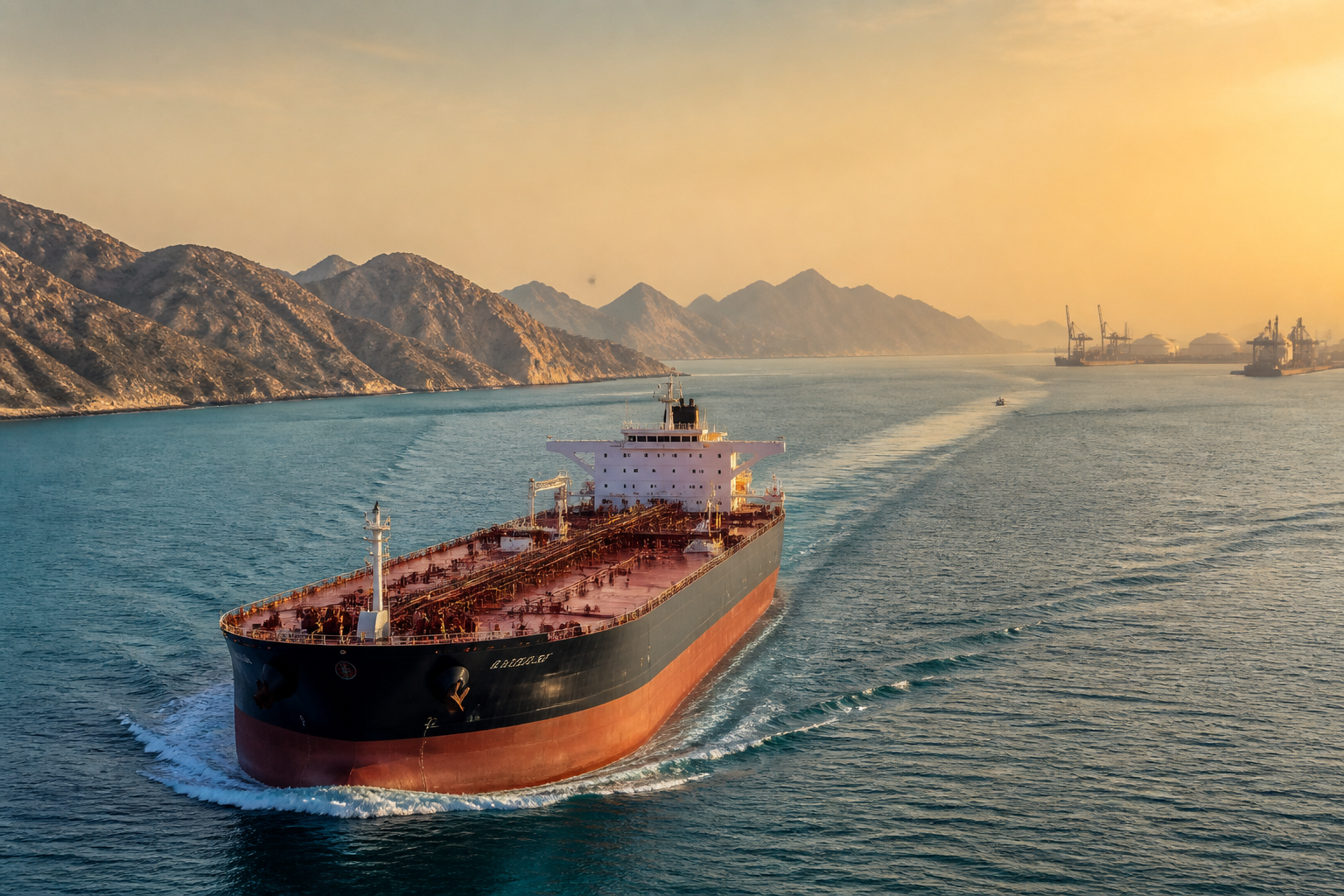
Indian oil refiners are changing how they buy and transport crude through the Strait of Hormuz, shifting more responsibility for shipping back to themselves as war-related disruption, freight premiums and changing political conditions reshape one of the country’s most important supply routes. The move is not simply a procurement adjustment. It shows how an international maritime chokepoint can alter the risk, cost and administrative mechanics of India’s energy infrastructure.
Since the start of the US-Iran conflict in March, the Strait of Hormuz has been described in the supplied report as effectively shut, with only limited numbers of ships and tankers passing through. Indian refiners initially avoided sending their own vessels into the waterway because of the risk of attacks. Gulf producers and international trading companies instead transported crude to India, allowing refiners to avoid directly managing the most exposed part of the journey.
That arrangement reduced the refiners’ immediate operational exposure but increased the cost of securing crude. The companies paid a premium under cost-and-freight terms, in which the seller or supplier arranges transport to the destination. In recent weeks, the refiners have begun moving towards free-on-board purchases, under which the buyer takes responsibility for arranging the vessel, loading the crude and transporting it.
According to the Bloomberg report cited by Times of India, Indian Oil Corporation, Reliance Industries, Bharat Petroleum Corporation and HPCL-Mittal Energy have purchased Iraqi crude on a free-on-board basis. The companies have floated tenders and entered discussions with shipping firms. Sinokor Group and Dynacom Tankers Management have won tenders so far, while bids submitted by Shipping Corporation of India and Lila Global were subsequently cancelled, according to people cited in the report.
The change matters because the price of crude is only one part of the delivered cost of oil. Once a refinery buys on a free-on-board basis, it must secure an appropriate tanker, manage the loading schedule and accept responsibility for the voyage. That can provide greater control over freight costs when ships are available, but it also exposes the buyer to the difficulty of sourcing vessels for a route viewed as high-risk.
The refinery strategy therefore reflects a trade-off between control and exposure. Under the earlier arrangement, the refiners paid more but transferred much of the shipping risk to producers and trading companies. Under the newer arrangement, they may be able to reduce the transportation premium, but must themselves handle the operational and safety challenges of sending tankers through the Strait of Hormuz.
The shift has become more feasible because oil flows through the waterway have recovered in recent months, while Saudi Arabia’s East-West pipeline has also been restored. A note issued by JPMorgan Chase this week, cited in the report, said Middle Eastern crude shipments had recovered to 98% of their pre-war levels. The recovery does not remove the underlying vulnerability of the route, but it appears to have made direct procurement and tanker chartering more practical for Indian buyers.
Data cited from Kpler shows that crude volumes moving through the Strait of Hormuz to India averaged around 1.3 million barrels a day in September. That was the highest level recorded since February, before the war began. India’s overall crude imports from the Middle East were about 2.8 million barrels a day, including Saudi oil transported through the Red Sea.
These figures explain why the shipping decision has consequences beyond individual refinery purchasing departments. The Strait of Hormuz is a crucial link in India’s crude supply chain, and changes in the volume, price or reliability of traffic through it can affect how refiners plan inventories, charter vessels and negotiate supply contracts. The reported strategy does not eliminate the route’s importance; it confirms how dependent the procurement system remains on its continued operation.
The composition of the crude being purchased is also changing. The report says Indian refiners are showing greater reluctance to accept Russian cargoes as political pressure from the United States increases. At the same time, Iraqi crude has become more attractive on price. Iraq’s state-owned oil marketing company, SOMO, offered contracted supplies for October at discounts of as much as $37 a barrel compared with regional benchmarks, according to the report.
That discount can materially influence the economics of a free-on-board purchase. A buyer may be willing to accept greater responsibility for shipping if the underlying crude is available at a sufficiently large discount. However, the reported discount does not by itself establish the final delivered cost to India, because freight, insurance, vessel availability, loading arrangements and route risk remain part of the calculation.
The episode also exposes the role of administrative decisions in energy logistics. Indian refiners had previously faced difficulty arranging crude pickups from inside the Gulf because New Delhi did not allow vessels undertaking such voyages to use Indian crew. That position changed in August, when the Directorate General of Shipping eased its advisory.
Under the revised guidance, Indian seafarers were not prohibited from travelling through Hormuz. Instead, shipowners and placement agencies were asked to obtain the consent of Indian seafarers before they undertook the voyage. This adjustment did not make the route risk-free, but it removed a regulatory barrier that had complicated the deployment of Indian crew on tankers travelling through the waterway.
The change illustrates that the resilience of a supply chain depends on more than physical infrastructure. It also relies on rules governing crews, shipping companies, charter contracts, insurance and port operations. When the risk profile of a route changes, these institutional arrangements can determine whether a refinery is able to respond quickly or must rely on a more expensive intermediary.
The reported tender activity shows the same institutional complexity. Refiners must not only decide how much crude to buy; they must also identify vessels, evaluate shipping companies and align tanker availability with crude-loading schedules. The cancellation of some tenders, alongside the award of others, indicates that securing capacity remains difficult even as flows through Hormuz recover.
For India’s urban economy, the implications are indirect but substantial. Refineries convert imported crude into fuels used by transport systems, freight operators, construction activity, industrial units and households. The source material does not establish how the procurement shift will affect retail fuel prices or inflation. It does, however, show that the costs and risks embedded in maritime supply chains are being actively managed by companies whose output supports everyday urban mobility and economic activity.
The larger urban question is whether supply-chain resilience can be created through commercial adaptation alone. Indian refiners are responding by changing contract terms, chartering vessels and using a different balance of responsibility between buyers, producers and traders. But the episode also shows the limits of that approach: when a major maritime route becomes dangerous or restricted, even large refiners remain dependent on vessel availability, regulatory permissions and the operating decisions of other countries and companies.
The evidence currently confirms a tactical shift rather than a permanent redesign of India’s crude-import system. Refiners are moving towards free-on-board purchases for some Iraqi cargoes, tanker firms have won selected tenders, Hormuz flows have recovered and shipping rules for Indian crew have been eased. The developments that require monitoring are whether the route remains accessible, whether the reported discounts persist, whether more tenders are awarded and whether refiners continue reducing their reliance on cost-and-freight arrangements.
