


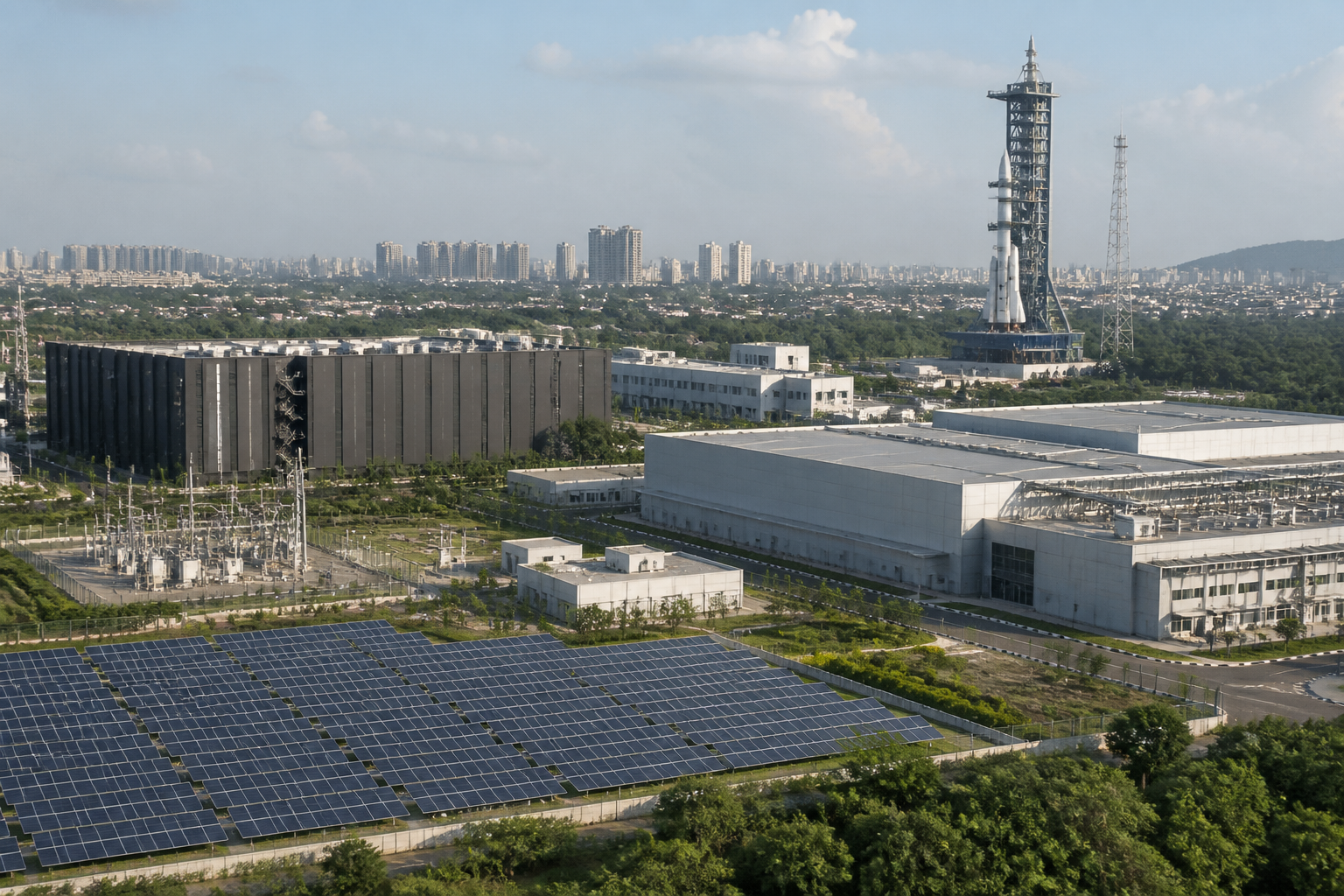
A Jefferies report has identified space, data centres, solar energy, semiconductors and electronics as sectors likely to drive India’s next phase of industrial growth. The assessment places these industries within a broader transition: India is moving from dependence on established manufacturing sectors towards newer activities that combine infrastructure, technology, strategic capability and domestic demand.
The report’s central argument is not that India is beginning to industrialise from scratch. It is that the country’s next industrial expansion will be built on an existing base of steel, cement, automobiles and oil refineries, while newer sectors add higher-value manufacturing and digital infrastructure. That combination raises a larger urban and economic question: how will cities, utilities, industrial regions and public institutions support industries whose physical requirements are very different from those of traditional factories?
The answer will depend on more than investment announcements. Space facilities, semiconductor plants, electronics units, solar-cell manufacturing and data centres require land, reliable electricity, water, transport links, skilled labour and predictable regulation. The Jefferies assessment suggests that government policy is attempting to assemble these conditions through tax holidays, incentive schemes and greater private participation. Whether that policy support produces durable industrial ecosystems will depend on how effectively these inputs are coordinated.
The report describes domestic opportunity as a major reason for rising private participation. India’s large market provides a base for companies in electronics, digital services, energy and advanced manufacturing. It also allows policy intervention to operate alongside demand rather than in isolation. A factory or data centre serving only an export market may be more exposed to external cycles, while a facility connected to expanding domestic consumption can have a broader commercial rationale. The supplied report, however, does not quantify the size of that demand or establish how much of the projected growth will come from domestic users and how much from exports.
The space sector illustrates the shift from state-dominated capability towards a more diverse commercial ecosystem. According to the report, India is among a small group of spacefaring nations with globally competitive capabilities. The government is targeting nearly fivefold expansion in the space economy, reaching between $40 billion and $50 billion during 2023-30. The report also states that the number of space start-ups rose from one in 2014 to more than 400 in 2026, while cumulative private investment reached $600 million by 2025-26.
Those figures point to a rapid expansion in participation, but they also show why the next stage is different from the first. The report says Indian space start-ups are moving from early-stage innovation to commercial execution. That transition requires companies to develop products, secure customers and operate at scale rather than depend primarily on experimentation or public interest. It also requires supporting infrastructure and institutional arrangements that can connect private firms to launch, testing and other parts of the space value chain. The supplied material does not specify how those arrangements are being implemented.
Semiconductors represent another test of the shift from policy intent to industrial execution. The report puts announced or planned investments in the sector at nearly $20 billion, including a chip fabrication plant under construction. It also refers to a new $13 billion incentive plan intended to expand the ecosystem and increase value addition, including chip design.
A semiconductor ecosystem is broader than a single fabrication facility. Even within the limited evidence in the report, the reference to chip design indicates an effort to develop capabilities beyond assembly or the production of one category of component. The distinction matters because manufacturing capacity, design capability and supporting suppliers create different requirements for land, skills, power and institutional coordination. The report establishes the scale of investment and the stated policy direction, but it does not provide details on project locations, construction schedules, employment or production targets.
Data centres are described as a strategic digital infrastructure segment whose expansion is already visible in capacity figures. The report says colocation capacity has increased fivefold over the past five years to 2 gigawatts. It expects capacity to grow another fivefold to nearly 10 gigawatts over the next five years, supported by cost conditions, policy support and demand from hyperscale users.
That projection places data centres alongside roads, power systems and telecommunications as a major infrastructure concern. Their growth requires concentrated electricity supply and dependable connectivity, while their physical footprint connects the digital economy to land-use decisions in and around cities. The report does not discuss the water requirements, grid arrangements, locations or environmental implications of this projected expansion. Those omissions do not invalidate the capacity forecast, but they show that investment projections alone do not describe the full urban infrastructure challenge.
The common thread across these sectors is the growing importance of industrial policy as an organiser of private investment. Tax holidays for data centres, incentives for semiconductors and solar cells, and policies encouraging private participation in space are presented as mechanisms that can reduce barriers and improve the commercial case for investment. The report’s argument is that policy support works most effectively when it is combined with scale, domestic demand and existing manufacturing capabilities.
This approach differs from treating each sector as a standalone initiative. Steel, cement, automobiles and oil refineries form part of an established industrial base. Newer industries can draw on some of that base while creating demand for new suppliers, logistics systems and technical skills. At the same time, their infrastructure requirements may expose gaps that traditional manufacturing did not resolve. A data centre’s dependence on power and connectivity, for example, is not identical to the requirements of an automobile plant; a semiconductor facility brings its own demands for specialised production and supply-chain reliability.
The figures cited by Jefferies indicate the scale of the proposed transition. India’s space economy is targeted at $40-50 billion by 2030, private investment in space has reached $600 million by 2025-26, semiconductor investments are estimated at nearly $20 billion, a new semiconductor incentive plan is valued at $13 billion, and data-centre colocation capacity is projected to rise from 2 gigawatts to nearly 10 gigawatts. Together, these numbers describe a policy and investment landscape that is expanding across both physical manufacturing and digital infrastructure.
They do not, by themselves, demonstrate that the next industrial revolution is assured. The report uses terms such as “strong foundation” and points to favourable conditions, but the supplied material does not provide evidence on completed projects, operating capacity, financial returns, job creation or regional distribution. The gap between announced investment and functioning industrial capacity remains important, particularly in sectors where projects require long construction periods, specialised skills and coordinated infrastructure.
For cities and industrial regions, the emerging pattern means that the built environment will be part of industrial strategy. Land-use planning, power availability, transport connectivity and the ability of local institutions to process approvals will influence whether new facilities become isolated investments or anchors for wider economic ecosystems. The source material does not identify specific cities or industrial corridors, so it cannot establish where these effects will be concentrated.
What the evidence confirms is a change in the composition of India’s industrial ambition. The country is relying on established manufacturing strength while attempting to build capabilities in strategic technology, renewable energy, electronics and digital infrastructure. Policy incentives are being used to attract private participation, and the report records substantial targets and investment figures across the identified sectors.
What remains uncertain is the quality and distribution of the resulting growth. The next phase will be measured not only by the number of start-ups, investment announcements or projected gigawatts, but by whether facilities are completed, ecosystems deepen and infrastructure keeps pace. The milestones that deserve monitoring are therefore the construction and commissioning of projects, the conversion of private investment into operating capacity, and the expansion of supporting capabilities such as chip design and commercial space services.

