


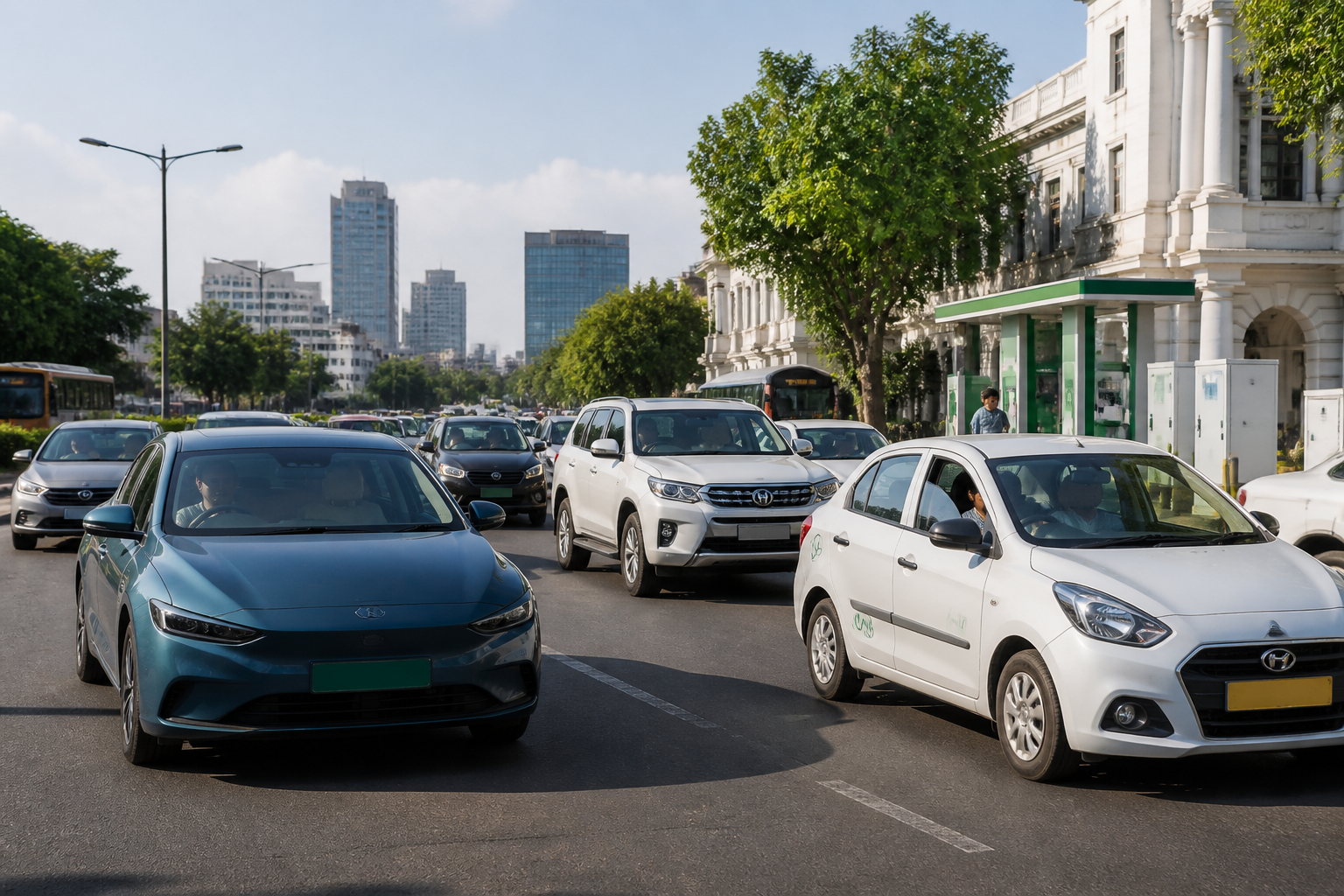
India’s passenger-vehicle market has reached a point where alternatives to petrol are no longer a niche category. In August, CNG, hybrid and electric passenger vehicles together accounted for 41.9% of retail sales, edging past petrol-powered cars at 40.8%, according to figures attributed to the Federation of Automobile Dealers Associations, or FADA. The change is important not because one technology has replaced another, but because buyers are increasingly choosing among several alternatives based on running costs, efficiency, charging access and concerns around the transition to E20 fuel.
The figures show a market becoming more varied rather than simply more electric. CNG accounted for 25.2% of passenger-vehicle retail sales, hybrids for 9% and electric vehicles for 7.6%. Petrol remained the largest individual fuel type, while diesel cars held a 17.2% share. The combined performance of the alternative-fuel categories nevertheless marks a change in the structure of demand: the choices grouped outside petrol now represent a larger share of monthly passenger-vehicle purchases than petrol itself.
That distinction matters for how India’s mobility transition is understood. The market is not moving along a single path from internal-combustion engines to battery-electric vehicles. Instead, consumers are adopting different powertrains for different use cases. CNG is gaining ground where lower running costs are a priority. Hybrids appeal to buyers seeking better fuel efficiency without relying entirely on charging infrastructure. EVs are expanding as their availability and acceptance grow. The August figures therefore point to a broadening transition, with electrification forming one part of a larger change in vehicle ownership and use.
The shift also represents a sharp change from the position a year earlier. According to the report, petrol had led the alternative-fuel basket by nearly 11 percentage points at that time. By August, the combined share of CNG, hybrids and EVs had moved ahead. The available figures do not establish that the change will continue at the same pace every month, but they do show that alternative powertrains have become a mainstream part of the passenger-vehicle market rather than a peripheral choice.
CNG is the clearest driver of this change. With a 25.2% share, it was the largest alternative to petrol and accounted for more than the combined reported shares of hybrids and EVs in passenger vehicles. The report attributes its appeal primarily to running-cost economics. That preference reflects a practical consideration for vehicle owners: the transition is being shaped not only by environmental objectives or technology policy, but also by the recurring cost of operating a vehicle.
The concentration of the CNG market also shows that the transition is not evenly distributed among manufacturers. Maruti Suzuki held around 71% of the CNG segment, according to the report. This gives the company a dominant position in the category and indicates how product availability can influence the direction of consumer adoption. The figures do not, however, establish whether that share reflects differences in pricing, model range, distribution, fuel access or other factors. They do show that CNG demand is currently associated with a highly concentrated supplier landscape.
Hybrids occupy a different position. Their 9% share places them well below CNG but ahead of EVs in the reported passenger-vehicle mix. The report links their appeal to buyers seeking improved efficiency without depending on charging infrastructure. That makes hybrids a bridge between familiar petrol-powered ownership and full battery-electric operation, particularly for consumers who want to reduce fuel use but remain concerned about the practical requirements of charging.
Electric passenger vehicles accounted for 7.6% of retail sales, with Tata Motors holding around 43% of the electric passenger-vehicle market. EVs therefore remain smaller than CNG and hybrids within the passenger-car mix, but their position is no longer marginal. The data also suggest that electric adoption is developing differently across vehicle categories, depending on purchase economics, daily travel patterns and the operational requirements of the user.
The two-wheeler figures reinforce that point. Electric two-wheelers accounted for 10.7% of sales in August, up from 7.7% a year earlier. The report describes this as the first time penetration crossed 10% in a non-festive month. Electric scooters are consequently moving beyond an early-adopter segment and becoming part of the mainstream commuter market, at least in terms of the reported retail-sales share. The comparison with passenger vehicles is useful because it shows that electrification is not necessarily advancing at the same speed across mobility categories.
Three-wheelers are further along. Electric vehicles accounted for 65.3% of three-wheeler sales in August, compared with 56.6% a year earlier. In this category, electric power has already become the dominant form of new-vehicle sales. Three-wheelers often operate in commercial or shared-mobility settings, where usage intensity can make running-cost calculations especially important. The supplied figures do not explain the full reason for the category’s high EV penetration, but they establish that the transition is structurally more advanced in three-wheelers than in passenger cars or two-wheelers.
Commercial vehicles are beginning from a much smaller base. Their EV share rose to 5.2% from 2.1% a year earlier, reaching an all-time high according to the report. The increase suggests that electric adoption is beginning to move beyond pilot activity and into fleet purchases, although the share remains limited compared with three-wheelers. The figures do not identify the fleets, locations or vehicle segments responsible for the increase, so the extent and durability of this shift cannot be determined from the available material alone.
Across all vehicle categories, EV retail sales reached 2.98 lakh units in August, a year-on-year increase of 52.9%. This is the strongest single growth figure in the report, but it needs to be read alongside the category-level shares. Rapid EV growth does not mean that all vehicle segments are transitioning at the same speed, nor does it mean that EVs alone explain the change in consumer behaviour. The passenger-vehicle data show a broader pattern in which CNG, hybrids and EVs collectively gain ground against petrol.
The E20 transition is another factor identified in the report. FADA said continuing hesitation around E20 was nudging some buyers towards CNG, hybrids and EVs. The report does not provide survey data or a breakdown of how many purchases were directly influenced by that concern. It does, however, place fuel-transition uncertainty alongside running-cost economics as part of the market context. That combination is significant because it shows how policy-related questions can intersect with everyday purchasing decisions.
For cities, the implications concern more than the fuel used by individual cars. A wider mix of powertrains changes the infrastructure interface between vehicles and the urban system. CNG adoption depends on access to refuelling points. EV growth depends on charging arrangements and electricity connections. Hybrids reduce dependence on charging but continue to operate within the conventional fuel system. The supplied data do not quantify infrastructure availability or identify regional differences, but the range of powertrains makes clear that urban mobility planning cannot assume a single replacement technology.
The figures also complicate the idea that India’s vehicle transition can be measured only through EV penetration. EVs are growing rapidly in several categories, and three-wheelers have already crossed a substantial electric threshold. At the same time, CNG is the largest alternative in passenger vehicles and hybrids have gained a significant share. The market is therefore combining multiple pathways, with each technology occupying a different position according to vehicle type and consumer priorities.
The central evidence from August is clear: alternatives to petrol collectively crossed a notable threshold in passenger-vehicle retail sales, while EV adoption continued to expand across two-wheelers, three-wheelers, commercial vehicles and cars. What remains uncertain is whether the passenger-vehicle crossover will persist across future months, how much of the shift is driven by fuel economics or E20 concerns, and how evenly the trend is distributed across cities and manufacturers. Those are the developments that will determine whether August represents a temporary market crossover or a durable change in India’s urban mobility system.
