


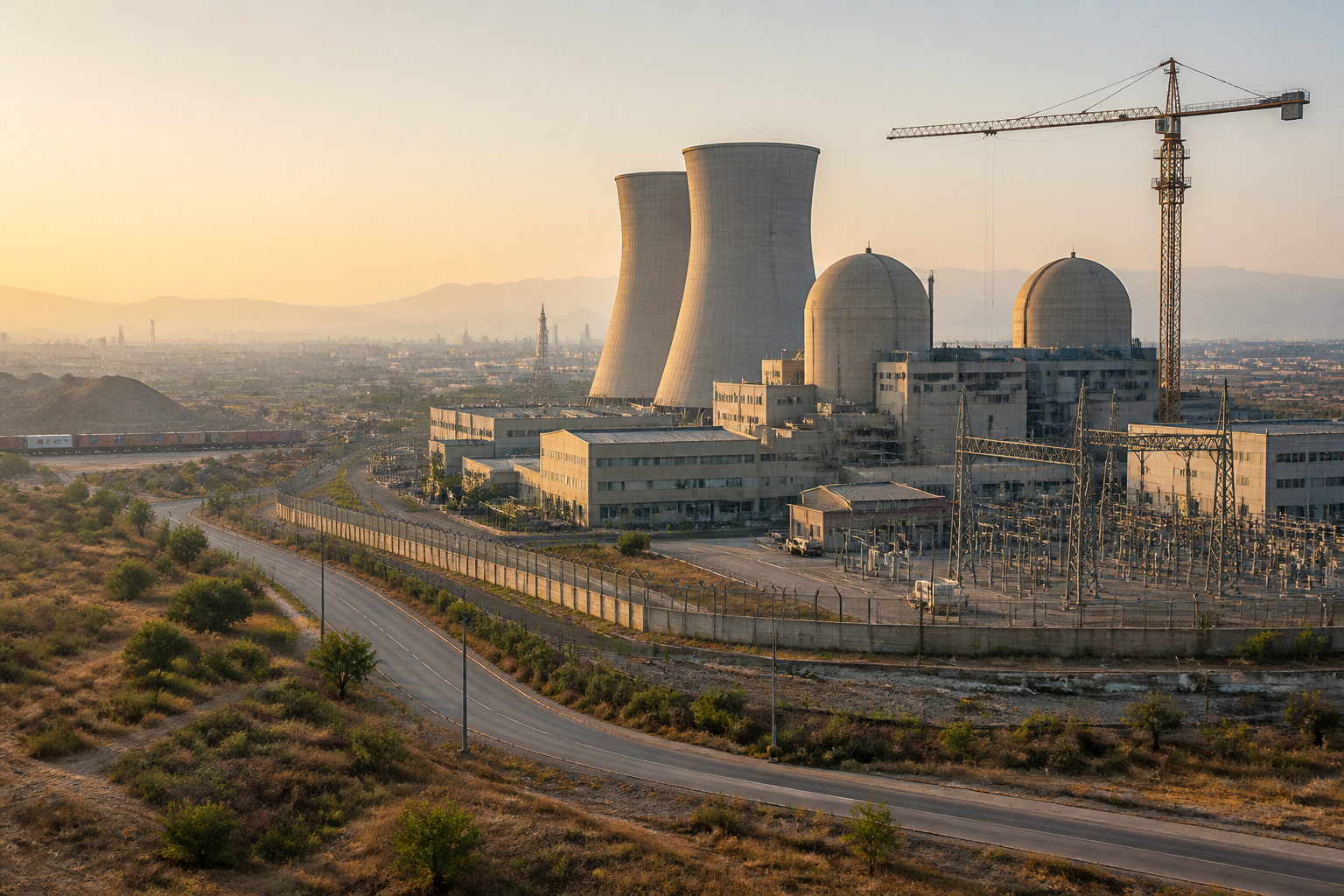
India’s plan to expand nuclear power capacity from about 8.78 GW today to 100 GW by 2047 is creating a fuel-security challenge that cannot be solved by building reactors alone. The country is now pursuing uranium supplies from Uzbekistan, Australia and Canada, while state-owned power companies examine direct investments in overseas mining assets.
This international search is unfolding alongside a major domestic policy shift. Parliament passed the Sustainable Harnessing and Advancement of Nuclear Energy for Transforming India, or SHANTI, Act, in December 2025, ending the state’s six-decade monopoly over civil nuclear power generation. Private companies can now build, own and operate nuclear power plants, although the government continues to control sensitive parts of the fuel cycle, including uranium enrichment, heavy-water production and long-term spent-fuel management.
Together, these developments point to a nuclear expansion strategy built on two parallel tracks: creating the industrial and regulatory conditions for more reactors in India, and securing enough uranium to operate them. The scale of the proposed expansion makes the second task particularly important. Industry estimates cited in the source material suggest that a 100-GW nuclear fleet could require around 18,000-20,000 tonnes of natural uranium each year, equivalent to roughly a third of current global uranium mine production.
That requirement would be far above the scale of India’s current domestic availability. India has uranium reserves in Jharkhand, Andhra Pradesh and Meghalaya, but domestic supply has historically constrained the civil nuclear programme. For years, the country managed the gap through government-to-government supply agreements. The planned increase in capacity means that procurement must now become more diversified, longer-term and less dependent on a limited number of arrangements.
The latest step involving Uzbekistan illustrates this shift. India and Uzbekistan have had a uranium supply relationship since 2019, when state-owned Navoi Mining and Metallurgical Company agreed to supply 1,100 metric tonnes of natural uranium concentrate to India through 2026. Parliamentary records showed that India had received about 600 metric tonnes of the contracted quantity by March 2025.
During Prime Minister Narendra Modi’s visit to Tashkent last month, the two countries discussed a longer-term framework for uranium supplies. Siby George, secretary (west) in the Ministry of External Affairs, was quoted by PTI as saying that positive discussions had taken place and that the sides were moving towards signing such an arrangement. No uranium-specific agreement was among the 11 agreements formally signed during the visit, which means the proposed framework was still being finalised.
The significance of the Uzbekistan discussions lies less in an immediate increase in supply than in the attempt to retain a major uranium producer as a long-term partner. It also shows why India is building a portfolio of suppliers rather than treating any one agreement as sufficient for its future reactor fleet.
Australia provides another part of that portfolio. In July, India and Australia finalised an Administrative Arrangement under their 2014 Civil Nuclear Cooperation Agreement. The arrangement, concluded during the Third India-Australia Annual Summit in Melbourne, creates a framework for long-term Australian uranium exports to India under International Atomic Energy Agency safeguards.
Australia has more than a third of the world’s known uranium resources, according to the supplied material. Its inclusion in India’s fuel strategy gives the country access to one of the largest resource bases globally. But the arrangement is a framework for exports, not evidence that Australia alone can meet the requirements of India’s projected nuclear fleet.
The Canada agreement provides a more clearly defined commercial supply commitment. In March, Cameco Corporation and India’s Department of Atomic Energy signed a nine-year agreement worth about $2.6 billion for nearly 22 million pounds of uranium ore concentrate between 2027 and 2035. The agreement was signed during Canadian Prime Minister Mark Carney’s visit to India and was described by both governments as part of a renewed strategic energy partnership.
The Cameco contract gives India visibility over supplies for a defined period and adds another major producer to its procurement network. However, the quantities involved need to be read against the much larger fuel requirement associated with the 100-GW target. The available information does not establish that the Uzbekistan, Australia and Canada arrangements, separately or together, are sufficient to cover the future needs of the planned fleet.
India is therefore examining a second form of fuel security: ownership or equity exposure in uranium resources. NTPC, the country’s largest power producer, has been tasked with developing roughly 30 GW of the planned 100-GW nuclear capacity. It has issued a tender to appoint consultants to identify uranium mining assets in which it could invest. Countries under consideration include Canada, Australia, Kazakhstan and South Africa.
This approach would move India beyond a model based entirely on long-term purchase contracts. Direct investment could give Indian state-owned companies a stake in overseas resources, although the supplied material does not establish which assets may ultimately be selected, how much capital could be committed or when any investment would begin producing fuel. The tender is evidence of a search process, not yet of an operating overseas mining portfolio.
The demand question is becoming more urgent because domestic reforms could enlarge the number of organisations seeking access to nuclear generation. The SHANTI Act allows private companies to enter power generation for the first time, while the government retains control over critical fuel-cycle activities. This creates a hybrid model: private participation in plant development and operation, alongside continued public control over strategic nuclear functions.
A tender floated by the state-run Nuclear Power Corporation of India for co-developing 220 MWe Bharat Small Reactors has attracted interest from Reliance Industries, Adani Power, Tata Power, Hindalco Industries, Jindal Steel and Power and JSW Energy. These companies are examining nuclear power partly as a source of captive, round-the-clock electricity for energy-intensive sectors such as steel, cement and data centres.
Tata Power has set 2032-33 as a target for commissioning what would be India’s first privately built nuclear plant. The company has been scouting sites in Madhya Pradesh, Odisha and Gujarat, with construction potentially beginning as early as 2028. These plans remain subject to the regulatory, technical and implementation processes required for nuclear projects, but they demonstrate how fuel procurement is becoming linked to a wider industrial strategy.
The intermediate capacity target is about 22 GW by 2031-32, compared with the longer-term goal of 100 GW by 2047. India currently operates 24 nuclear reactors with combined capacity of approximately 8.78 GW. The gap between present capacity and the interim target, and then between the interim target and 100 GW, indicates the scale of construction and fuel planning required over successive phases.
The numbers also explain why uranium procurement cannot be treated as a supporting detail. Reactor construction, licensing, grid integration and financing may determine how quickly capacity is added, but the plants will also need reliable fuel over their operating lives. A reactor that is built without dependable access to fuel does not provide the firm electricity that the expansion plan assumes.
India’s longer-term answer is its three-stage nuclear programme and the planned use of thorium. The Department of Atomic Energy describes thorium-232 as a material that can be converted into fissile uranium-233 for the programme’s third stage. The strategy envisages a transition from uranium-fuelled reactors to fast breeder reactors and eventually to reactors that can use uranium-233 produced from thorium.
A major milestone came this year when the 500 MWe Prototype Fast Breeder Reactor at Kalpakkam in Tamil Nadu achieved first criticality. The DAE has described the PFBR as the flagship of the second stage of India’s programme. In that stage, thorium-232 can be converted through transmutation into uranium-233, which could provide fuel for the third stage.
The PFBR does not, however, immediately remove the need for conventional uranium supplies. The technology represents part of a longer transition, while the reactors planned during the coming decades will still require dependable access to uranium. This is why India is simultaneously pursuing overseas contracts, domestic resources, possible mining investments and future thorium-based technologies.
The central institutional challenge is coordination. The Department of Atomic Energy remains responsible for strategic parts of the fuel cycle, state-owned companies are being positioned as major developers and potential private operators are entering generation. International suppliers and mining companies add another layer of contractual and geopolitical dependence. The 100-GW target therefore requires more than a construction pipeline; it requires an integrated supply chain that connects procurement, mining, reactor deployment and fuel-cycle governance.
The evidence currently supports a conclusion about direction, not completion. India is diversifying uranium sources, extending relationships with major producers, exploring overseas mining exposure and opening nuclear generation to private companies. The available agreements improve supply visibility, but they do not demonstrate that the fuel requirement implied by 100 GW has already been secured.
India’s nuclear expansion will consequently be measured on two connected timelines. The first is the immediate effort to obtain enough uranium for planned reactors and new private-sector participation. The second is the much longer development of a thorium-linked fuel cycle that could reduce dependence on conventional uranium. Until the second track becomes commercially and operationally significant, the success of the first will remain a central condition for the country’s nuclear ambitions.
