


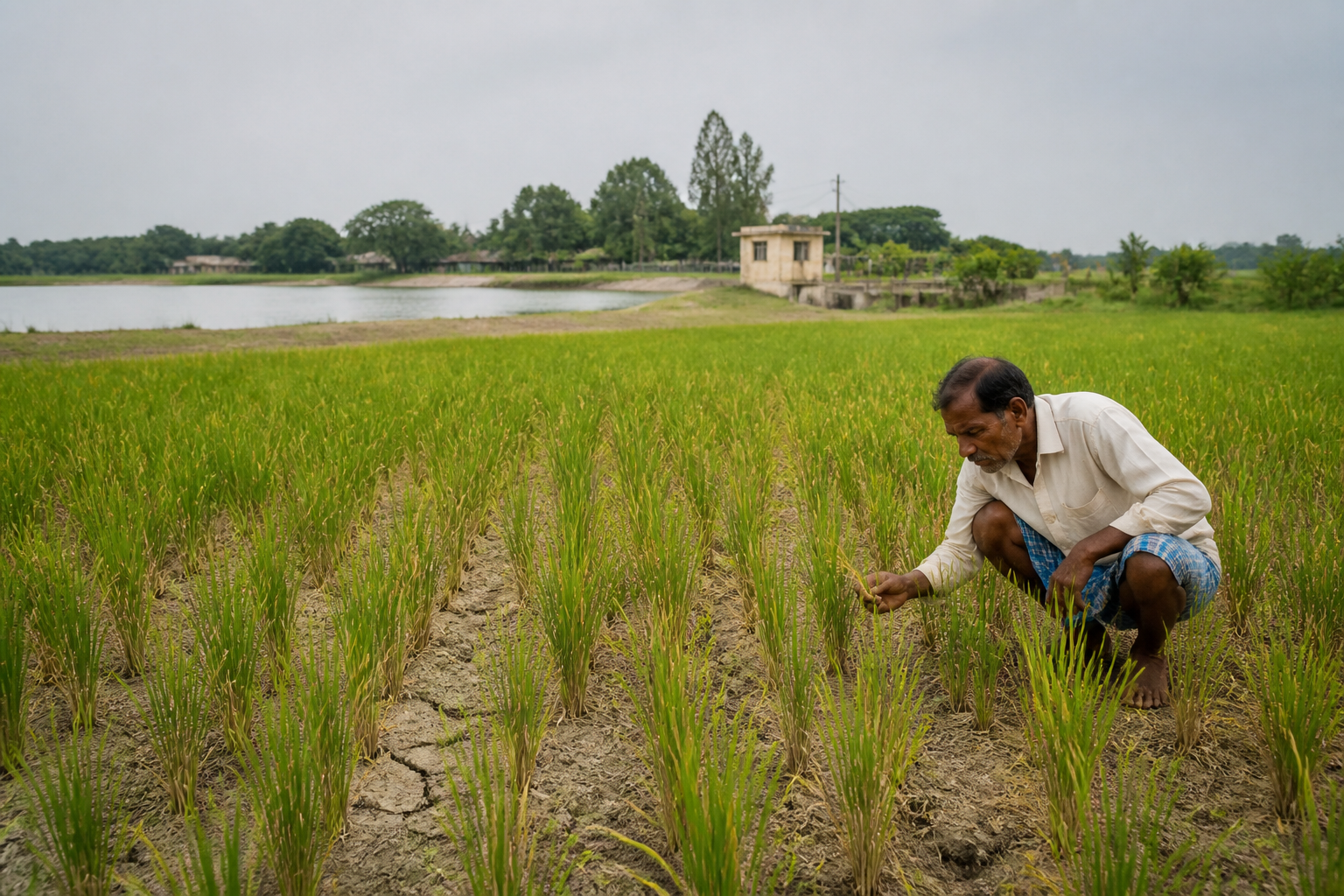
India’s rice production may fall by about 10 million metric tons this year, according to industry estimates cited in a report published by Economic Times and attributed to Reuters. The projected decline would be the country’s sharpest in nearly two decades, as below-normal rainfall during the crop’s maturation period reduces yields across important rice-growing states. The immediate agricultural shock is also becoming a wider food-system issue: domestic prices are rising, export prices have reached their highest level in more than a year, and the government’s unusually large rice reserves are now central to whether India can maintain overseas supplies without imposing restrictions.
The report places the expected decline against last year’s record production of 154 million tons. A fall of roughly 10 million tons would represent an estimated 6.5% reduction and the largest decline since 2009/10, when an El Niño-related drought curtailed output. B. V. Krishna Rao, president of the Rice Exporters Association, said yields would be lower because of reduced rainfall and that production could decline by around 10 million metric tons.
That estimate matters because India is both the world’s biggest rice-producing and rice-exporting country. A production drop in such a large supplier does not remain confined to farm districts. It can affect procurement, wholesale prices, government stocks, export availability and the cost of food for consumers in towns and cities. The report says local rice prices have already begun to rise on expectations of lower production, while export prices have moved to their highest level in more than a year.
## India rice production is being squeezed by rainfall and crop timing
The reported pressure is not simply a question of how much land was planted. Rainfall during the crop’s maturation period has reduced yield potential, particularly in southern and eastern states, according to the Rice Exporters Association. India had received 15% less rainfall than normal since the four-month monsoon season began on June 1, weather department data cited in the report showed. In some rice-growing states, the deficit was as high as 42%.
The timing of the shortfall is important. When rainfall is below normal during a crop’s development, the same planted area can produce less grain. This makes production vulnerable even before the final harvest figures are available. The report’s evidence therefore points to a combined problem: the area under the summer crop has also declined, while the remaining crop is facing lower yields.
Government data showed that the area under summer-sown rice stood at 42.68 million hectares as of September 11, nearly 4% below the level a year earlier. Summer-sown rice accounts for more than 80% of total production. This makes the summer harvest the main determinant of the year’s overall supply and leaves less room for a weak season to be offset by the winter crop.
The winter crop may face its own constraint. Nitin Gupta, deputy country head at Olam Agri India, said the area under winter-sown rice was also likely to fall because reservoirs were holding less water than normal. The report does not establish the eventual size of that decline, but it identifies reservoir levels as a second supply-side concern after rainfall during the summer crop.
## The price signal is arriving before the final harvest
Rice prices have begun moving higher even though the final production outcome is not yet known. This is a familiar feature of agricultural markets: expectations about supply can influence prices before the full quantity harvested is measured. In this case, the reported rainfall deficit, lower summer-sown area and concerns over the winter crop are already shaping market behaviour.
The price implications operate through several linked channels. Lower yields reduce the quantity available from farmers. Higher local prices can improve returns for producers of premium varieties, but they also increase costs for consumers and buyers further along the supply chain. At the export end, higher domestic prices can make Indian rice more expensive in international markets, particularly when competing exporters such as Thailand and Vietnam are also experiencing price increases.
The report specifically notes that farmers growing premium varieties are expected to receive higher prices in the open market. That could reduce the quantity they sell to the government, according to Rao. This is an important institutional detail because public stocks depend not only on harvest volumes but also on procurement flows. If more grain moves through open-market channels and less enters government reserves, the state’s ability to replenish stocks may be affected even when its existing inventory is large.
The impact on urban residents is likely to be felt through food prices rather than through direct exposure to the production shortfall. Rice moves through a chain of farmers, traders, millers, wholesalers, retailers and public distribution systems. A rise at the farm or export level does not translate into an identical increase at every stage, but the direction of the market signal can still influence household budgets, food businesses and institutional buyers. The supplied report confirms the early rise in local prices but does not provide a retail price estimate or quantify the likely effect on household expenditure.
## Large government stocks provide a buffer, not a complete solution
India’s existing reserves are the main reason the country may be able to maintain exports despite lower production. State rice reserves, including unmilled paddy, totalled a record 59.6 million tons as of September 1, according to the report. That was far above the government’s target of 10.3 million tons by October 1.
The scale of the difference changes the immediate policy calculation. A lower harvest does not automatically mean an immediate export shortage when inventories are high. A New Delhi-based dealer with a global trading house said India should still be able to export rice without imposing restrictions because of the size of its stockpiles. The report also says the large inventories were built up after record harvests in recent years.
But reserves perform more than one function. They can support exports, help manage domestic availability and provide the government with a procurement and distribution buffer. Using them to maintain overseas supplies while local prices rise could create a tension between export continuity and domestic price management, although the supplied report does not state what policy decision the government will take.
The stock figures also highlight the difference between annual production and usable supply. A weak crop can coexist with substantial availability when earlier surpluses remain in storage. Conversely, a large stockpile can be drawn down only for a limited period before future harvests and procurement become critical again. The current information establishes the size of the buffer but does not specify how much of it may be allocated to exports, domestic distribution or other uses.
## Procurement could become the pressure point
The expected production decline raises questions about how the state will manage procurement. Government purchases are influenced by the quantity harvested, the varieties produced, prices available in the open market and farmers’ willingness to sell into official channels. The report suggests that higher market prices for premium rice could result in lower government purchases of those varieties.
That relationship is significant because public stock management is not only about storage capacity. It also depends on the design of procurement systems and the relative attractiveness of official and private markets. When open-market prices rise, farmers may have stronger incentives to sell outside government procurement channels. That can benefit producers in the short term, but it may complicate the replenishment of public inventories.
At the same time, the country’s current stock level gives policymakers more time than they would have after a poor harvest with depleted reserves. The report does not indicate that the government has announced a new procurement, export or release policy in response to the projected decline. The evidence therefore supports a clear conclusion about the present position—India has a substantial buffer—but not about how that buffer will be used.
## The bigger urban question is food security through infrastructure and institutions
The rice story is often presented as an agricultural production story, but its consequences extend into the systems that connect rural production with urban consumption. Rainfall affects yields; reservoir storage affects future planting; procurement affects public stocks; and export policy affects the price and availability of grain across markets. Each link is managed by different actors, making coordination as important as the harvest itself.
For cities, the central issue is not only whether rice is available nationally. It is whether food can move through supply chains at prices that households and businesses can absorb. The report confirms that local and export prices are already rising, but it does not provide a breakdown by city, consumer category or income group. That missing information is important because the effects of a national production decline will not be distributed evenly.
The data available so far describes a supply system under pressure but not yet without a buffer. Production could fall by approximately 10 million tons from last year’s 154 million tons; summer-sown area is down nearly 4%; rainfall is 15% below normal nationally and as much as 42% below normal in some rice-growing states; and public stocks stand at 59.6 million tons against a government target of 10.3 million tons. Together, these figures show why prices can rise even while India retains enough stock to continue exports.
What remains uncertain is the final production number, the extent of the winter-crop decline, the trajectory of reservoir levels, the volume that farmers will sell to government agencies and the policy choices that will govern the use of existing reserves. Those are the developments that will determine whether the current supply shock remains a manageable seasonal setback or becomes a longer food-price and procurement challenge.
