


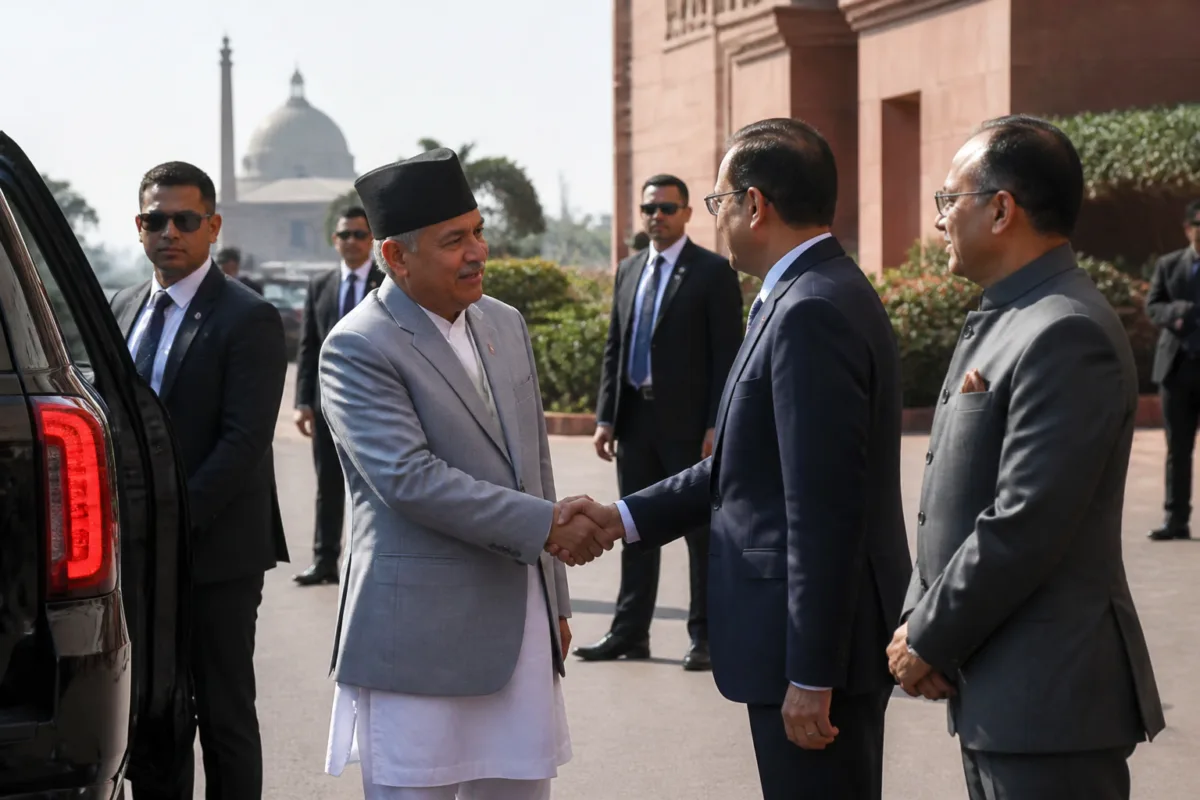
India and Nepal are set to focus on energy, hydropower, railways and wider connectivity when Prime Minister Narendra Modi meets Nepalese Prime Minister Balendra Shah in New Delhi on November 23, according to PTI, as the two countries seek to expand infrastructure and economic cooperation.
Shah arrived in the Indian capital on November 22 for his first bilateral visit abroad since taking office in March 2026. He was received by Jitin Prasada, India’s Minister of State for Commerce and Industry. The two-day visit is Shah’s first state visit to India and the first in-person meeting between the two prime ministers, PTI reported.
Several projects in Nepal are expected to be inaugurated virtually after the leaders’ talks, while bilateral documents covering multiple areas may be exchanged. People familiar with the matter told PTI that major outcomes are likely to be announced in energy, hydropower, railways, connectivity and infrastructure, although the report did not specify the projects or documents.
A key connectivity proposal under discussion is the Raxaul-Kathmandu railway link, which could create new passenger and freight connections between the two countries. PTI also reported that a new passenger train service is expected to begin between Ayodhya and Janakpur Dham, linking two religious centres associated with the Ramayana tradition.
Energy cooperation is another major component of the relationship. India currently imports about 1,200 MW of electricity from Nepal annually, according to the report. A long-term power-trade agreement envisages India importing up to 10,000 MW from Nepal over 10 years. Nepal has also exported electricity to Bangladesh through India’s grid since November 2024, while the two countries are expanding cross-border transmission capacity through new high-capacity lines.
Indian entities are involved in several hydropower projects in Nepal, including the 900 MW Arun-3 Hydroelectric project, which is under construction. Nepal earned approximately 1,800 crore Nepalese rupees from net electricity exports to India in 2025-26, PTI reported.
The infrastructure discussions are taking place within a broader economic relationship. India is Nepal’s largest trade, transit and investment partner, and provides the landlocked country with access to the sea. About 80 per cent of Nepal’s goods exports go to India, while Indian investment accounts for almost one-third of the foreign direct investment received by Nepal, according to PTI.
India’s External Affairs Ministry spokesperson Randhir Jaiswal said on X that Shah’s visit provided an opportunity to strengthen the enduring and multifaceted partnership between the two countries. The report said both governments see alignment in areas including economic growth, infrastructure expansion, technology adoption, natural-disaster response and climate change.
The visit follows diplomatic unease in May, when Shah sought the involvement of China and the United Kingdom in addressing the longstanding India-Nepal boundary dispute. New Delhi rejected a third-party role and said the issue should be handled through the established bilateral mechanism. The dispute covers Lipulekh, Limpiyadhura and Kalapani, which India maintains are part of Uttarakhand.

