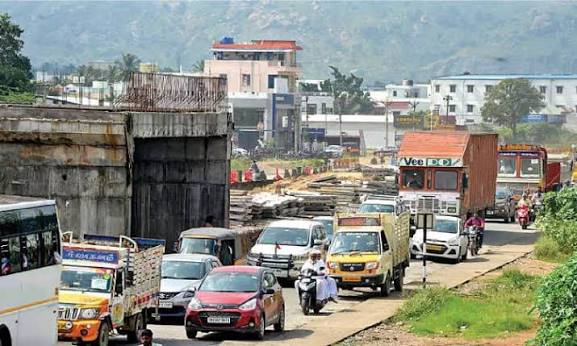
HYDERABAD: Travellers using the Hyderabad-Chennai road corridor are encountering delays at multiple points, with ongoing maintenance, narrow lanes and junction bottlenecks affecting journey times. Recent road-trip reports point to particularly slow movement around Nellore and the approach to Chennai, highlighting the gap between highway capacity and traffic conditions on key urban stretches.
The latest Hyderabad Chennai route assessment comes from journeys made in late August. One traveller reported leaving Hyderabad early in the morning and reaching Chennai’s Mount Road after about 10 hours, including breaks. The final section between Sholavaram and Mount Road reportedly took around 90 minutes for roughly 20 kilometres, showing how congestion near Chennai can offset faster travel on longer highway sections. Nellore remains another pressure point. The bypass has reduced the need for through traffic to enter the city, but additional grade-separated crossings could be needed to address remaining junction conflicts. One of two flyover projects under construction is expected to open soon, according to recent traveller observations. Maintenance work along the Nagarjuna Sagar–Addanki–Medarametla (NAM) corridor is also affecting movement. Sections under maintenance have reportedly been reduced to narrower lanes, with some stretches operating effectively as single lanes. Such temporary restrictions can have an outsized impact on journey times when heavy vehicles and passenger traffic share limited road space.
The issue is not simply about road quality. It also reflects the challenge of managing a long-distance corridor that carries local traffic, commercial vehicles and intercity travellers. Junctions where bypasses meet existing town roads can become recurring bottlenecks even when the main highway itself has adequate capacity. Piduguralla presents another example. Recent road users have flagged large speed breakers at a bypass intersection, where traffic entering or leaving the town must negotiate a sharp change in movement. Such junction treatments can improve local safety when designed appropriately, but poorly managed transitions may also interrupt highway traffic and increase travel uncertainty.
The corridor has seen gradual improvements in recent years. Earlier route assessments noted better movement around sections of the Piduguralla bypass, while other parts continued to face incomplete works and traffic conflicts. For businesses, freight operators and regular commuters, reliability may matter as much as headline travel speed. Delays increase fuel consumption, affect delivery schedules and make journey planning harder. For towns along the corridor, the priority is to balance through-traffic movement with safe local access. The Hyderabad Chennai route therefore needs more than isolated upgrades. Completing pending works, managing maintenance zones efficiently and improving junction design could make the corridor more predictable. Better coordination between highway improvements and local mobility will be important as traffic volumes continue to grow.