


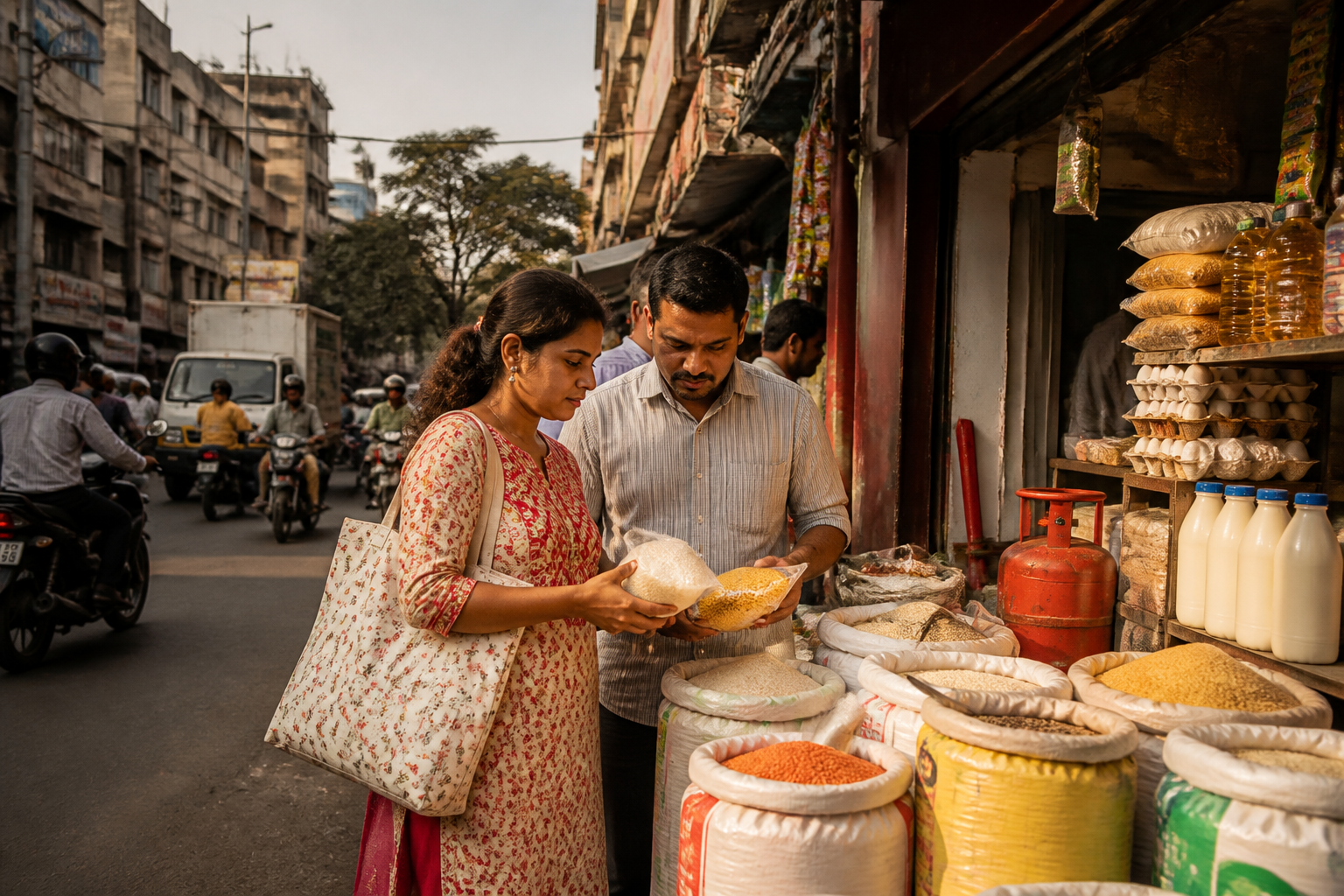
India’s consumer inflation is expected to rise to a 20-month high in August, driven by food and fuel costs, according to a Reuters poll of 44 economists. The forecast points to a third consecutive month above the Reserve Bank of India’s 4% medium-term target and places renewed pressure on household budgets, particularly through essential food, cooking energy and transport-related expenses.
The poll, conducted between September 3 and 9, estimated that annual consumer price inflation, measured by the Consumer Price Index, would increase to 4.80% in August from 4.45% in July. Forecasts ranged from 4.40% to 5.05%. The official August data is due on September 14.
The significance of the forecast lies less in the headline number alone than in the composition of the increase. The expected rise is being led by food and fuel rather than by a broad surge in underlying demand. That distinction matters for cities, where households depend on purchased food, cooking gas and daily mobility, while businesses face the same pressures through operating and distribution costs.
Food supply disruption is at the centre of the latest increase. An erratic monsoon affected supplies and pushed up prices of sugar, cereals, milk, edible oils, eggs and meat, according to the report. These are not discretionary purchases. Their price movements can alter household consumption quickly, particularly for families with limited room to absorb higher monthly expenses.
Sugar prices reached a record high in August and were expected to add at least 15 basis points to headline inflation, said Kanika Pasricha, chief economic adviser at Union Bank of India. Potato and pea prices continued to decline year on year, partially offsetting increases in other food items and limiting the rise in overall inflation.
The government’s response to sugar prices is already affecting the market. India’s ban on sugar exports, introduced in May to cool domestic prices, is scheduled to remain in place until the end of September. The measure illustrates how food inflation is being managed through a combination of supply conditions and administrative intervention rather than monetary policy alone.
Fuel is the second major pressure point. Global crude prices were nearing $100 a barrel, while higher cooking gas prices were also contributing to inflation. For urban residents, the effect can travel through several parts of the household budget: cooking energy becomes more expensive, transport costs face pressure, and goods delivered through road-based supply chains can become costlier.
The pass-through from fuel to urban prices is not uniform and the supplied material does not establish the size of its impact on individual cities. But the combination of fuel and food increases creates a wider cost-of-living challenge than a rise in one commodity category would. Food is purchased directly by households, while fuel costs can also be reflected indirectly in the movement of goods and the operation of services.
The latest forecast also highlights the limits of headline inflation as a complete description of urban economic stress. Core inflation, which excludes volatile food and fuel components and is used as an indicator of underlying demand pressures, was expected to rise to 4.1% in August. India does not publish an official core inflation measure.
That distinction leaves policymakers with a difficult reading of the economy. If food and fuel are the main drivers, an interest-rate response may not directly resolve the supply pressures behind the increase. If price pressures broaden into other goods and services, however, the central bank may face a stronger case for tightening financial conditions.
The RBI held interest rates last month because inflation remained within its 2%-6% target band. Minutes of its latest meeting indicated that the central bank was prepared to tighten policy if price pressures broadened. The Reuters poll did not expect a rate increase until next year, while a separate poll conducted the previous month forecast a 25-basis-point increase in the second quarter of 2027 and another increase in the fourth quarter, taking the policy rate to 5.75%.
The projected timing shows the difference between remaining inside the formal inflation band and meeting the RBI’s medium-term target. At 4.80%, the forecast remains within the permitted range but exceeds the 4% benchmark for the third month in succession. For the central bank, the question is therefore not only whether inflation is technically contained, but whether the factors driving it are temporary or becoming more persistent.
Wholesale price inflation adds another layer to the picture. It was forecast to edge up to 9.89% in August from 9.78% in July, remaining around 10% for a fourth consecutive month. The supplied material does not establish how much of this increase will reach retail consumers, but the parallel pressure indicates that inflation is present beyond the household-facing CPI measure.
For cities, the inflation story is also a governance and service-delivery story. Urban households experience national price movements through local markets, rental and commuting decisions, food purchases, domestic energy use and the prices charged by small businesses. The report does not provide city-level inflation data or break down the effect by income group, so the precise distribution of the burden remains unestablished.
That gap is important. A national CPI forecast can identify the direction of pressure but cannot show whether residents in Bengaluru, Mumbai, Delhi or smaller urban centres are facing the same increase in food, energy or transport costs. Nor does the supplied evidence establish whether wage growth is keeping pace with the expected inflation increase. Those questions would require city-level price and income data not included in the Reuters poll summary.
The evidence does, however, identify a clear institutional chain. Weather conditions disrupt food supplies; commodity prices respond; government may intervene through trade restrictions such as the sugar export ban; global crude prices affect fuel costs; and the RBI assesses whether inflation is broadening enough to justify a change in interest rates. Each institution acts on a different part of the system, and no single measure controls all of the pressures simultaneously.
This is why the August forecast should not be read simply as a signal about interest rates. It is also an indicator of how exposed household budgets remain to food supply volatility and energy prices. The expected rise in core inflation to 4.1% suggests that the underlying picture deserves monitoring, while the report’s emphasis on food and fuel indicates that the immediate trigger is still concentrated in volatile categories.
The larger urban question is whether cities and households can absorb repeated increases in essentials without a visible deterioration in consumption, mobility or access to services. The available evidence does not answer that question. It confirms that inflation is expected to rise, identifies food and fuel as the main drivers, and shows that policymakers are watching for a broader spread of price pressures.
The next decisive information will come with the official August CPI release on September 14. That data will determine whether the forecasted 4.80% increase materialised, how individual food and fuel components performed, and whether the pressure remained within the RBI’s target band while continuing to exceed its medium-term target.
