


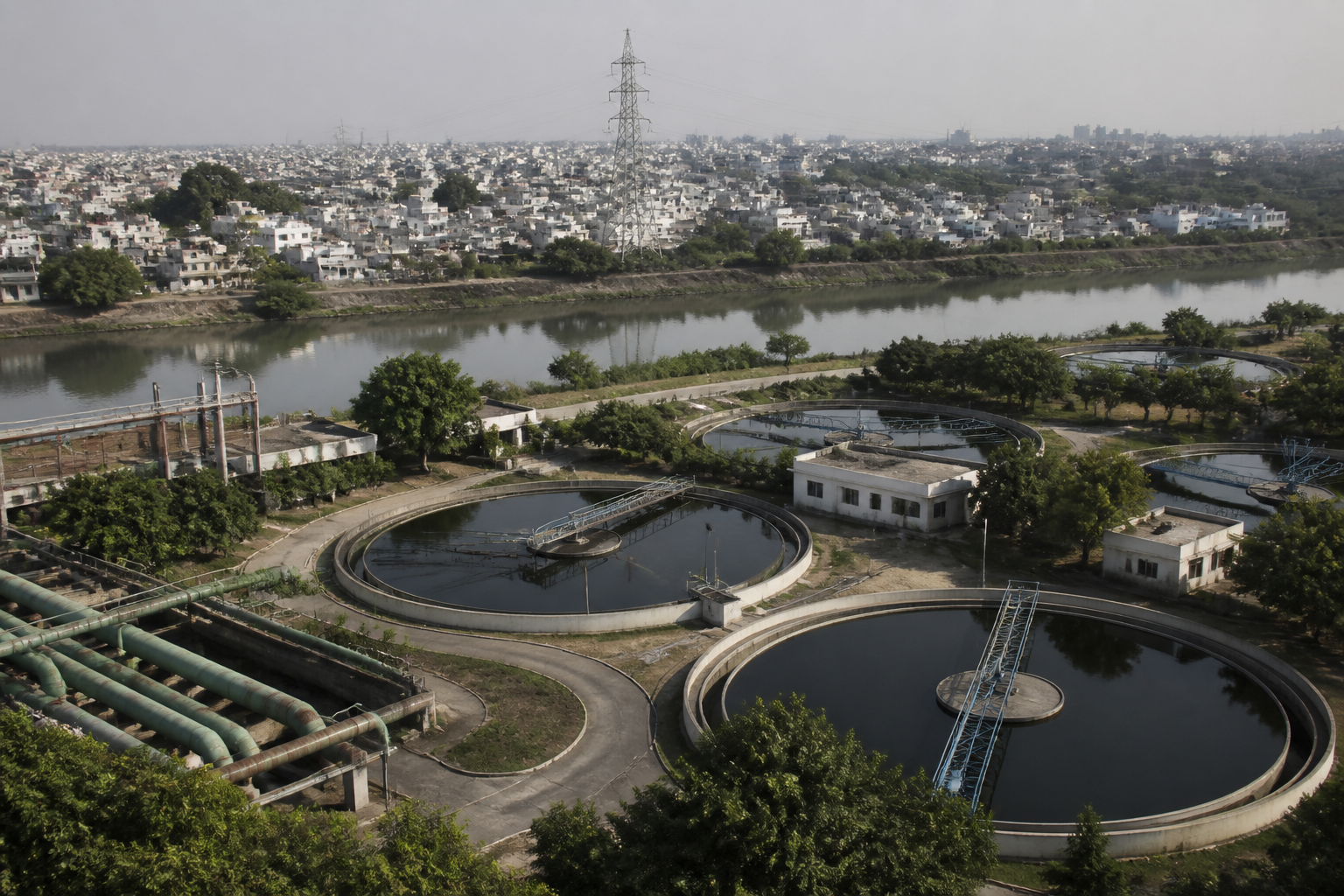
Subheadline: Telangana’s NGT affidavit records repeated exceedances of BOD, COD, suspended solids and coliform limits at treatment plants linked to Hussain Sagar, the Musi and several urban lakes.
Standfirst: Telangana’s latest compliance affidavit to the National Green Tribunal does not establish that Hyderabad’s sewage treatment plants are currently breaching pollution standards. It does, however, present a detailed record of repeated exceedances during tests conducted in 2025. The findings span facilities discharging into Hussain Sagar, the Musi river and a number of city lakes, with plants of widely different capacities showing problems across biological oxygen demand, chemical oxygen demand, total suspended solids and total coliform. Read together, the filing shifts attention from the existence of sewage-treatment infrastructure to the harder question of whether that infrastructure is consistently producing compliant effluent. This analysis examines what the affidavit establishes, what it does not establish, and why plant-level monitoring matters for Hyderabad’s urban water system.
The latest development is contained in a compliance affidavit filed before the National Green Tribunal on September 7 by Telangana chief secretary Sanjay Jaju. The filing followed an NGT hearing on February 25, when the tribunal sought clarifications on earlier submissions, including the performance of sewage treatment plants. The affidavit includes plant-wise monitoring results from 2025 and identifies instances in which treated effluent exceeded prescribed limits.
That distinction is important. The state’s filing records past test results; it does not, by itself, prove that the plants were still violating standards when the affidavit was submitted. Nor does the material establish that every discharge from every plant was non-compliant. What it does show is a repeated pattern of parameter exceedances at multiple facilities across different parts of Hyderabad’s sewage network.
The evidence is organised around the quality of treated effluent rather than simply the installed capacity of the plants. The parameters identified include biological oxygen demand, or BOD; chemical oxygen demand, or COD; total suspended solids, or TSS; and total coliform, or TC. Each measures a different aspect of wastewater quality. In the affidavit as reported, exceedances appear at different plants, in different months and across different parameters.
For the urban water system, that spread matters. The plants named in the filing discharge into major water bodies and urban lakes, including Hussain Sagar and the Musi. The issue is therefore not confined to an isolated treatment facility. It concerns the relationship between sewage collection, treatment performance, final discharge points and the water bodies receiving that discharge.
The Hussain Sagar-linked plants provide one of the clearest examples. Three facilities, with a combined installed capacity of 183 million litres per day, were flagged: the 20 MLD Khairatabad plant, the 30 MLD KIMS/Picket plant and the 133 MLD Fatehnagar plant.
At Khairatabad, BOD levels exceeded prescribed limits from March to August and again in October 2025. Total coliform exceeded the standard in August, while COD crossed the permissible level in October. The KIMS/Picket plant recorded BOD exceedances in March, April and from July through October. It also recorded a COD exceedance in October and was under maintenance in May.
The Fatehnagar plant presents a different pattern. Its BOD levels were marginally above the prescribed limit in March and April, at 11 to 12 milligrams per litre against a limit of 10 milligrams per litre. BOD remained above the standard from May to July, while total coliform exceeded the permissible level in June.
These results do not indicate an identical failure across the three plants. They show different combinations of duration, parameter and severity. Some exceedances were marginal, while others occurred repeatedly over several months. The distinction is relevant for oversight because a single abnormal reading and a recurring pattern raise different questions about operations, maintenance, influent quality, laboratory monitoring and corrective action. The supplied affidavit summary does not provide enough information to determine which of these factors explains each breach.
The Musi-linked plants also appear in the state’s annexure. The 339 MLD Amberpet STP recorded BOD and COD exceedances in October. The facility also receives partially treated industrial effluent from common effluent treatment plants at IDPL and PETL. The affidavit records exceedances at those CETPs in parameters including total dissolved inorganic solids, COD, BOD, TSS and ammoniacal nitrogen during certain months.
That detail complicates the idea that the performance of a municipal sewage treatment plant can be assessed separately from the material entering it. Amberpet’s reported role includes receiving partially treated industrial effluent, which means the quality and treatment requirements of incoming flows form part of the compliance picture. The available material does not establish how much each source contributed to the recorded exceedances, but it identifies an interface between municipal treatment and industrial effluent management.
The 172 MLD Nagole STP recorded BOD exceedances in March, April and July, along with a marginal exceedance in May. Total coliform levels exceeded standards in April, July and August. STPs at Nalla Cheruvu recorded exceedances in BOD, COD, TSS and total coliform during different months. Two Attapur plants discharging into the Musi also reported BOD exceedances.
The distribution across Amberpet, Nagole, Nalla Cheruvu and Attapur suggests that the monitoring issue is not limited to one named corridor. However, the evidence should not be overstated. The reported data covers tests conducted during 2025, and the summary does not provide a complete time series for every plant, information on flow volumes during each test, or the corrective measures taken after each exceedance. It therefore supports a finding of repeated recorded breaches, not a complete diagnosis of the Musi’s water quality or the current condition of every linked STP.
The same pattern extends to city lakes. The state’s filing records instances involving plants discharging into Pedda Cheruvu, Durgam Cheruvu, Khajaguda lake, Saroornagar Cheruvu, Bhagiradha or Manikonda Cheruvu, Noor Mohammed Kunta, Safilguda lake, Rangadhamuni Cheruvu and Langer House lake.
At the 10 MLD Nacharam/Pedda Cheruvu plant, BOD exceedances were recorded from March to July and again in October. The 17.5 MLD Pedda Cheruvu-HMT Nagar plant reported BOD exceedances through much of the monitoring period and recorded TSS and COD exceedances in October. Together, the two facilities illustrate how a lake-linked treatment network can experience both persistent BOD problems and additional parameter breaches at particular points in the year.
The plant capacities also show why a citywide assessment cannot rely on one headline number. The facilities named in the affidavit range from 10 MLD and 17.5 MLD plants serving lake-linked systems to the 339 MLD Amberpet plant and the 133 MLD Fatehnagar plant. Capacity indicates the scale of a facility, but it does not by itself establish treatment performance. The affidavit’s plant-wise approach is therefore significant: it makes it possible to see where breaches were recorded, how often they occurred and which parameters were involved.
The governance question is what follows from that monitoring. An STP’s compliance is not demonstrated merely by its installed capacity or by the fact that it is operating. It depends on whether treated effluent meets the prescribed standards at the relevant discharge point. The affidavit places those results before the NGT because the tribunal is examining compliance, not simply the existence of infrastructure.
The filing also records a separate municipal solid-waste processing gap of 1,856 tonnes per day, with additional processing infrastructure targeted for completion by December 31. That issue is distinct from STP performance and should not be treated as evidence of sewage-treatment failure. It does, however, place the wastewater findings within a wider compliance submission covering urban environmental infrastructure and the state’s obligations before the tribunal.
What remains uncertain is as important as what is known. The available material does not say whether each plant has since returned to compliance, what operational changes were made, whether repeat samples were taken, or how the recorded results affected the receiving water bodies. It also does not establish whether the breaches were caused by plant design, maintenance, inflow variation, industrial effluent, collection-system conditions or another factor.
Those gaps define the next stage of scrutiny. The NGT will need to consider the plant-wise data alongside the state’s explanations and any subsequent compliance information. For Hyderabad, the central issue is whether the recorded exceedances were isolated failures that were corrected or evidence of recurring weaknesses in how sewage and industrial effluent are collected, treated, monitored and discharged.
The affidavit confirms that Hyderabad has substantial treatment infrastructure, but it also shows that infrastructure and compliance are not interchangeable. The city’s sewage system will ultimately be judged at the point where treated water leaves each plant and enters a river, lake or reservoir-linked environment. The next meaningful development will be the state’s further response and the tribunal’s assessment of the corrective and monitoring measures submitted after the 2025 test results.
