


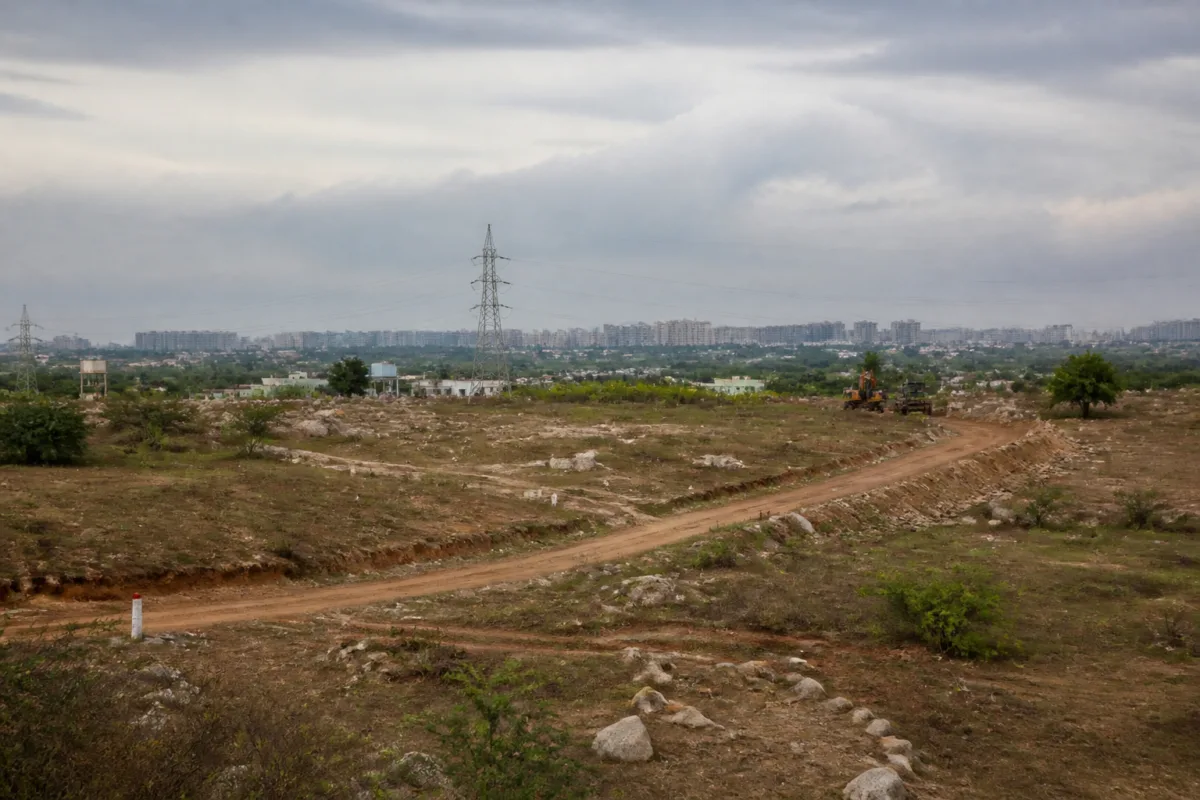
Hyderabad’s waste-processing expansion is facing a governance bottleneck rather than a single legal obstacle. Four sites identified by the Greater Hyderabad Municipal Corporation (GHMC), together covering more than 782 acres across three districts, remain delayed by court cases, land-transfer disputes, environmental approvals, zoning changes and objections from villages on the city’s outskirts.
The details were placed before the National Green Tribunal’s Southern Zone Bench in Chennai in a report filed by GHMC commissioner RV Karnan. The report lists 19 filings since October 2021 and records a different administrative problem at each location. At one site, land transfer is pending; at another, work has stopped under court orders; a third is awaiting pollution-control consent; and a fourth requires land-use conversion before construction can proceed.
That distribution of delays is important. It shows that Hyderabad’s waste infrastructure is not being held up by one isolated dispute that can be resolved through a single court order or government direction. The projects are moving through several approval systems at once, involving municipal authorities, state agencies, district collectors, the Telangana High Court, the NGT, the Telangana Pollution Control Board, the Hyderabad Metropolitan Development Authority and local communities.
The GHMC has asked the NGT to dispose of the case even as the projects remain incomplete. The state administration, meanwhile, has directed officials to coordinate applications seeking the vacation of stay orders, expedite pending approvals and identify additional sites. The latest position was to be placed before the tribunal on October 29, according to the report.
The four sites were selected to support decentralised waste processing. Their delays therefore have implications beyond the boundaries of the parcels themselves. Decentralised facilities are intended to distribute waste-processing activity across a metropolitan region rather than concentrate it at one location. But the report does not establish how much waste is currently being processed at existing facilities, how much additional capacity the four sites would create, or whether alternative arrangements are available while the projects remain stalled.
The Banda Ravirayala site in Abdullapurmet mandal represents the most extensive land and litigation challenge. GHMC sought the transfer of 494 acres and 21 guntas in Survey No. 268 from the Telangana Industrial Infrastructure Corporation on April 25, 2026. The transfer remains pending. The commissioner’s report also states that 22 cases filed by mining agencies concerning the land are pending before the Telangana High Court.
During a review meeting on October 27, the legal head of the Mines and Geology Department was instructed to coordinate the filing of applications seeking the vacation of stay orders. The available account does not say when those cases will be decided or whether the land-transfer process can be completed before the litigation is resolved. That gap illustrates a recurring problem in large public projects: administrative possession, legal title, regulatory clearance and construction readiness are treated as separate tasks, although a facility cannot proceed unless they align.
At Pyaranagar in Sangareddy, the GHMC took advance possession of 117 acres and acquired 0.6 hectares from the Forest Department for an approach road in February 2025. Litigation followed claims that the land was privately owned, that public hearings and environmental clearance had not been obtained, and that waste disposal outside GHMC limits was impermissible.
The work has been halted under status quo orders issued by the High Court and the NGT. The Sangareddy collector was directed to coordinate applications seeking to vacate the stay orders within 15 days. The report does not indicate whether those applications have been filed or whether the underlying questions concerning land ownership, public consultation and environmental clearance have been settled.
Pyaranagar also reveals why waste infrastructure can become a contested regional issue. The GHMC is the municipal body responsible for Hyderabad, but the proposed sites lie across the wider metropolitan geography and outside the corporation’s immediate limits. The dispute described in the report is therefore not only about the location of a processing plant. It also concerns which authority can establish such a facility, what procedures apply, and how residents and landholders in surrounding villages are involved.
The Siddapur site in Kothur mandal has moved further in the administrative process but remains unresolved locally. Eighty-six acres were handed over to the GHMC on February 10, 2026, and subsequently transferred to Hyderabad Integrated MSW for a processing facility. The application for Consent for Establishment is under consideration by the Telangana Pollution Control Board.
Villagers and local representatives have filed objections. The Rangareddy collector has been directed to examine and address them immediately. The source report does not specify the substance of the objections, the number of objectors, or whether a formal hearing has been completed. Those details matter because a project may have land available and a private operating entity in place, yet still be unable to begin construction without regulatory consent and a process for responding to local concerns.
At Dundigal in Medchal-Malkajgiri, 85 acres and three guntas have been handed over for another facility. The site requires conversion from Forest and S5 Use Zones to industrial use. The HMDA has approved the change in principle and sent a draft variation certificate to the government on October 6. The Special Chief Secretary agreed to expedite approval within a month.
Unlike the two sites affected by court orders and the Siddapur site awaiting pollution-control consent, Dundigal’s immediate obstacle is land-use compatibility. A waste-processing facility requires a site that is not only physically available but also legally compatible with the applicable development plan and zoning framework. The need to change the land-use designation after the site has been selected suggests that project preparation and planning approval have not moved in a fully sequential manner.
The four cases together point to a fragmented project pipeline. Land identified by one agency may remain controlled by another. A site may be handed over while questions about ownership or environmental procedure continue. A project may receive an in-principle planning approval while the final government certificate remains pending. Court proceedings can then suspend work even as departments prepare applications to remove the stay orders.
This fragmentation is especially consequential for waste management because waste generation does not pause while facilities await clearance. Yet the supplied report contains no citywide waste-generation figure, current processing capacity, landfill-dependency data or deadline for commissioning the four plants. It is therefore not possible from the available evidence to quantify the immediate capacity shortfall or determine how the delays have affected daily waste operations.
What can be established is the duration and breadth of the institutional problem. Litigation over Hyderabad’s garbage disposal reached the NGT five years ago, and the report lists 19 filings since October 2021. The four proposed sites span Rangareddy, Sangareddy and Medchal-Malkajgiri districts, while the review process also involved the collectors of Rangareddy, Sangareddy and Yadadri Bhuvanagiri. The administrative geography of the project is consequently larger than the municipal geography of the GHMC.
The response so far has been to coordinate more closely across departments. The October 27 review meeting, chaired by the Special Chief Secretary of Municipal Administration and Urban Development, directed officials to pursue legal remedies, resolve objections and accelerate approvals. Collectors were also instructed to identify additional sites. That last direction indicates that the government is not relying only on the four existing parcels, although the report does not disclose the number, location or status of any additional options.
The institutional question is whether coordination after litigation begins can substitute for integrated project preparation before land is selected. The record described in the report suggests that the projects have encountered problems at each stage: ownership and transfer at Banda Ravirayala, court stays and environmental-process claims at Pyaranagar, regulatory consent and village objections at Siddapur, and zoning conversion at Dundigal.
For citizens, the significance lies in the distance between a planned waste facility and an operating one. Announcing or identifying land does not create processing capacity. The facility must pass through title and transfer procedures, planning approvals, environmental and pollution-control requirements, legal challenges and local consultation. Until those steps are completed, the city’s waste system continues to depend on whatever existing arrangements are available, though the report does not describe those arrangements.
The evidence therefore confirms a serious implementation delay but leaves several operational questions unanswered. It does not establish whether the four facilities will receive final clearances, when construction will begin, how much waste they will process, or whether the court cases will be resolved in the government’s favour. The next measurable developments are the applications seeking vacation of stay orders, the pollution-control decision for Siddapur, the government’s decision on the Dundigal variation certificate, the response to village objections and the identification of additional sites.

