


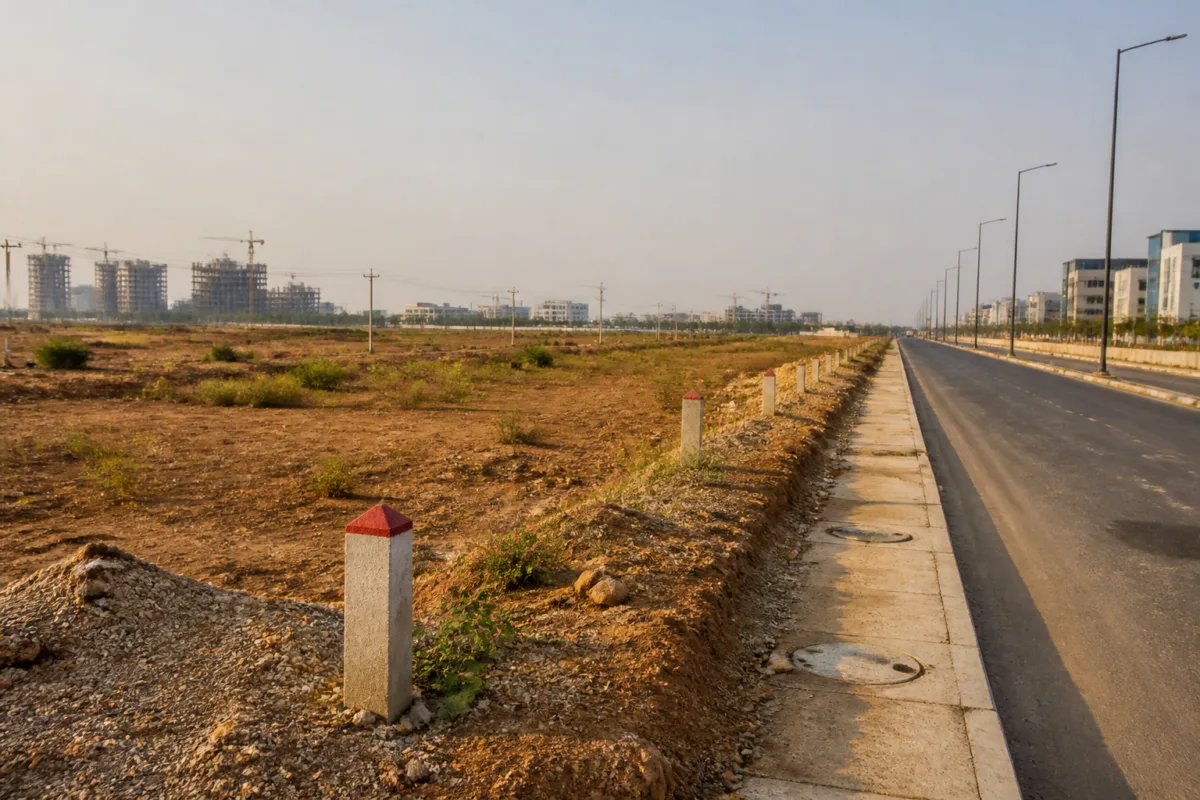
Telangana land monetisation is emerging as a central part of the State government’s response to financial pressure, with Hyderabad’s expanding periphery positioned as both a revenue source and a future infrastructure reserve. The strategy combines government land auctions, private land pooling, industrial-property regularisation and infrastructure development around auction-ready plots. Its central tension is clear: land can generate immediate revenue, but the same land may also be required later for roads, public facilities and planned urban expansion.
The proposals were discussed at a Cabinet sub-committee meeting on revenue mobilisation, according to Telangana Today. The government is looking to unlock the value of existing public assets, including departmental properties, while also identifying land requirements in advance for future projects. In rapidly urbanising areas of Medchal-Malkajgiri and Rangareddy districts, this means attempting to connect land management with infrastructure planning rather than treating each parcel as an isolated asset.
The approach reflects the financial importance of land in the State’s fiscal strategy. Over the last 34 months, the Congress government raised more than Rs 30,000 crore through the monetisation and mortgage of government lands and properties, the report said. The new proposals would extend that strategy by creating a land bank, improving access to selected government plots, and auctioning them after roads and basic infrastructure have been developed.
That sequence matters. A plot without reliable access, roads or surrounding services typically has lower development potential than one connected to the urban network. By investing in infrastructure before auction, the government expects to secure higher prices. In administrative terms, this converts public spending on access and services into a mechanism for raising the value of public land. But it also makes the State responsible for deciding which parcels deserve public investment, which should be preserved, and which can be released without compromising future public needs.
Hyderabad’s metropolitan growth makes those decisions more consequential. The report identifies Medchal-Malkajgiri and Rangareddy as key areas for private land pooling and future infrastructure projects. These districts contain some of the city-region’s fastest-growing peripheral corridors, where urban development frequently expands ahead of coordinated public infrastructure. A land bank could help the government secure sites before rising land values make acquisition more difficult. It could also provide a formal inventory of land required for roads and other projects, instead of leaving public agencies to assemble parcels after projects have already been planned.
The proposed land-pooling model is therefore different from a simple auction programme. Under land pooling, private land is assembled for a larger development purpose, with the value of the resulting urbanisation expected to benefit participating landowners and the public authority in different ways. The supplied report does not specify the terms, compensation structure or legal framework proposed for Telangana’s model. That absence is significant because the feasibility of land pooling depends not only on the availability of land, but also on how ownership, development rights, infrastructure costs and eventual returns are distributed.
The State is also examining industrial properties. The proposals include regularising industrial lands and expediting approvals in older industrial estates such as Azamabad, Balanagar and Hafeezpet. B-category and micro industrial units are expected to be examined as part of the revenue mobilisation effort. This places industrial land at the intersection of two objectives: increasing the value of underused or irregular properties, and retaining space for productive economic activity within a city that is steadily converting older industrial areas to other uses.
The report also points to the scale of the institutional landholding involved. The Hyderabad Metropolitan Development Authority controls around 5,000 acres of prime land in and around Hyderabad, while more than one lakh acres are under the active asset management and monetisation pipeline of the Telangana Industrial Infrastructure Corporation, particularly across high-value corridors in Hyderabad, Rangareddy and Medchal districts. These figures indicate that land monetisation is not a marginal exercise managed by one department. It involves metropolitan planning, industrial infrastructure, revenue administration and the management of departmental assets.
That institutional spread creates both opportunity and risk. Multiple agencies may hold land for different purposes, with different legal conditions, development plans and public obligations. The government has asked departments to identify non-performing assets, auction-ready layouts and plots with better connectivity and development potential. A consolidated inventory could improve visibility over public land. However, the supplied material does not establish how non-performing assets will be defined, how competing departmental claims will be resolved, or what safeguards will apply before land is classified as surplus or auction-ready.
The infrastructure-first element also raises a question about the direction of value capture. The government plans to develop roads and basic infrastructure around selected plots before auctioning them, expecting improved access to fetch higher prices. This is a form of public investment intended to unlock land value. The eventual result will depend on whether the added value is retained for public purposes, used to finance more infrastructure, or primarily reflected in the price paid by private purchasers. The report does not provide the proposed auction design or the mechanism through which future revenue will be allocated.
For Hyderabad’s peripheral districts, the consequences will extend beyond government finances. Land auctions and pooling can shape where new commercial, industrial and residential development takes place. The location of roads and services around public plots can strengthen some corridors while leaving other areas dependent on private or piecemeal infrastructure. Decisions made through a revenue mobilisation programme can therefore influence the geography of urban growth even when the immediate objective is fiscal.
The policy also exposes a basic difference between land as an asset and land as urban infrastructure. A government parcel may have a monetary value today, but it may also serve as a potential site for a road, transport facility, public institution, utility installation or future urban expansion. Monetisation can make public land more productive when it brings idle assets into use. It can weaken long-term planning when short-term revenue requirements override the need to reserve land for public functions. The Cabinet sub-committee’s decision to identify future land requirements in advance suggests that the government recognises this trade-off, although the report does not detail the criteria that will guide it.
The next stage will determine whether the strategy becomes a coordinated land and infrastructure programme or remains a series of asset sales. The important milestones are the creation of the proposed land bank, the identification of departmental assets, the terms for private land pooling, the treatment of industrial properties and the development plans for land held by HMDA and TGIIC. These details will show whether Telangana is using land monetisation to fund planned urbanisation, or primarily using urban growth to meet immediate fiscal pressure.

