


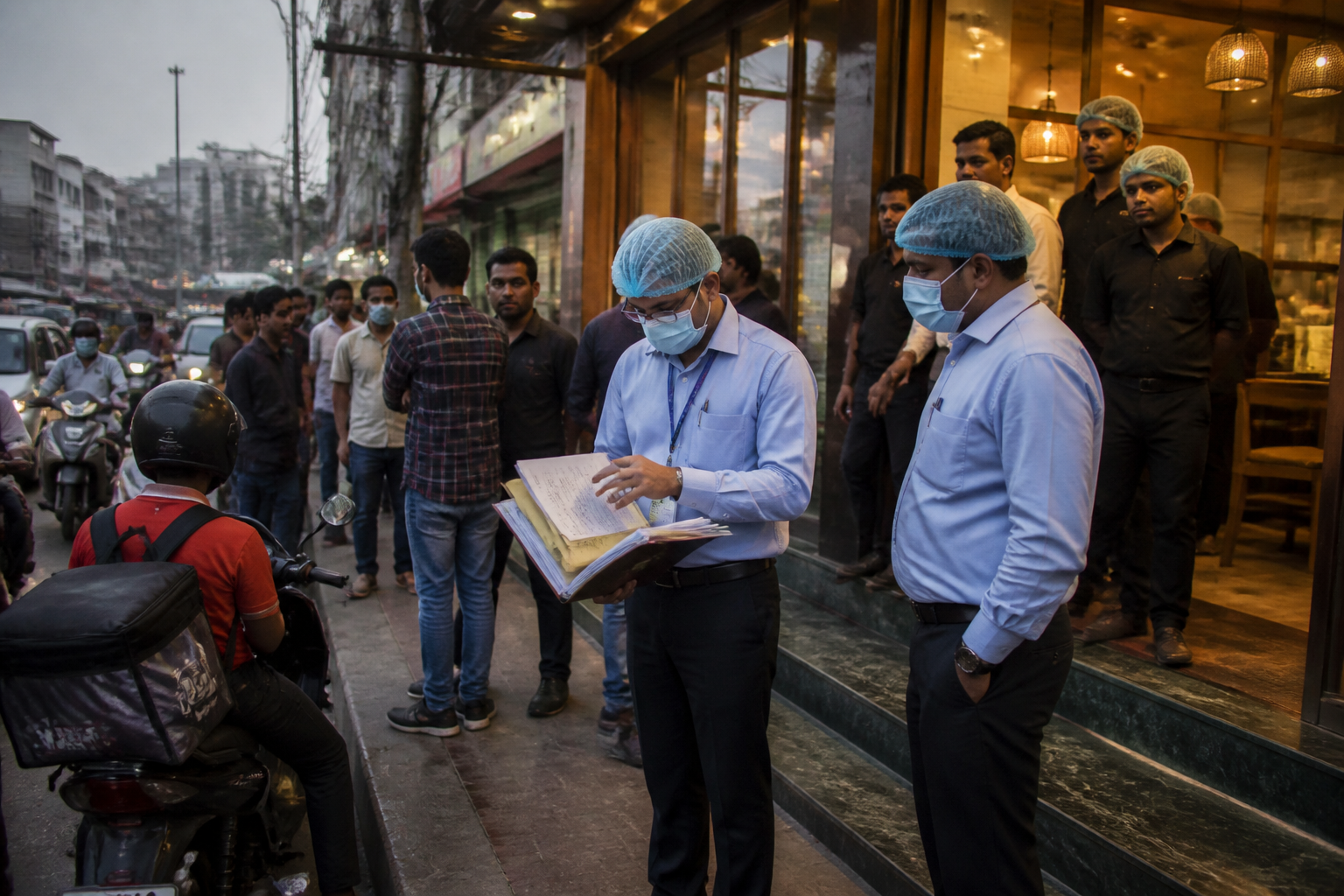
Hyderabad’s restaurant enforcement system is facing a test that begins after an inspection ends. Restaurants whose food licences were suspended, or which were sealed or served closure notices following inspections on Saturday, were reported to have resumed operations by Monday in some cases, raising questions about how municipal corporations and the Telangana Standards Authority for Food and Essential Drugs (TG SAFE) track compliance after action is announced.
The issue is not simply whether inspections are being conducted. It is whether a suspension, sealing order or closure notice produces a reliable change on the ground, and whether customers can distinguish between a restaurant that is legally permitted to operate and one that is trading while enforcement is incomplete. The report shows a gap between regulatory action and public visibility: authorities may identify violations, but customers can still be left uncertain about the status of the premises they enter.
That uncertainty matters because eating outside is not an occasional choice for many urban residents. Students living away from home and employees said they depend on restaurants regularly. Families also described restaurant visits as an important part of their lives. In both situations, customers cannot treat food safety as a question reserved for regulators. They need usable information before ordering or eating.
The reported enforcement sequence exposes several points at which the system can weaken. An inspection may identify a violation. A licence may be suspended or a closure notice may be issued. A premises may then need to be sealed, with officers physically serving the notice. If that physical service takes a day or two, the establishment can remain open during the gap, according to a TG SAFE official quoted in the report. Even where the action is legally initiated, the public-facing result can therefore be delayed.
This distinction between issuing an order and implementing it is central to the Hyderabad case. A regulatory decision has practical value only when the establishment receives the notice, stops operations, remains closed and is visibly identified as non-compliant. The report indicates that officials in some Gachibowli cases said restaurants were closed on Monday after notices were physically served. That explanation establishes that at least some apparent reopening was linked to the time required for service of notices rather than a final decision to permit continued operations. It also shows why the timing of enforcement is difficult for customers to understand.
The response described by officials relies partly on consumers checking information themselves. TG SAFE commissioner Avinash Mohanty advised customers to follow TG SAFE on social media and check a restaurant’s status before visiting. He also said food delivery applications were posting when a restaurant was closed because of licence suspension. These measures can improve access to information, but they also transfer part of the compliance burden to people who may not know which licence applies, when a notice was issued or whether an establishment has been cleared to reopen.
That is especially important because the report describes confusion around licences. Some commercial establishments allegedly told customers that they held trade licences issued by municipal authorities and Food Safety and Standards Authority of India, or FSSAI, licences when they did not. Customers were also reportedly shown documents from unrelated departments, along with certificates and awards issued by lesser-known organisations. A trade licence, a food licence and other certificates do not necessarily answer the same regulatory question. If restaurants display documents without making their scope and validity clear, customers may mistake the existence of one permit for proof of overall compliance.
A request from a Hyderabad resident for licence numbers to be displayed on restaurant name boards, menu cards and websites points to a basic transparency problem. The proposal, cited in the report, would not replace inspections or enforcement. It would give customers a clearer starting point for checking whether the establishment has identified itself accurately. The report does not establish that such a display system currently exists or that a uniform public database is available across municipal areas.
The institutional structure also complicates accountability. Municipal corporations are involved in trade-related licensing and local enforcement, while TG SAFE is identified in the report as the food-safety authority involved in inspections, suspensions and closure-related action. Food delivery platforms may publish closure information, but they are not the same as regulators. Customers therefore encounter several channels of information, each potentially showing a different part of a restaurant’s compliance status.
The report also refers to re-inspections in LB Nagar, where sub-inspectors and constables were sent to check establishments again. Re-inspection is important because an initial inspection identifies a problem, while a follow-up establishes whether the direction has been obeyed. Yet the need to send officers back also illustrates the continuing operational demands of enforcement. Regulatory capacity is not measured only by the number of inspections conducted; it includes the personnel, time and administrative process needed to complete notice service, closure and verification.
The available evidence does not establish how many restaurants reopened, how many were eventually closed, or how long the reported gaps lasted across Hyderabad. It also does not provide a city-wide assessment of compliance, the number of inspections conducted, or the proportion of notices that resulted in confirmed closure. Those limits matter. The report supports concern about follow-up enforcement in specific cases, but it cannot by itself establish that every suspended or sealed restaurant reopened unlawfully or that the enforcement system as a whole failed.
What it does establish is a recurring information problem at street level. Customers may see a functioning restaurant, a displayed certificate or a claim that licences are in place, while the regulator may have issued a suspension or closure notice. Unless the status is current, specific and easy to verify, the visible business operation can become more persuasive than the regulatory record. For residents, that makes compliance a matter of trust rather than something they can independently confirm.
The public-health implications are also unevenly distributed. Students living away from home and employees who eat outside frequently have fewer practical alternatives than occasional diners. They may be more exposed to the consequences of incomplete information because they depend on restaurants as part of their daily routine. Families, meanwhile, may assume that a higher-priced establishment has stronger compliance, although the report records a customer saying that some comparatively expensive restaurants appeared on the offenders list. Price and appearance are therefore not reliable substitutes for verified regulatory status.
The immediate policy question is how authorities close the gap between action and confirmation. The report records official efforts to serve notices, conduct re-inspections and publish status information through social media and delivery applications. It does not say whether these channels are integrated, whether updates occur at the same time, or whether customers can see the precise reason and date for a suspension or closure. Those administrative details determine whether transparency becomes a dependable public service or remains a fragmented collection of announcements.
For Hyderabad’s urban food system, the larger lesson is that enforcement must be designed around the moment when residents make decisions. Inspections and orders are essential, but so are timely notice service, visible closure, verified reopening and a clear public record. Without that chain, a regulatory action can exist on paper while the restaurant continues to appear open to customers.
The evidence currently confirms a problem with follow-up clarity and enforcement timing in reported cases, not a complete city-wide picture of restaurant safety. The next developments to watch are the outcome of re-inspections in areas such as LB Nagar and Gachibowli, the continued publication of restaurant status by TG SAFE, and whether municipal authorities and regulators provide a more consistent way for customers to verify licences before they eat.
