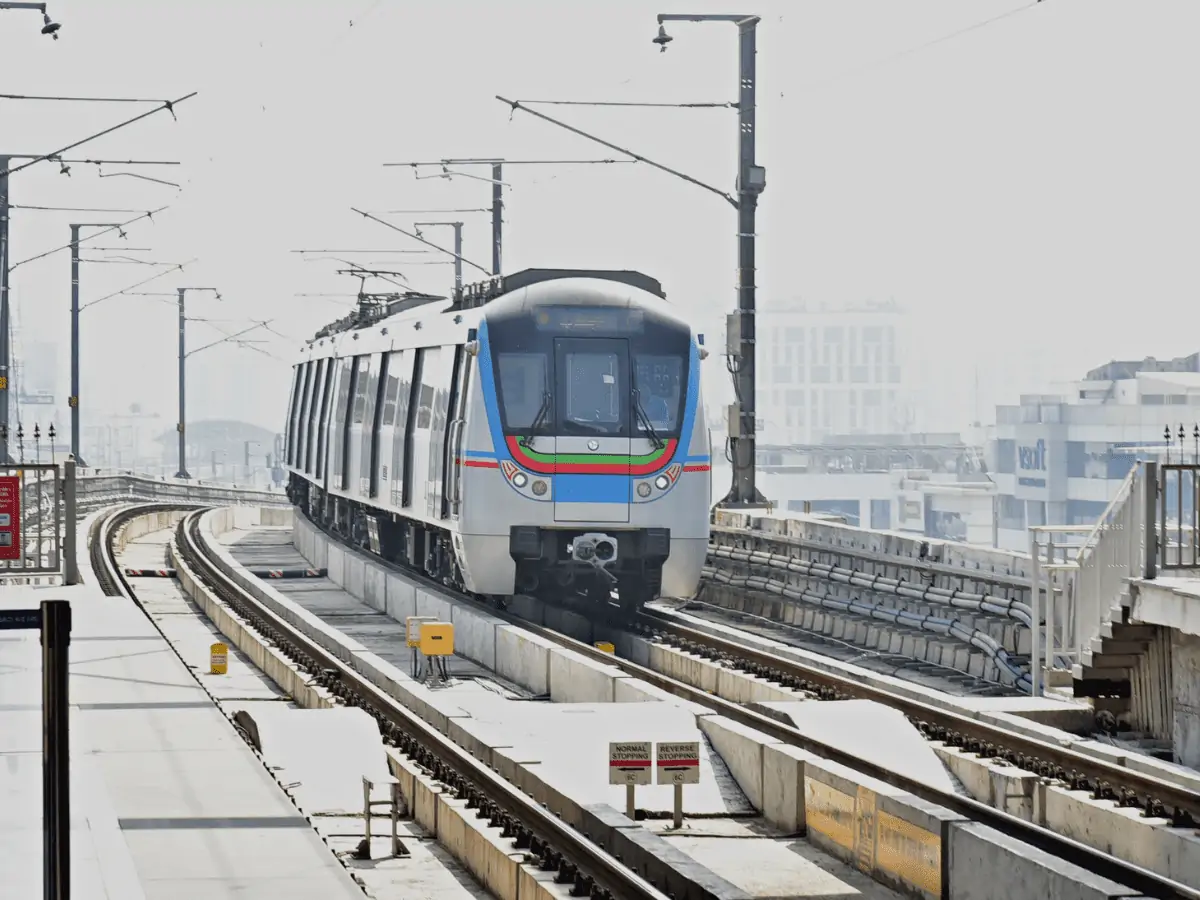
Hyderabad Metro Expansion Push Targets Urban Growth
The Telangana government has taken full ownership of Hyderabad’s metro rail Phase I, acquiring the asset from Larsen & Toubro in a deal that marks a significant shift in how large urban transport systems are financed and managed. The transaction, centred in Hyderabad, is expected to reshape the city’s public mobility strategy while raising questions about long-term financial sustainability and expansion planning.
The agreement involves the purchase of 100% equity in the metro’s operating entity for approximately ₹1,461 crore, alongside the state assuming responsibility for substantial project debt. This effectively transitions the metro from a public-private partnership to a fully state-controlled system, bringing operational and financial decisions under government oversight. Phase I of the Hyderabad Metro spans nearly 69 kilometres and forms the backbone of the city’s mass transit network, connecting key residential and commercial corridors. Since becoming operational in stages from 2017, it has carried hundreds of millions of passengers, playing a central role in reducing travel time across a rapidly expanding urban region. Officials view the takeover as a prerequisite for future expansion. Plans for a second phase—potentially extending the network by over 150 kilometres—require integrated ownership and alignment with central government funding frameworks. Without full control of the existing network, approvals for expansion were unlikely, according to policy observers familiar with urban transport financing.
However, the move also transfers financial risk to the public sector. The metro project carries significant outstanding liabilities, estimated at over ₹13,000 crore, which the state will now refinance or service over time. Urban economists caution that such commitments could impact fiscal space for other infrastructure priorities unless supported by strong ridership growth and diversified revenue streams. The shift reflects a broader rethinking of public-private partnerships in Indian cities. While PPP models have enabled rapid infrastructure creation, revenue uncertainties—especially in mass transit systems dependent on fare income—have often led to renegotiations or exits by private players. Hyderabad’s transition suggests a move towards greater public control in essential urban services where long-term viability may not align with private return expectations.For the city, the implications are immediate and long-term. Integrated planning could improve last-mile connectivity, enable fare rationalisation, and align metro expansion with housing and employment clusters. At the same time, the success of the takeover will depend on operational efficiency, financial discipline, and the ability to embed sustainability into future corridors—through transit-oriented development and reduced carbon mobility.
As Hyderabad continues to grow as a major economic hub, the metro’s evolution will be closely tied to how the city manages congestion, emissions, and equitable access to mobility. The transition to state ownership sets the stage for a more unified transport strategy, but its effectiveness will ultimately be measured by how well it balances expansion ambitions with fiscal and environmental responsibility.