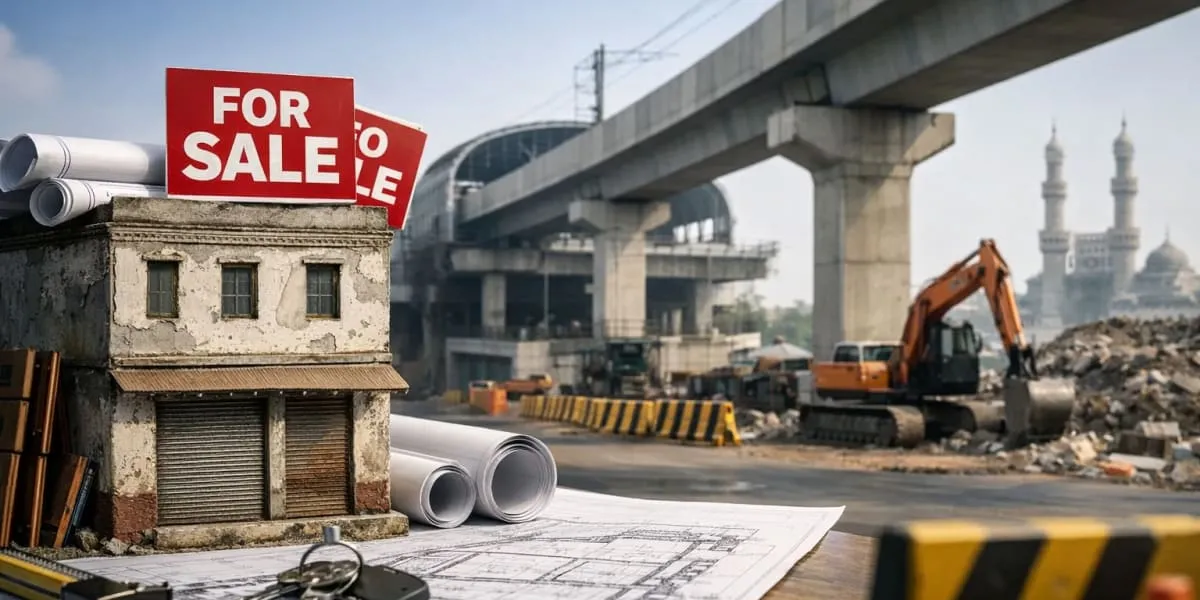
Hyderabad Metro Expansion Awaits Final Property Deals
HYDERABAD: The proposed Hyderabad Metro extension through the Old City is approaching another critical stage, with acquisition of 55 properties still pending for the corridor. The remaining land parcels are important for moving construction forward, highlighting the challenge of balancing major transport infrastructure with property rights and the dense urban fabric of the Old City.
The acquisition process is part of the preparation for the Old City metro corridor, which is intended to extend Hyderabad’s rapid transit network into one of its most established and densely populated areas. Unlike newer parts of the city, the Old City has a tightly built urban environment. Commercial properties, homes, religious structures and narrow streets sit close to one another. Land acquisition for transport infrastructure therefore involves more than securing vacant plots. The remaining properties could affect the pace at which construction activities progress along sections of the alignment. For residents and businesses, the process also has direct implications, particularly where properties are required for stations, road widening or other project-related works. Property acquisition is often one of the most sensitive stages of large urban infrastructure projects. Delays can increase project timelines and costs while creating uncertainty for affected property owners and tenants.
For Hyderabad, however, the corridor carries significance beyond construction schedules. The Old City has a large concentration of residents, businesses and daily commuters. Better mass transit could improve access to employment, education and essential services while reducing dependence on private vehicles. The project also needs to be viewed alongside the wider expansion of Hyderabad’s transport network. As the city grows, metro connectivity can help accommodate rising travel demand without relying entirely on additional road capacity. Urban planners point out that transport projects in established neighbourhoods require careful coordination. Construction planning must account for pedestrian movement, local businesses, traffic diversions and access to homes and community facilities. A people-first acquisition process will therefore be important as the remaining properties are brought into the project. Clear communication, timely compensation and practical rehabilitation measures can reduce disruption for affected communities.
The pending parcels also underline a broader issue facing Hyderabad’s infrastructure expansion. Large projects increasingly have to work within already developed neighbourhoods rather than open land. This makes early land planning and coordination critical to avoiding delays. Once the remaining acquisition issues are addressed, construction can progress with greater certainty. The eventual success of the Old City metro corridor will depend not only on completing the infrastructure but also on how effectively it integrates with existing roads, public transport and neighbourhood-level mobility. For Hyderabad, the immediate priority is to resolve the remaining property requirements while limiting disruption to residents and local commerce. The longer-term opportunity is to ensure that improved metro access supports more inclusive and sustainable growth across the city.