


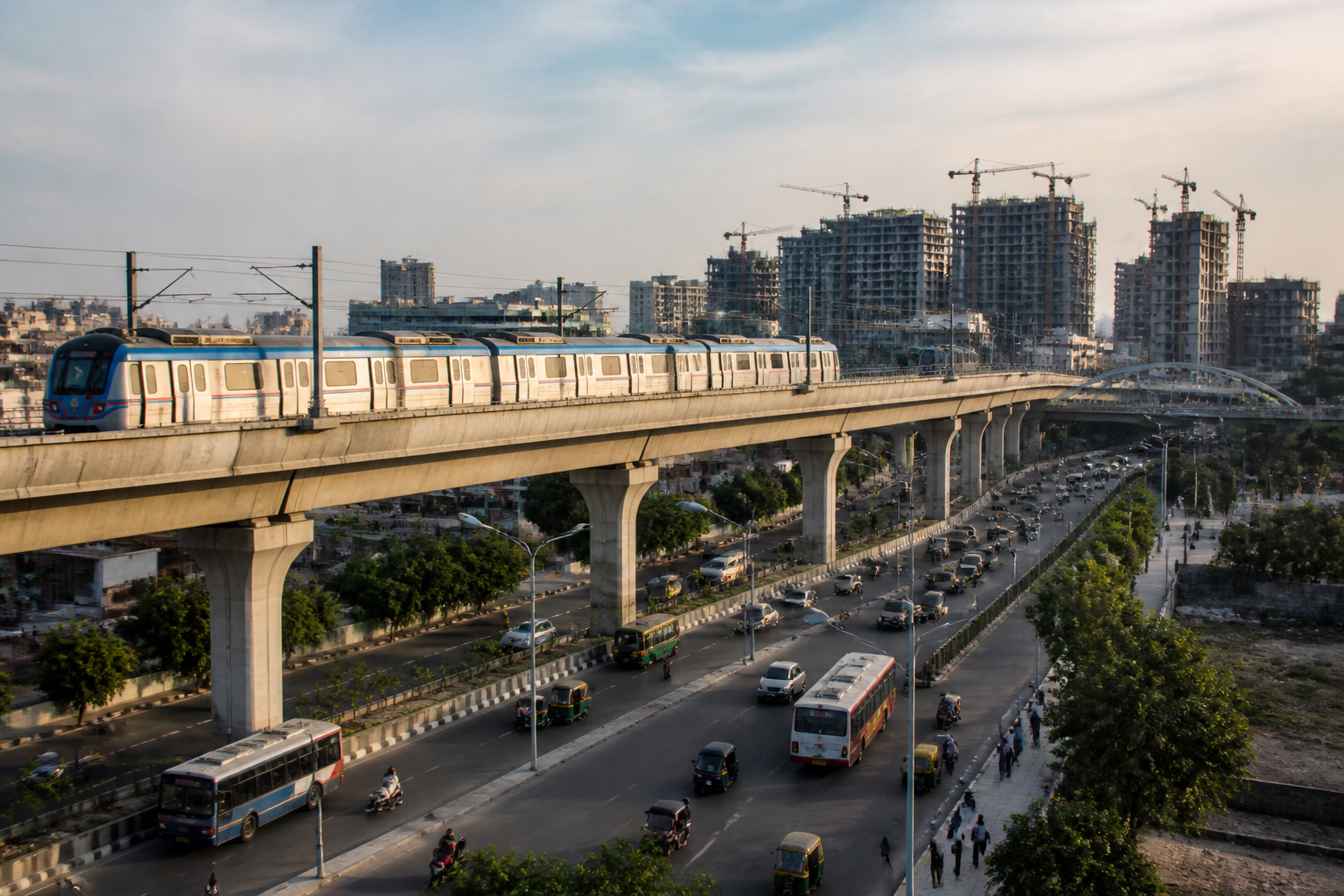
The Telangana government’s latest infrastructure claims place Hyderabad at the centre of a proposed expansion covering roads, metro rail, regional connectivity, water supply and cleaner public transport. Deputy Chief Minister Mallu Bhatti Vikramarka said projects worth Rs 52,000 crore were progressing across the city, while also outlining a 122-km Metro Rail expansion, a 362-km Regional Ring Road and a network of radial roads linking the Outer Ring Road with the new regional corridor.
Taken together, the announcement represents more than a list of individual works. It describes an attempt to reorganise Hyderabad’s growth at several scales: within the Hyderabad Metropolitan Development Authority limits, across the existing urban area and beyond the city into other districts. The challenge is that the announcement provides large headline figures and broad project descriptions, but limited information on timelines, financing, delivery milestones or how the schemes will be coordinated.
The most immediate layer is the infrastructure programme within the HMDA area. According to Bhatti Vikramarka, works worth Rs 35,000 crore had been taken up, including roads, flyovers and bridges. The wider Rs 52,000-crore figure also includes underpasses and drinking water lines. The supplied report does not provide a project-wise breakdown of the total, nor does it clarify whether the Rs 35,000 crore identified within HMDA is a component of the Rs 52,000 crore or a separate figure.
That distinction matters because the numbers point to a major urban investment programme, but cannot by themselves establish the volume of work physically under construction. The Deputy Chief Minister described the works as progressing rapidly, yet the announcement does not state how many projects have reached tendering, construction or completion stages. It also does not identify the agencies responsible for each component or provide completion dates.
Public transport forms the second major layer. The government plans to expand Hyderabad’s Metro Rail network by 122 kilometres under Phase-II at an estimated cost of around Rs 38,000 crore. The proposed corridors would connect the Old City, Rajiv Gandhi International Airport, Patancheru and Hayathnagar. These destinations represent different urban needs: established inner-city areas, an airport connection, an industrial and peripheral growth area, and a large eastern extension of the metropolitan region.
The announcement was made at the launch of a common pass for the Telangana State Road Transport Corporation and Hyderabad Metro Rail. That launch provides a direct link between the expansion of physical infrastructure and the way passengers use the public transport system. A common pass is intended to make transfers between bus and metro services simpler, while the proposed Metro Phase-II would extend the rail network to areas not currently covered by the system.
However, the report does not specify the proposed alignment of the 122-km expansion, station locations, construction packages, implementation schedule or funding arrangement. It therefore establishes the government’s stated intention and estimated cost, but not the full delivery framework. The same distinction applies to the wider infrastructure figure: an announced allocation or estimated project value is not the same as completed capacity available to residents.
The proposed Regional Ring Road adds a different geographic dimension. Bhatti Vikramarka said the 362-km project was being taken up to extend Hyderabad’s development beyond the city limits to other parts of Telangana. The project is estimated to cost Rs 30,627 crore and is described as connecting all districts. The government is also developing 21 radial roads between the Outer Ring Road and the Regional Ring Road. Alignment approvals have reportedly been given for 10 of those roads, while work has commenced on two.
This network suggests a planned hierarchy of movement: the existing Outer Ring Road serving the metropolitan area, radial roads connecting it to a larger outer corridor, and the Regional Ring Road distributing connectivity beyond Hyderabad. Yet the available information does not establish the land-acquisition status, construction timelines, traffic forecasts or the precise role of each radial road. Those details will determine whether the network primarily supports through-traffic, new development, freight movement or urban expansion.
The stated objective of extending development beyond the city limits also raises a governance question. Infrastructure that crosses the metropolitan boundary requires coordination between urban authorities, the state government and agencies responsible for roads and transport. The announcement names the intended geography, but it does not explain the institutional mechanism through which the ring road, radial roads, metro extensions and municipal infrastructure will be planned together.
Water supply is included in the broader infrastructure programme through drinking water lines. The report does not provide the number of kilometres, beneficiary areas, source of supply or implementation agency. That absence makes it difficult to assess how the water component relates to the proposed expansion of roads and transport infrastructure. In a growing metropolitan region, the sequencing of water, roads, housing and public transport can shape where development becomes viable, but the supplied material does not set out that sequencing.
The Musi River is another stated priority. The Deputy Chief Minister said the government had initiated measures for the river’s revival and that Phase-I works had commenced. The report does not describe the scope of Phase-I, its cost, the agencies involved or the locations covered. As a result, the announcement confirms that work has begun according to the government’s statement, while leaving the environmental and urban-development components of the programme unspecified.
The transport and environmental agenda also includes a shift towards electric buses. Bhatti Vikramarka said 550 electric buses had already been introduced in Hyderabad and that another 2,200 would be brought into service. He also said Rs 200 crore had been sanctioned to retrofit diesel auto-rickshaws so that drivers could convert them into electric vehicles.
These figures indicate that the government is approaching emissions reduction through both public transport and commercial passenger vehicles. Electric buses can alter the fuel profile of the bus fleet, while auto-rickshaw retrofitting targets a large group of small operators. But the supplied announcement does not provide the proportion of electric buses in the total fleet, the locations of charging infrastructure, the retrofit terms for drivers or the timeline for introducing the additional 2,200 buses.
The figures also show why implementation details are central to understanding the programme. The proposed metro expansion is estimated at Rs 38,000 crore; the Regional Ring Road at Rs 30,627 crore; and the wider city infrastructure programme is described through a Rs 52,000-crore figure, alongside Rs 35,000 crore of works within HMDA limits. These amounts cannot be added together without knowing whether they overlap. The announcement presents them as parts of a broad development push, but does not provide a consolidated financial statement.
That is the key evidence gap in the current account. The government has outlined a large portfolio of projects and identified several locations, but it has not, in the supplied material, published a unified schedule showing which projects are approved, funded, tendered, under construction or complete. Nor does the report state how the Metro Phase-II estimate, the ring road estimate and the HMDA works figure are distributed across annual budgets or implementing agencies.
For residents, the consequences will depend less on the aggregate value of the announcement than on whether the projects improve daily connectivity and service reliability. The proposed metro destinations could connect central, western, eastern and airport-linked parts of the metropolitan region. The ring roads and radial roads could change the relationship between Hyderabad and surrounding districts. Electric buses and auto-rickshaw retrofits could reduce dependence on diesel, while water and Musi-related works address essential urban services and environmental conditions.
The government’s common-pass initiative offers one concrete example of integration between modes. The larger programme will require the same kind of integration between projects and institutions. A metro corridor that does not connect effectively with buses, roads and pedestrian access will have a different public value from one planned as part of a coordinated network. Similarly, a ring road can extend access beyond the city, but its urban impact depends on how land development, utilities and public services are managed around it.
The announcement therefore confirms an ambitious direction for Hyderabad’s next phase of infrastructure development, but not yet a complete delivery record. It establishes the government’s stated investments, proposed corridors and early implementation claims. What remains to be established are the project-level schedules, financing structures, agency responsibilities, construction progress and measurable service outcomes.
The next milestones identified in the announcement are the continued implementation of Metro Phase-II, the Regional Ring Road and its radial-road network, further electric-bus deployment, auto-rickshaw retrofitting and Phase-I work for the Musi revival. Those milestones will show whether the Rs 52,000-crore infrastructure claim develops into a coordinated metropolitan programme or remains a collection of separately announced projects.
