


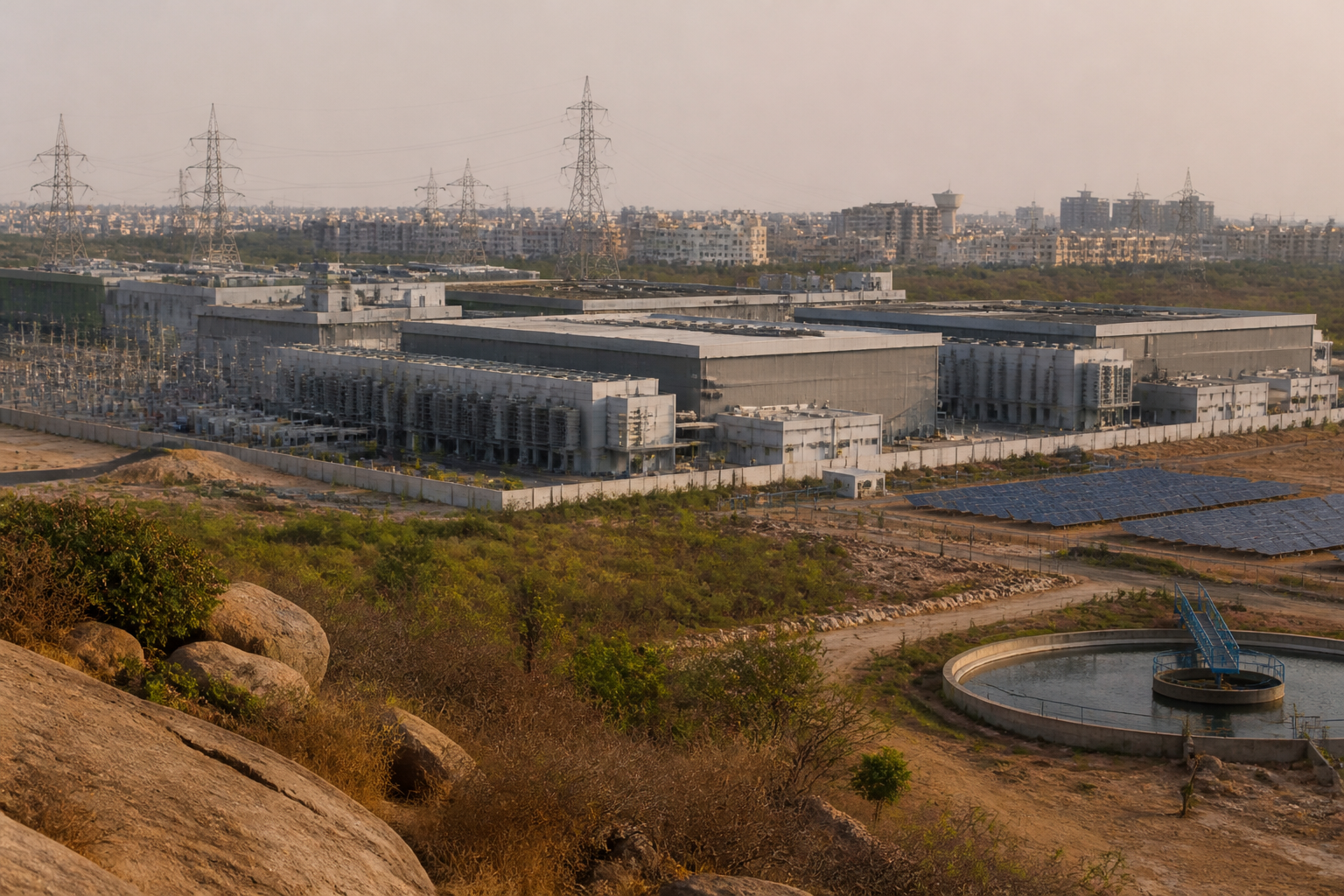
Telangana’s ambition to attract 8–10 GW of data-centre investment is increasingly becoming a test of Hyderabad’s basic urban infrastructure. The state is being ranked among India’s most attractive destinations for data centres, but the same advantages that make the city appealing—its technology ecosystem, fibre connectivity, inland land costs and policy support—now confront sharply rising electricity demand and a projected shortage of water for domestic and industrial use.
The tension is straightforward. Data centres require large, reliable electricity supplies and continuous cooling. Hyderabad’s projected water shortfall is estimated at 240 million gallons per day by 2027–28, while deficient monsoon rainfall has already left major reservoirs supplying the city at low levels. Telangana’s policy promises continuous water supply for heavy-duty cooling systems, but the city’s broader supply outlook raises questions about how that promise can be delivered without intensifying pressure on households, industry and existing urban users.
This makes the data-centre proposal more than a real-estate or technology story. It is a question of whether a city can absorb a new, high-consumption industry while maintaining reliable public utilities. The answer will depend less on the headline investment target than on transmission planning, renewable-energy procurement, cooling technology, water standards and the administrative conditions attached to each project.
Power demand is already moving in the wrong direction for a city seeking to add several gigawatts of electricity-intensive facilities. Telangana recorded an all-time peak power demand of 19,543 MW last month, according to the report, representing a 23 per cent increase over the corresponding day last year. Within Greater Hyderabad Municipal Corporation limits, peak power demand reached 4,782 MW last summer and is projected to cross 5,000 MW next summer.
These figures do not represent data-centre consumption alone. They reflect the total demand placed on the state’s electricity system, including households, commercial establishments and industrial users. But they establish the operating environment in which new data-centre clusters would have to function. A facility that needs uninterrupted power cannot be treated as an isolated building connection; it requires dependable generation, transmission capacity, backup systems and arrangements for managing peak demand.
The energy burden also extends beyond the servers themselves. Cooling systems account for an estimated 40 per cent of a data centre’s electricity consumption. As a result, the scale of the proposed expansion would affect not only power generation but also the transmission network, energy storage, backup infrastructure and the design of the cooling systems installed at each site.
The Union power ministry informed Parliament in July 2026 that artificial intelligence data centres were expected to add 26.3 GW of electricity demand by 2031–32. The additional demand is expected to be integrated into the grid and met primarily through renewable energy. For Telangana, this national trend makes renewable procurement and grid planning central to the data-centre proposition rather than optional sustainability features.
Telangana’s Data Centres Policy is designed to address some of these requirements. It promises dual-grid power supply, access to renewable energy, fibre infrastructure and continuous water supply for cooling systems, alongside fiscal incentives. The policy also provides for renewable-energy procurement through open access, explores captive solar and wind generation, and promises electricity at generation cost for eligible data centres.
The policy architecture has helped Telangana rank alongside Maharashtra, Uttar Pradesh and Gujarat at the top of S&P Global’s Data Centre Policy Attractiveness India Index. The ranking reflects power-related measures, regulatory support, land and capital incentives, and operational assistance. It indicates that the state has built a competitive framework for attracting investors.
But policy attractiveness and infrastructure readiness are different measures. Energy and utilities consultant Dr P. Sridhar said the ranking validated Telangana’s early policy design, while cautioning against relying on incentives without adequate grid infrastructure. He said the state should publish a data-centre-specific transmission and renewable-procurement roadmap before approving further multi-gigawatt clusters.
That distinction matters because a policy can reduce the cost and uncertainty of establishing a facility without guaranteeing that the surrounding utility system can support multiple large facilities at the same time. Dual-grid connections, for instance, improve redundancy at the site level, but they do not by themselves create additional generation or transmission capacity. Similarly, access to renewable energy depends on the availability of supply, the terms of procurement and the infrastructure required to deliver power when generation fluctuates.
The water challenge is more immediate at the city level. Hyderabad is among India’s data-centre markets facing high water stress, and a projection cited in the report estimates a domestic and industrial supply shortfall of 909 million litres per day, equivalent to 240 MGD, by 2027–28. Low reservoir levels following deficient monsoon rainfall add pressure to a system already facing a future gap.
Water use at data centres is closely linked to cooling design. Traditional heavy-duty cooling systems may require continuous water supply, while alternatives include treated wastewater, closed-loop systems, liquid cooling and dry coolers. These technologies do not remove the need for planning, but they can change the volume and quality of water required and reduce dependence on freshwater sources.
The report cites proposals to use treated wastewater wherever feasible, adopt closed-loop or liquid cooling systems, disclose water consumption and conduct environmental assessments. IT solutions architect T. Kiran Reddy said data centres should use recycled water and dry coolers wherever possible, with water audits forming part of the approval process.
Such measures would shift water management from a broad policy promise to a project-level compliance system. A continuous supply commitment is not the same as a transparent allocation framework. The latter would require the state to establish how much water a facility may draw, what quality of water it may use, how consumption will be measured, and what happens when reservoirs or municipal supplies fall below planned levels.
The same institutional question applies to power. Mr Reddy said investors wanted predictable regulations and reliable infrastructure rather than incentives alone. He said global hyperscalers were looking for bankable power contracts, credible renewable supply, transparent water norms and predictable approvals, adding that Telangana could lead if it converted policy commitments into measurable service-level standards.
This is where Hyderabad’s data-centre push intersects with the governance of urban growth. The state government is responsible for policy and investment facilitation, while electricity utilities and transmission agencies must ensure system capacity. Urban water agencies must manage reservoirs, treatment and distribution, and environmental authorities must assess the consequences of large facilities. The investment proposition therefore crosses administrative boundaries that are often managed separately.
The proposed expansion also raises a question about how infrastructure costs are assigned. The supplied report does not establish the financing structure for the additional transmission, renewable, storage or water infrastructure that the data-centre pipeline would require. It does, however, show that the public value of new investment will depend on whether those systems are planned and funded before demand materialises, rather than after local constraints become visible.
For Hyderabad, the data-centre opportunity is therefore both economic and infrastructural. The city has advantages that investors value, including an established technology ecosystem, fibre connectivity, relatively lower inland costs and a growing artificial-intelligence-ready development pipeline. Those strengths explain why Telangana is competing successfully for investment.
But the same growth could expose weaknesses in the city’s utility model. Power demand is rising, cooling adds a substantial electricity burden, and water availability is already under pressure. The policy has identified the services investors require; the next stage is to make their availability measurable, enforceable and resilient during periods of stress.
The evidence currently confirms a strong investment proposition facing significant infrastructure tests. It does not establish whether Telangana has already secured the transmission capacity, renewable contracts or water systems needed for the full 8–10 GW target. The developments to monitor are the publication of a dedicated power and renewable-procurement roadmap, the water norms attached to approvals, the use of treated wastewater and the incorporation of water and energy audits into project operations.
