


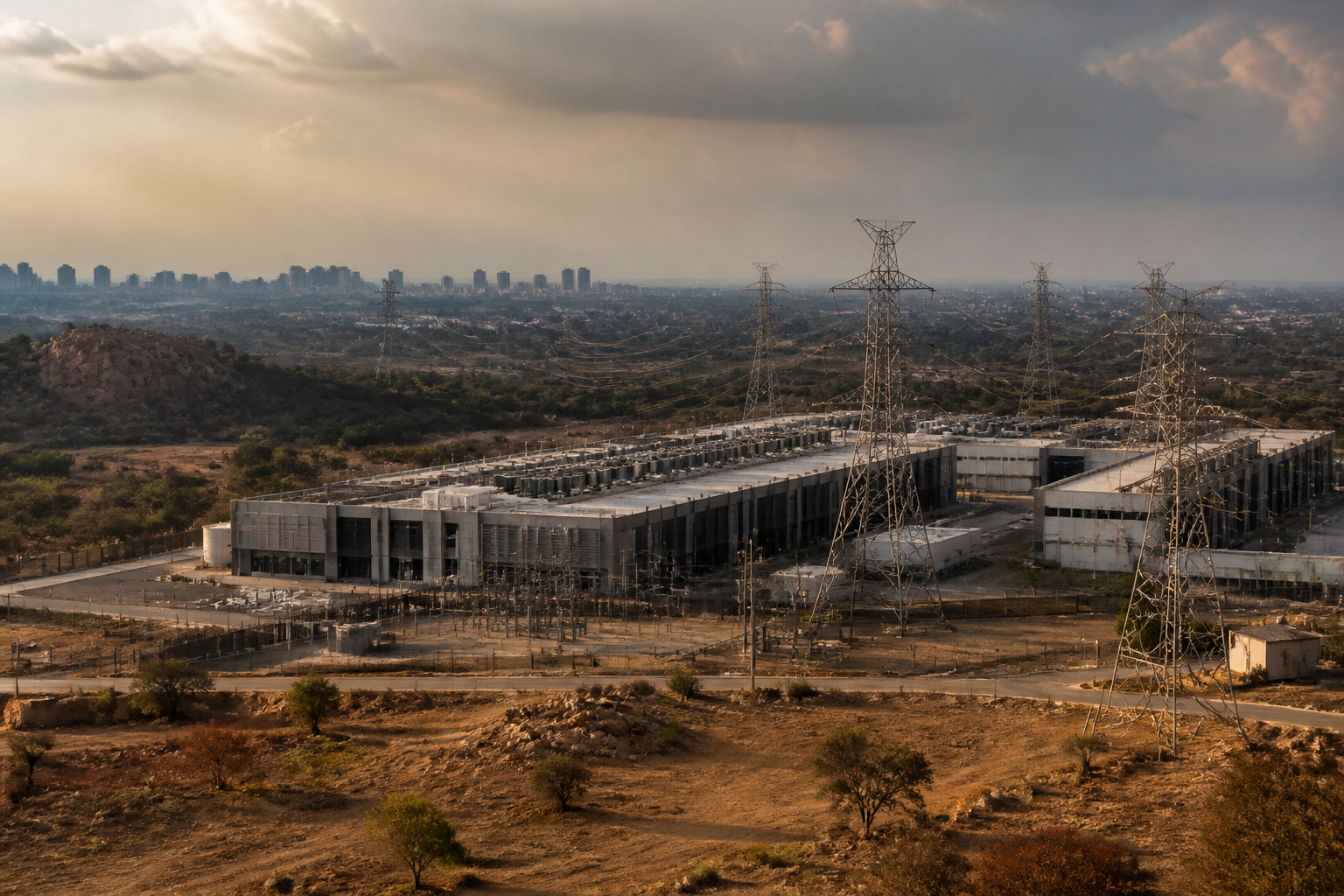
Hyderabad data centres are at the centre of Telangana’s next investment push, but the state’s ambition to attract 8–10 GW of capacity is colliding with two basic urban constraints: electricity reliability and water availability. The challenge is not simply whether Telangana can offer land, incentives and fibre connectivity. It is whether Hyderabad’s power, transmission, renewable-energy and water systems can support large facilities whose operations depend on continuous cooling.
The tension is visible in the state’s recent electricity demand. Telangana recorded an all-time peak power demand of 19,543 MW last month, a 23 per cent increase over the corresponding day a year earlier, according to the report. Within Greater Hyderabad Municipal Corporation limits, peak demand reached 4,782 MW last summer and is projected to cross 5,000 MW next summer. These numbers matter because data centres add a concentrated, round-the-clock load to an electricity system already exposed to seasonal stress and rising demand from homes, businesses and industry.
The proposed investment scale makes the question more significant. An 8–10 GW data-centre build-out would not represent an ordinary commercial real-estate cycle. It would require long-term power contracts, dedicated transmission capacity, backup arrangements, renewable-energy procurement and cooling systems that can operate reliably through extreme heat. The report notes that cooling accounts for an estimated 40 per cent of a data centre’s electricity consumption. That means the infrastructure burden extends beyond the servers themselves to the energy required to remove heat from buildings operating continuously.
Telangana’s policy framework was designed to make the state attractive to this sector. S&P Global placed Telangana alongside Maharashtra, Uttar Pradesh and Gujarat at the top of its Data Centre Policy Attractiveness India Index. The ranking reflects measures covering power, regulatory support, land and capital incentives and operational assistance. Telangana’s Data Centres Policy promises dual-grid power supply, access to renewable energy, fibre infrastructure and continuous water supply for cooling systems. It also provides for renewable-energy procurement through open access, explores captive solar and wind generation, and promises electricity at generation cost for eligible data centres.
Those provisions show why the state has been able to compete for investment. Hyderabad already has an established technology ecosystem, relatively lower inland costs, fibre connectivity and a growing pipeline positioned for artificial-intelligence-related demand. Policy incentives can reduce the initial cost and uncertainty faced by developers. But the report’s central question is whether policy commitments can be converted into measurable, dependable services at the scale investors require.
Energy and utilities consultant Dr P. Sridhar said the state’s high ranking validated its early policy design, but cautioned against relying on incentives without adequate grid infrastructure. He said Telangana should publish a data-centre-specific transmission and renewable-procurement roadmap before approving further multi-gigawatt clusters. That suggestion points to an institutional issue: attracting a project and serving it are separate administrative tasks. The first is often handled through investment promotion and approvals; the second requires coordinated planning by power utilities, transmission agencies, renewable-energy providers and local authorities.
The pressure is not limited to Telangana’s current peak demand. The Union power ministry informed Parliament in July 2026 that artificial-intelligence data centres were expected to add 26.3 GW of electricity demand by 2031–32. The ministry said the additional requirement was expected to be integrated into the grid and met primarily through renewable energy. For Telangana, that national demand projection makes the timing of transmission planning more important. A data-centre strategy based on future renewable supply must also address when power will be available, how it will be contracted, and what happens when renewable generation is intermittent.
The distinction between installed generation and dependable supply is crucial for facilities that cannot tolerate extended interruptions. Telangana’s policy promises dual-grid power supply, but dual connections alone do not establish that the wider system has sufficient generation, transmission headroom or backup capacity. The report does not provide a project-by-project assessment of available capacity, so it does not establish whether the state can immediately support the full proposed investment target. What it does show is that the investment ambition is moving faster than the publicly described infrastructure roadmap.
Water creates a parallel constraint. Hyderabad is projected to face a domestic and industrial water-supply shortfall of 909 million litres per day, equivalent to 240 million gallons per day, by 2027–28, according to an estimate cited in the report. Deficient monsoon rainfall has also left major reservoirs supplying the city at low levels. At the same time, Telangana’s data-centre policy promises continuous water supply for heavy-duty cooling systems. The contrast raises a direct planning question: how should new, high-consumption industrial users be accommodated when existing urban demand is already expected to exceed supply?
The answer cannot be reduced to whether a data centre has access to a water connection. Cooling design determines how much freshwater a facility consumes, how much water is recirculated and whether treated wastewater can replace potable or reservoir-supplied water. The measures cited in the report include using treated wastewater wherever feasible, adopting closed-loop or liquid-cooling systems, disclosing water consumption and conducting environmental assessments. These are not merely technical choices. They determine whether data-centre growth increases competition for municipal water or can be separated from the city’s drinking-water system.
IT solutions architect T. Kiran Reddy said investors wanted predictable regulations and reliable infrastructure rather than incentives alone. He identified bankable power contracts, credible renewable supply, transparent water norms and predictable approvals as requirements for global hyperscalers. He also said data centres should use recycled water and dry coolers wherever possible, with water audits forming part of the approval process. His comments reinforce the difference between a policy promise and a service-level standard that can be monitored after approval.
This is where the governance architecture becomes important. Data-centre approvals typically involve several forms of infrastructure and regulation at once: land and building permissions, electricity connections, transmission planning, renewable-energy procurement, water allocation, wastewater management and environmental assessment. A single investment-promotion agency may help coordinate approvals, but it cannot substitute for capacity planning by the agencies responsible for each utility. If these decisions are made independently, the city may approve buildings before the supporting systems have been secured.
The report does not establish that Hyderabad’s data-centre expansion has already caused a power or water shortage. It establishes a prospective mismatch between planned growth and projected utility stress. The electricity figures describe rising demand and a higher expected peak within GHMC. The water estimate describes a future shortfall in domestic and industrial supply. The data-centre policy describes guaranteed or assisted access to utilities. Together, they show why approvals for large clusters require a common assessment of cumulative demand rather than a facility-by-facility approach.
The issue also changes the meaning of “green” data-centre growth. Renewable-energy procurement can reduce the carbon intensity of electricity, but it does not automatically solve transmission congestion, backup requirements or water consumption. Similarly, efficient cooling can lower electricity demand without eliminating the need for cooling water. The state’s challenge is therefore multi-dimensional: energy efficiency, renewable procurement, grid reinforcement, water reuse and transparent disclosure must work together if the sector is to expand without shifting hidden costs onto the wider city.
For Hyderabad, the larger urban question is whether a technology investment strategy can be aligned with the physical limits of the metropolis. Data centres may bring capital, strengthen the technology ecosystem and support the growth of artificial-intelligence services. But their infrastructure needs are unusually continuous and concentrated. They must be assessed alongside household and industrial demand, reservoir conditions, transmission investments and the city’s ability to treat and reuse water.
The evidence currently supports two conclusions. Telangana has built a policy platform that makes it a strong contender for data-centre investment, and Hyderabad has locational advantages that investors value. At the same time, the state’s projected growth will test whether those policy commitments are backed by sufficient grid capacity, renewable procurement arrangements and water-management systems. The next milestones are a data-centre-specific transmission and renewable roadmap, clearer water norms, and approval processes that measure cumulative power and water demand before further multi-gigawatt clusters are sanctioned.
