


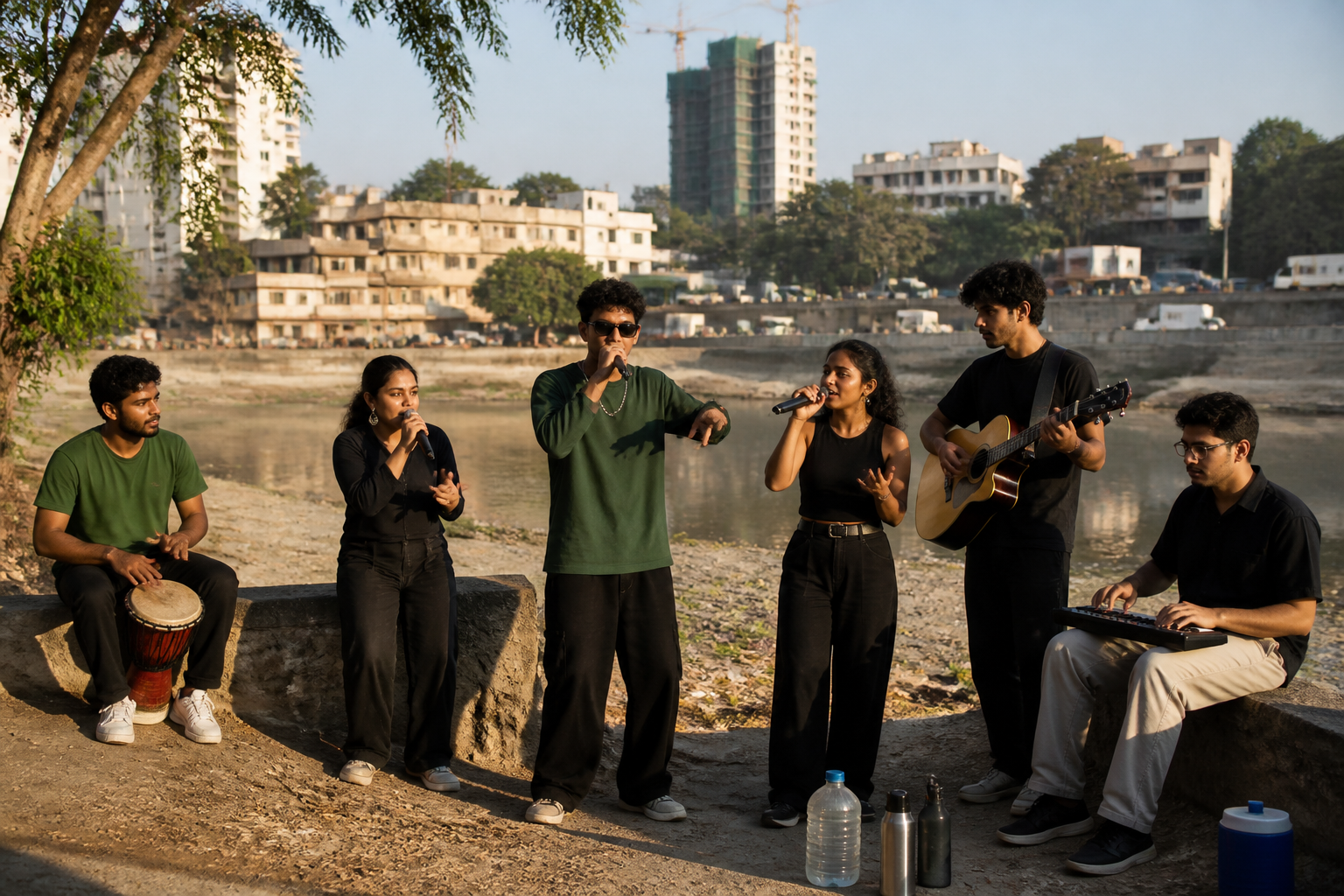
Climate change in Indian cities is no longer presented only through temperature records, policy documents or disaster warnings. In a new climate-focused music project, six young Indian artistes turn heatwaves, water shortages, polluted surroundings, disappearing trees and expanding construction into stories about how environmental change is experienced in everyday urban life.
The project brings together rap and other musical forms from Bengaluru, Delhi, Maharashtra, Tamil Nadu and Mumbai. Its significance lies not simply in using music to communicate climate concerns, but in the questions the songs raise about who experiences environmental damage first, who has the resources to adapt and whose definition of development is being protected.
For a generation growing up with these changes, climate disruption is not framed as a distant future. The artistes describe it through the air people breathe, the water they struggle to access, the landscapes they have watched disappear and the rising cost of staying safe and comfortable. That framing places climate change inside the urban systems that shape daily life: housing and neighbourhoods, public space, water supply, energy access, construction and mobility.
### From climate awareness to lived experience
The project’s central argument is that awareness alone does not necessarily produce engagement. Abisha of the Bengaluru-linked collective Sollisai Sistahs says music can make a large and distant issue personal. Her description of art as political points to the role of cultural work in connecting environmental change with questions of power and public action.
Kali makes a similar point from a working-class perspective. He says his music is intended for working-class people and that he has simplified his approach by combining humour with everyday reality. This matters because climate communication often depends on technical language that can distance people from the issue. The songs instead use familiar experiences—heat, water shortages, power cuts and the struggle to stay cool—to make environmental risk more recognisable.
Gamak Sinha, whose song gives soil a voice, says one song cannot solve a problem as large as climate change. Her stated objective is more limited but still important: if music makes even a few people feel strongly enough to think or act differently, it has achieved something meaningful. That distinction keeps the project from presenting culture as a substitute for public policy. It positions music as a way to create emotional and social attention around problems that institutions must still address.
The artistes also describe how creating the songs altered their own understanding of the places around them. Gamak speaks of trees being cut and construction replacing natural spaces. Abisha refers to heat, disappearing water bodies, changing weather and the ways people adapt. These observations connect environmental decline to visible changes in the built environment rather than treating climate change as an abstract atmospheric process.
### The city as a climate inequality map
The strongest urban dimension of the project emerges from the way different songs locate climate change in specific places and communities. Kali’s Kannada rap, “Neer Kodu”, meaning “give water”, draws on his experience of growing up in Laggeri in Bengaluru. The song describes access to water as shaped by money and caste, while also addressing power cuts, rising heat and the difficulty of staying cool.
This account shows that the effects of climate stress do not arrive evenly across a city. A shortage may be experienced as an inconvenience by one household and as a threat to health, work and dignity by another. The source report does not provide comparative water-access data, but Kali’s account identifies the institutional and social filters through which an urban climate problem is distributed.
The song by Sollisai Sistahs uses the neem tree as a symbol of shade, community and shared natural space. Its themes include urban heat, water scarcity, disappearing lakes and trees, floods and the unequal impact of climate change. It also links these issues with caste, class, gender and labour, arguing that communities that have contributed least to the crisis can face some of its heaviest consequences.
That connection is significant for cities because climate resilience is often discussed through infrastructure alone. Drains, reservoirs, cooling systems and flood-control measures are essential, but the songs ask a prior question: who receives protection, and who is left to manage risk through informal arrangements, reduced consumption or physical endurance? The material supplied for the project does not establish a policy answer, but it clearly identifies unequal exposure as a central urban concern.
### Development, land and disappearing ecological systems
Several tracks connect environmental damage to the transformation of land. Naveen Koomar’s Haryanvi rap, “Vann Katte”, draws on his childhood memories of Firozpur Jhirka and the changing Aravalli landscape. It addresses mining, real estate and rapid urbanisation, while asking whose development is being celebrated when natural systems are damaged.
The song’s focus is not simply on the loss of a landscape. It questions the terms through which development is described. When hills, forests or open spaces are treated primarily as land for construction or extraction, the environmental costs may not appear in the immediate project narrative. The source report does not quantify the land lost or identify a specific development decision, but it presents the tension between real estate expansion and ecological continuity as a recurring theme.
Devanshi’s Marathi track, “Nisargacha Kaayda”, meaning “law of nature”, widens that question beyond cities. It refers to animals entering human settlements, farmer suicides, indigenous communities losing land, deforestation and mining in Maharashtra, including the Konkan and Vidarbha regions. These subjects show how urban consumption and expansion are connected to rural and ecological pressures, even when the effects are not visible within city limits.
Gamak’s “Mitti” takes another route by imagining soil as a witness to discovery, creation, exploitation and destruction. By treating soil as more than a resource, the song brings attention to an urban element that is often hidden beneath roads, buildings and paved surfaces. The report does not claim that the track represents a scientific assessment of soil degradation. Its value is interpretive: it makes an overlooked physical foundation of the built environment part of the climate conversation.
### Pollution, health and the cost of adaptation
Alkama’s “Nasht Environment” focuses on pollution in south-east Delhi. The rapper describes growing up with polluted air, water and surroundings as part of everyday life. The song channels frustration and helplessness but attempts to convert environmental grief into awareness and action.
Devanshi similarly identifies worsening air quality, health problems and water becoming more expensive and less available. Her concern is directed towards future generations, including her 10-year-old sister. These accounts place health and affordability alongside environmental quality. Climate stress is therefore not limited to extreme events; it can also appear as a daily increase in the cost of water, the need to avoid polluted air or the loss of safe outdoor space.
Kali’s reflections extend the discussion to the resource demands of technology. He says that making the song led him to think about artificial intelligence, its water consumption and its impact on heat. The report does not provide figures or a specific assessment of AI-related resource use, so the point remains an area of concern raised by the artiste rather than an established finding in this account. It nevertheless shows how climate awareness is expanding to include the hidden infrastructure behind digital services.
### What the project reveals about urban climate communication
The six songs do not constitute a climate policy programme, and the supplied report does not present them as one. Their importance lies in the evidence they provide about how young artistes understand environmental change through place, class, language and memory. Kannada, Marathi, Haryanvi, Hindi, Tamil and Tamil-Kannada forms are used to reach audiences through cultural contexts rather than through a single national vocabulary.
That approach also challenges the idea that climate communication must be uniform. A water-access story from Laggeri, a reflection on the Aravallis, a pollution account from south-east Delhi and a song about shade under a neem tree describe different urban and regional realities. Together, they show that climate change is experienced through local systems, even when the underlying crisis is global.
For planners and public agencies, the questions raised by the project are institutional as much as cultural. Who has reliable access to water during shortages? Which communities live closest to pollution or construction-related loss of natural space? How are lakes, trees, soil and shade valued in urban decisions? What protections reach people whose work and homes expose them to heat? The source material does not answer these questions, but it demonstrates why they cannot be separated from climate policy.
The evidence presented is primarily testimonial and artistic rather than statistical. It should not be read as a substitute for official measurements, health studies, water data or environmental assessments. Its contribution is different: it records how climate pressures are being interpreted by young people who encounter them through neighbourhoods, family concerns, cultural memory and changing landscapes.
The project ultimately confirms a shift in the public language of climate change. Heat, water, pollution, floods and ecological loss are no longer treated only as future risks. They are being described as present conditions that expose existing inequalities in cities and surrounding regions. The next question for institutions is whether these experiences will remain cultural expressions or become part of the evidence used to shape urban planning, environmental protection and public services.
