


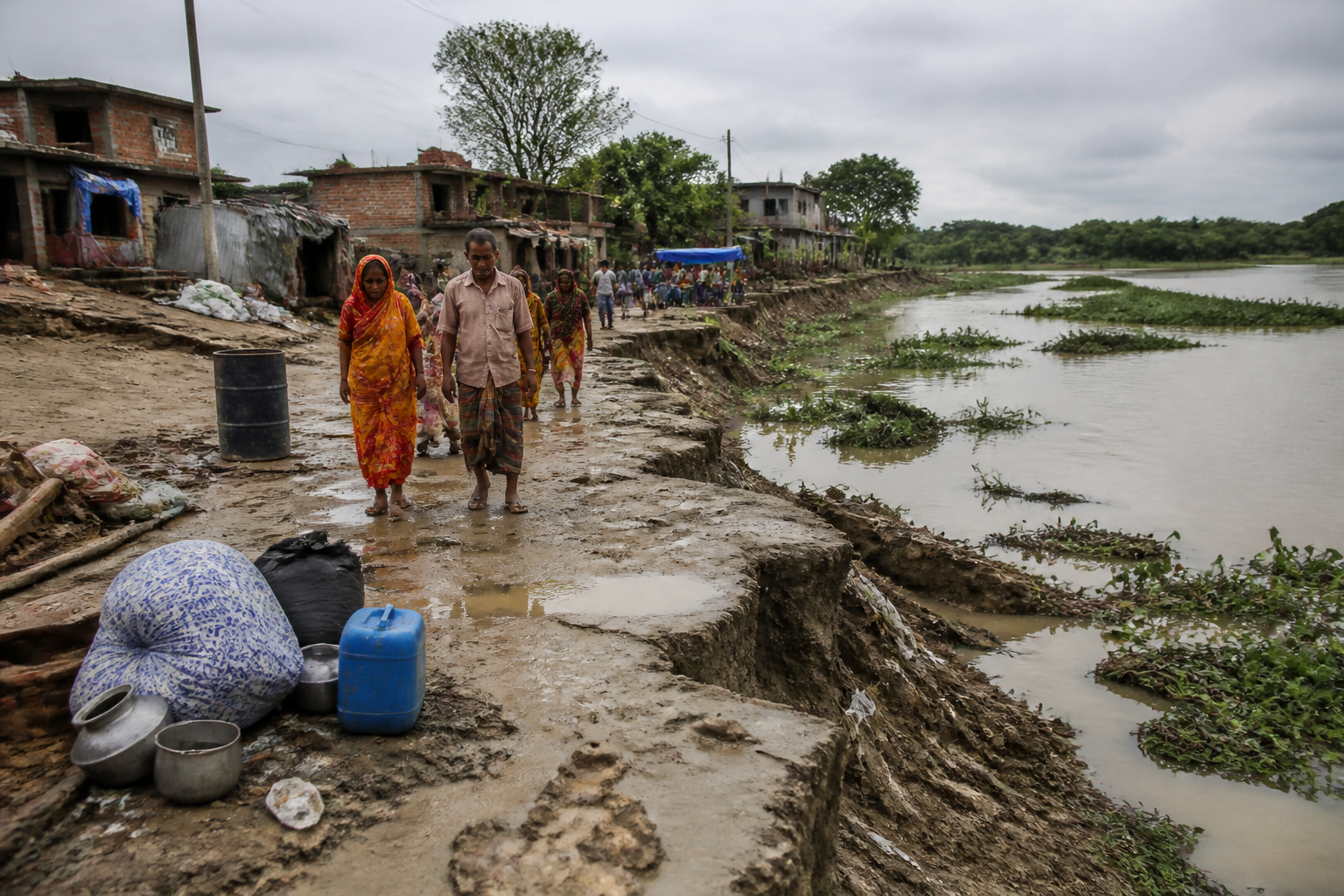
The compensation announced for flood and riverbank-erosion victims in Bhutni, Malda, offers immediate relief to families whose homes, farmland and livelihoods were damaged, but the scale of the response also exposes a deeper problem: for communities living behind vulnerable embankments, disaster support is arriving after a recurring failure rather than replacing the conditions that produce it.
According to a report by Anandabazar, around 25,000 people affected by flooding and erosion in Bhutni received financial assistance after the Kesharpur ring embankment breached on 3 September. The breach allowed Ganga water to enter settlements across three gram panchayats in Manikchak, leaving residents waterlogged for nearly two weeks. The report said homes were damaged, agricultural land was submerged and many families lost most of their possessions.
The reported package distinguishes between fully and partially damaged households. Families assessed as fully affected were to receive ₹1.8 lakh, while those classified as partially affected were to receive ₹90,000 directly in their bank accounts after the damage assessment. The state government has allocated ₹242 crore for assistance to people affected by the floods, the report said.
That direct-transfer mechanism is important because relief administration often becomes another source of delay for disaster-hit households. In Bhutni, the reported instruction was that affected people should not have to repeatedly visit government offices. Payments were made after damage assessments, allowing the state to connect the administrative record of loss with the delivery of compensation. The arrangement does not remove the challenge of assessing damage accurately, but it places the assessment and transfer process at the centre of the relief response.
The immediate needs described in the report extend beyond cash. Food and mosquito nets were distributed before the Durga Puja festival, while clothing was provided to 5,000 flood-affected families. These measures reflect the layered nature of displacement after a flood. A damaged house creates a shelter crisis; standing water creates public-health risks; submerged farmland threatens future income; and the loss of household goods makes recovery more expensive even after the water recedes.
The Bhutni episode also shows why flood reporting cannot stop at the announcement of compensation. The Kesharpur ring embankment reportedly suffered a breach measuring 1,400 metres. An embankment is not simply a piece of flood-control infrastructure. It is a boundary between settlement and river, agriculture and water, and everyday economic activity and emergency displacement. When it fails, the consequences spread across housing, mobility, food security, public health and local administration at the same time.
The report presents Bhutni as a place where flooding returns with the monsoon. That recurring pattern changes the meaning of relief. A one-time payment can help a family repair a house or replace essential belongings, but it cannot by itself resolve repeated exposure to riverbank erosion or embankment failure. The state’s longer-term response, therefore, will be judged not only by the speed of transfers but also by whether reconstruction reduces the risk of another evacuation.
The reported government plan is to rebuild the damaged embankment and undertake erosion-control work with advice from a specialist team from IIT Kanpur. The chief minister was quoted as saying that a proposal worth ₹3,300 crore had been sent to the Centre and that ₹500 crore had so far been approved. These figures indicate that the administration views the problem as a major infrastructure requirement rather than a local repair alone. The supplied report, however, does not provide the project design, construction schedule, funding release details or the agency responsible for execution.
That missing implementation detail matters. Embankment reconstruction requires decisions about alignment, materials, land, river behaviour, maintenance and the protection of settlements during construction. It also requires clarity on how responsibilities are divided between state departments, district administration, disaster-management agencies and central funding mechanisms. Without those details, the compensation package can be assessed as an immediate response, but the durability of the proposed protection remains unestablished in the supplied material.
The same distinction applies to the agricultural response. The report said paddy cultivation would not be possible in Bhutni this year because of the flooding. The administration has instructed the agriculture and food-processing departments to make arrangements for pulses such as black gram and green gram, as well as jute cultivation. This is an attempt to respond to a changed cropping cycle rather than assume that farmers can return immediately to their normal pattern.
For households dependent on agriculture, the loss is not limited to the current harvest. Flooding can delay sowing, reduce access to fields, damage stored inputs and interrupt local trade. A shift to alternative crops may provide a recovery pathway, but the report does not establish the availability of seeds, credit, irrigation, procurement or market access. Those operational questions will determine whether crop diversification becomes practical assistance or remains an administrative instruction.
The Bhutni case also brings disaster governance into focus. The chief minister credited disaster-response forces and central and state agencies with working together during the crisis, while specifically mentioning Joel Murmu and Khagen Murmu. Such coordination is essential during inundation, when rescue, shelter, health support, damage assessment and financial relief have to proceed in parallel. Yet emergency coordination and long-term risk reduction are different administrative tasks. A successful rescue operation does not necessarily create a safer settlement, just as a compensation transfer does not guarantee a rebuilt livelihood.
The reported political criticism of the previous government is part of the public statement surrounding the package, but it does not answer the central institutional question: who is accountable for maintaining the embankment between disasters? Repeated flooding creates a cycle in which the state spends on relief after a breach, reconstruction after damage and livelihood support after crop loss. The evidence supplied in the report does not quantify how often the embankment has failed, how much has previously been spent on repairs, or whether earlier interventions changed the risk profile.
Those gaps are significant because the reported ₹242-crore relief allocation and the proposed ₹3,300-crore erosion-control programme belong to different stages of the same risk system. Relief addresses immediate loss. Embankment work addresses physical exposure. Agricultural support addresses income recovery. A durable response requires these interventions to be planned together, with clear milestones and public information on what has been sanctioned, released, constructed and maintained.
The Bhutni announcement therefore represents both a relief measure and an administrative test. The direct payments may help affected families repair homes and stabilise household consumption before the festival. Food, mosquito nets and clothing respond to immediate living conditions. Alternative-crop planning recognises that recovery will continue beyond the end of the flood. But the longer-term significance will depend on whether the damaged 1,400-metre stretch is rebuilt through a credible, maintained and properly funded programme.
What the available evidence confirms is the extent of the immediate response: about 25,000 affected people, a ₹242-crore compensation package, differentiated payments for full and partial damage, support for 5,000 families, and a wider proposal for erosion control. What remains unclear is the delivery timetable, the engineering design, the institutional division of responsibility and the safeguards against another cycle of flooding. Those are the developments that will determine whether Bhutni’s latest relief operation becomes a step towards resilience or another temporary pause before the next monsoon crisis.
