


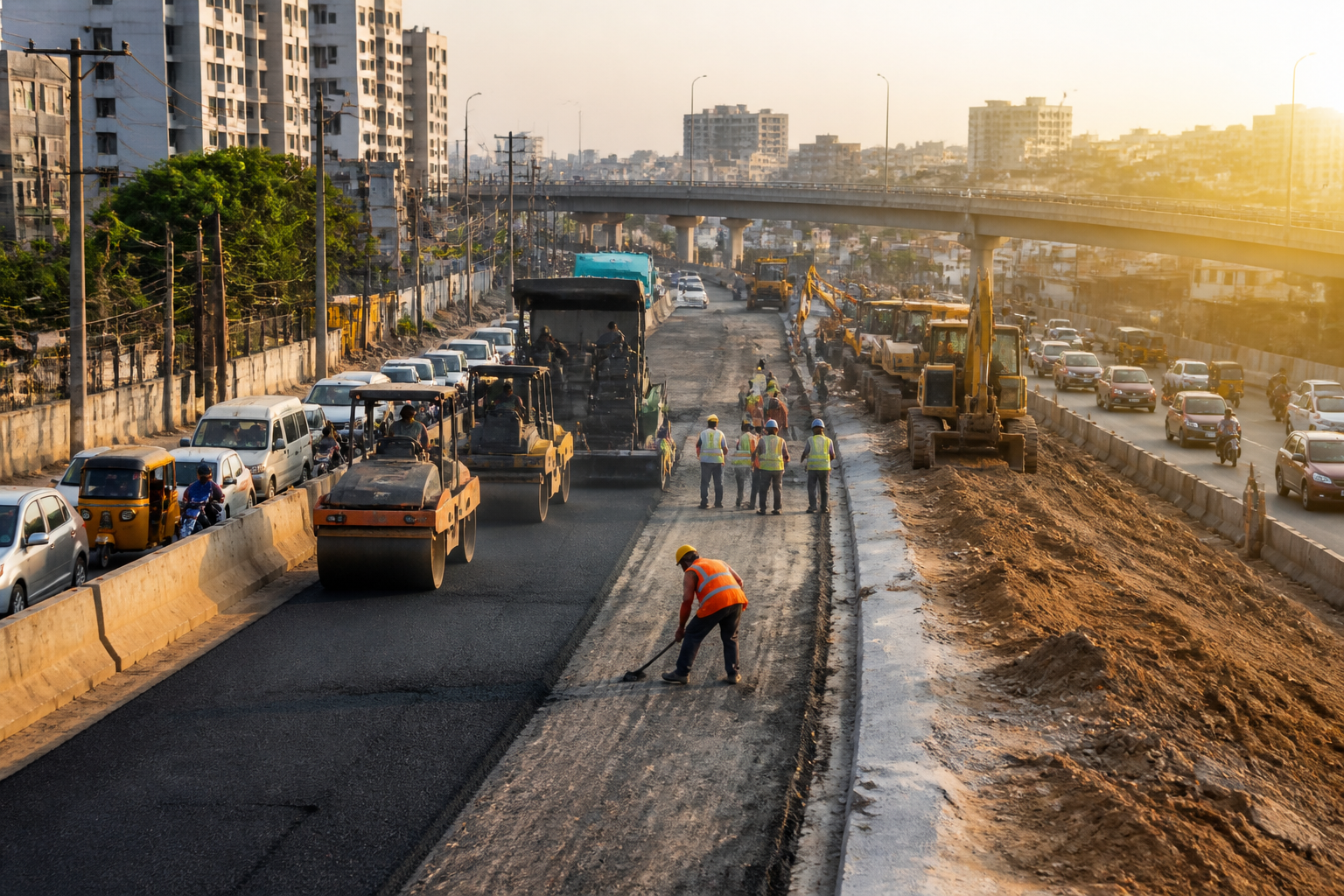
A representation seeking a Vigilance and Enforcement inquiry into the Hyderabad Road Development Corporation Limited’s finances and tendering has brought a broader institutional question into focus: how should Hyderabad plan, finance and audit road works when responsibilities are spread across multiple public agencies?
The Forum for Good Governance has alleged irregularities in HRDCL’s tendering process and a possible loss of about ₹300 crore to the government. The allegation relates to the cancellation and re-tendering of 13 road works that were initially divided into smaller contracts and later combined into larger packages. The forum has asked Chief Minister A. Revanth Reddy to order a comprehensive inquiry into HRDCL’s loans, expenditure, administrative functioning and tender decisions.
The allegations have not been established by an independent inquiry. They are contained in a representation submitted by FGG president M. Padmanabha Reddy to the Chief Minister. However, the details cited in the representation offer a useful view of the governance and procurement questions that arise when a special-purpose corporation operates alongside established municipal and departmental agencies.
HRDCL was created through a government order on March 11, 2017, as a special-purpose vehicle for the construction and maintenance of roads in Hyderabad. According to the FGG representation, the corporation has obtained loans close to ₹5,000 crore since its constitution. The forum has questioned why details of these borrowings, the expenditure incurred and the works completed were not reflected in the State Budget or discussed in the Legislative Assembly.
This concern is central to the accountability issue. Borrowing allows infrastructure work to proceed outside the immediate limits of annual budget allocations, but it also creates long-term repayment and oversight obligations. The material supplied in the representation does not establish the precise terms of HRDCL’s loans, the repayment schedule, the interest burden or the total expenditure against each borrowing. Those details would be important for assessing the corporation’s financial position, but they are among the matters the forum wants examined.
The institutional overlap is equally significant. The FGG has pointed to the Greater Hyderabad Municipal Corporation Act, 1955, under which roads and streets within city limits fall under GHMC’s jurisdiction. It has also noted that the Roads and Buildings Department has a road network of about 600 km within Hyderabad. Against this existing administrative structure, the forum has questioned the need for another agency, HRDCL, to undertake road works in the city.
The issue is not simply whether more than one agency can build roads. Large cities often use specialised agencies to raise finance, execute major projects or manage infrastructure programmes. The governance question is whether the roles of each agency are clearly defined, whether work is assigned through a transparent framework and whether citizens and legislators can trace responsibility for costs, timelines, quality and maintenance. In the material available, FGG argues that HRDCL has taken up works that should have been undertaken by GHMC. The representation asks the government to examine the reasons for this arrangement.
The tender sequence described by the forum forms the basis of the alleged financial loss. HRDCL obtained a ₹1,500-crore loan in 2025, according to the representation. In the first stage of tendering, contractors quoted prices about 7% below the estimated contract value. In a second stage, tenders were invited for 13 works, with individual estimated values ranging from ₹2 crore to ₹42 crore. Several small contractors participated, and the quoted prices were reported to be between 4% and 18% below the estimates.
The FGG alleges that these tenders were then cancelled, the 13 works were clubbed into larger packages and the tender conditions were modified before fresh bids were invited. The forum has said this change appeared to favour larger contractors. That is an allegation, not a finding. Establishing whether the changes were justified would require the original tender documents, the revised conditions, technical and administrative approvals, evaluation records and the reasons recorded for cancelling the first process.
The figures in the re-tendering provide the immediate basis for the forum’s calculation. Package-I had an estimated value of ₹487.74 crore and received a quoted price of ₹511.45 crore, which was 4.86% above the estimate. Package-II was estimated at ₹571.42 crore and attracted a quote of ₹594.22 crore, or 3.99% above the estimate. Only two contractors participated in the re-tendering, according to the representation.
A comparison between the first and second tender processes cannot, by itself, prove that the government suffered a loss. Contract values may change because of scope revisions, market conditions, technical specifications, packaging decisions or altered risk allocation. But the contrast between the reported first-stage bids below the estimates and the later package bids above the estimates creates a clear reason for documentary scrutiny. The critical question is not only why the final bids were higher, but why the procurement structure changed and whether that change reduced competition.
The participation of only two contractors in the re-tendering is another point requiring examination. The supplied report does not establish whether the number of bidders breached any procurement rule or whether the bids were otherwise technically and financially responsive. It does, however, show why the design of tender packages matters. Combining smaller works into large packages can change which firms are able to participate. It may reduce administrative complexity, but it can also raise the financial and technical threshold for bidders. Whether that happened in this case is a matter for the proposed inquiry and the relevant tender records.
The audit question adds another layer. FGG has alleged that HRDCL’s expenditure over the last eight years had not been audited by the Accountant General. The report does not provide the corporation’s audit status, the reasons for any delay or the specific legal route applicable to its accounts. Those facts would need to be established by the concerned authorities. Nevertheless, the allegation highlights the importance of a clear audit trail for a public corporation that has borrowed close to ₹5,000 crore and is executing publicly funded road works.
For Hyderabad’s residents, the administrative structure behind a road project is not an abstract matter. It determines which agency is responsible for project selection, land or utility coordination, construction supervision, payments, defect liability and maintenance. When responsibilities are divided between GHMC, the Roads and Buildings Department and HRDCL, the government must be able to identify the agency accountable for each stage. Without that clarity, delays or defects can become difficult to attribute, while the financial consequences remain spread across different institutional accounts.
The case also illustrates the difference between infrastructure creation and infrastructure governance. A loan can provide capital for roads, but it does not by itself establish whether the chosen works are the highest priority, whether procurement is competitive or whether the completed assets will be maintained. The evidence supplied in the report does not assess the physical condition of the roads, the completion status of HRDCL projects or the benefits delivered by the ₹1,500-crore borrowing. It instead focuses on the financial and tendering process, where the proposed inquiry would have to begin.
The Chief Minister has been asked to examine how HRDCL obtained and used its loans, its financial and administrative activities, the cancellation of the earlier tenders, the clubbing of the 13 works, the changes to the tender conditions and the higher values quoted in the fresh bids. FGG has also sought an assessment of the financial loss, if any, and action against those found responsible. These requests define the next institutional steps, but the supplied material does not indicate whether the government has ordered the inquiry or issued a response.
The available evidence therefore establishes a public demand for investigation, not a final finding of wrongdoing. The documents that would clarify the matter are the original and revised tender schedules, the approval files, the loan agreements, the corporation’s accounts, audit records and the technical reasons for restructuring the packages. Until those records are examined, the reported ₹300-crore figure remains a preliminary estimate advanced by FGG. The larger accountability question is whether Hyderabad’s road-financing model provides sufficient transparency when a special-purpose corporation operates alongside the city’s statutory municipal and departmental road agencies.
