


The dengue outbreak reported in Bankra, Howrah, is more than a count of infections in three gram panchayat areas. It is a test of how quickly local institutions can identify a vector-borne disease cluster, coordinate sanitation work and communicate with households in a densely settled urbanising belt. According to a report by Anandabazar, 47 people were infected between 14 and 26 October in Bankra-1, Bankra-2 and Bankra-3 gram panchayats, with the highest number recorded in Bankra-1.
The reported cases emerged during the festival period, when infections rose suddenly in the Bankra area under Domjur Assembly constituency. The affected localities sit within Howrah district, where administrative responsibility is divided across district health authorities, the zilla parishad and local panchayats. That institutional arrangement matters because dengue control is not limited to medical treatment. It also requires regular removal of waste, management of stagnant water, inspection of breeding sites and sustained household-level communication.
The immediate outbreak has already moved beyond a routine public-health response. The report identifies the head of Bankra-1 gram panchayat, Sheikh Monirul Islam, among those infected. He was admitted to hospital. The district health department, however, said the situation was under control. Vector-control teams from the district health department, the zilla parishad and local panchayats were sent to the affected areas after the increase in cases was reported.
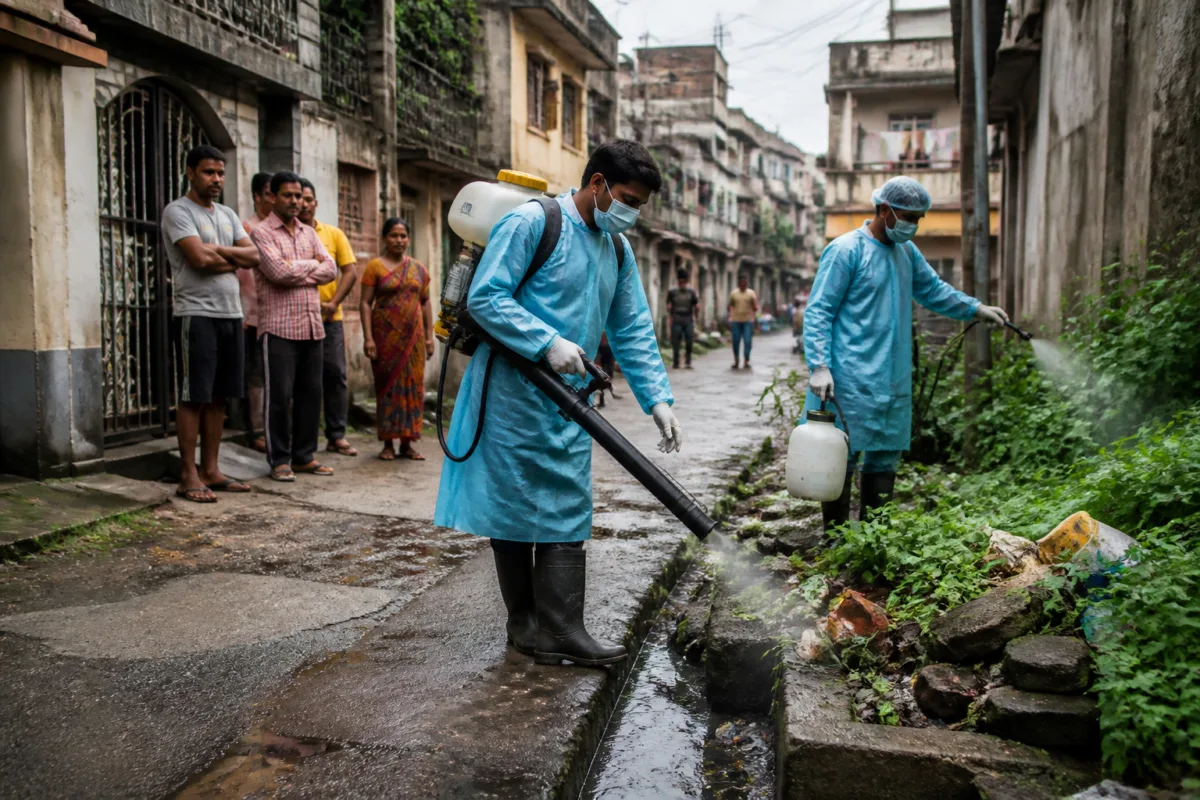
The response included spraying larvicide oil, clearing waste and conducting door-to-door awareness work. Residents were also being advised to prevent water from collecting in small containers around their homes. These measures reflect the operational nature of dengue control: the mosquito that spreads the disease can breed in relatively small collections of stagnant water, making household spaces, drains, discarded containers and poorly maintained public areas part of the same public-health system.
The district’s figures place the Bankra outbreak within a wider pattern. Anandabazar reported that Howrah district recorded 745 dengue cases between January and October, including 323 in the Howrah Municipal Corporation area. The report does not provide a comparable monthly series, ward-level distribution or information on hospitalisation and deaths. It therefore establishes the scale of the reported infections but does not, by itself, show whether the district-wide trend was accelerating, stabilising or declining during the period.
That limitation is important. A total case count can show the extent of detection, but it cannot fully explain transmission. To understand whether an outbreak is being contained, public-health administrators would need to track the location and timing of cases, the number of tests conducted, the status of suspected breeding sites, the frequency of sanitation operations and the speed at which new cases are being reported. None of those additional indicators is included in the supplied report.
The Bankra numbers nevertheless reveal a clear concentration within the three panchayat areas. Bankra-1 accounted for 29 of the 47 reported cases, while Bankra-2 and Bankra-3 together accounted for 18. The concentration suggests that the response cannot be designed only at district scale. Even when a district authority supplies personnel or materials, the work of identifying stagnant water, clearing waste and reaching households has to be organised at the level of neighbourhoods and local administrative units.
This is where the governance challenge becomes visible. Dengue prevention sits between public health and everyday urban management. Health officials can diagnose cases, deploy vector-control workers and issue warnings, but they do not independently control every drain, waste collection point, vacant plot or household container where mosquito breeding may occur. Panchayats and other local bodies are responsible for parts of the sanitation and environmental response, while district officials are expected to coordinate wider action.
The report says that the district administration acted after the cases increased and that teams were sent to the affected areas. It also records the chief medical officer of health, Kishlay Dutta, saying that health workers were working to prevent mosquito breeding and that the situation was largely under control. His statement attributed the spread partly to a lack of public awareness. That explanation highlights one part of the response, but the available material does not establish how much of the risk came from household practices, public sanitation conditions, drainage failures or other environmental factors.
That distinction matters because public-health messaging can become ineffective if it places the burden primarily on residents without documenting the condition of shared infrastructure. Households can remove water from containers inside or around homes, but they cannot independently clear public drains, manage neighbourhood waste accumulation or inspect every common area. Effective dengue control therefore depends on both behavioural cooperation and reliable municipal or panchayat services.
The political dispute reported in Domjur reflects this overlap. The Bharatiya Janata Party distributed mosquito nets and spread bleaching powder on roads in New Mondal Para, while alleging that Trinamool Congress MLA Tapas Maiti was absent during the crisis. The report does not independently verify that allegation. Maiti rejected the framing that this was a time for politics and said he had spoken with the district chief medical officer, the block development officer and panchayat heads about quickly cleaning drains and removing waste.
The competing statements point to a recurring problem in local disease response: responsibility is shared, but public accountability is often fragmented. Residents experience the outbreak at street level, while institutions respond through separate administrative channels. A district health department may report that the situation is controlled; a panchayat may be responsible for waste and drainage; elected representatives may claim coordination; and residents may judge the response by whether breeding sites disappear near their homes. Without a common public record of actions and outcomes, these accounts are difficult to compare.
The figures also show why urban health cannot be separated from the changing form of settlement. Bankra is covered administratively by gram panchayats, yet the outbreak is being discussed in the context of Howrah’s wider urban region. Such areas can contain village institutions, expanding housing, dense habitation, roadside commerce, construction and uneven civic services at the same time. The administrative label may be rural or semi-rural, but the public-health pressures can resemble those of an urban neighbourhood.
The supplied report does not provide population figures for the three panchayats, the area’s density, rainfall data, drainage maps or details of water-supply arrangements. It also does not state whether cases were concentrated in particular streets, housing clusters or institutions. As a result, it would be inaccurate to draw a direct causal link between a specific infrastructure failure and the reported infections. What can be established is that dengue cases were concentrated in Bankra-1, Bankra-2 and Bankra-3 and that sanitation and vector-control operations were initiated in response.
The district-wide figure of 745 cases, including 323 in the municipal area, also complicates the idea that dengue is only a rural or panchayat-level issue. Howrah’s municipal and panchayat areas are part of the same wider settlement system, connected by movement, markets, employment and services. Disease-control measures that stop at an administrative boundary may not reflect how residents and mosquitoes move through the built environment. The supplied material does not quantify such movement, but the distribution of cases across different local jurisdictions makes coordination a central administrative concern.
The next test is whether the response remains active after the immediate political and media attention fades. The report says that authorities were spraying larvicide oil, clearing waste, conducting door-to-door awareness campaigns and checking for water accumulation. Those are immediate measures. The available evidence does not show how often they were being repeated, how many locations were inspected, whether follow-up testing was planned or what threshold authorities would use to declare the cluster contained.
For residents, the practical issue is not only the number of cases already recorded but whether new infections continue to appear. For administrators, the relevant question is whether response capacity can move from emergency deployment to routine prevention. The distinction is significant because dengue control requires repeated attention to conditions that can return after a single cleaning drive or spray operation.
The Bankra outbreak therefore illustrates a wider urban-governance problem without proving a single cause. Dengue control depends on a chain that includes disease surveillance, testing, hospital access, waste removal, drainage maintenance, vector-control teams, household cooperation and clear public communication. A weakness in any one link can reduce the effectiveness of the others. In Howrah, the reported figures and official response show that the chain has been activated, but the supplied evidence does not yet establish whether it is working consistently across all affected areas.
The developments that merit monitoring are the number of new cases after 26 October, the continuation of vector-control operations, the condition of drains and waste sites in the three panchayat areas, and any updated figures from the district health authorities. Those indicators will show whether the reported outbreak was brought under control or whether the underlying conditions continued to generate infections.

