


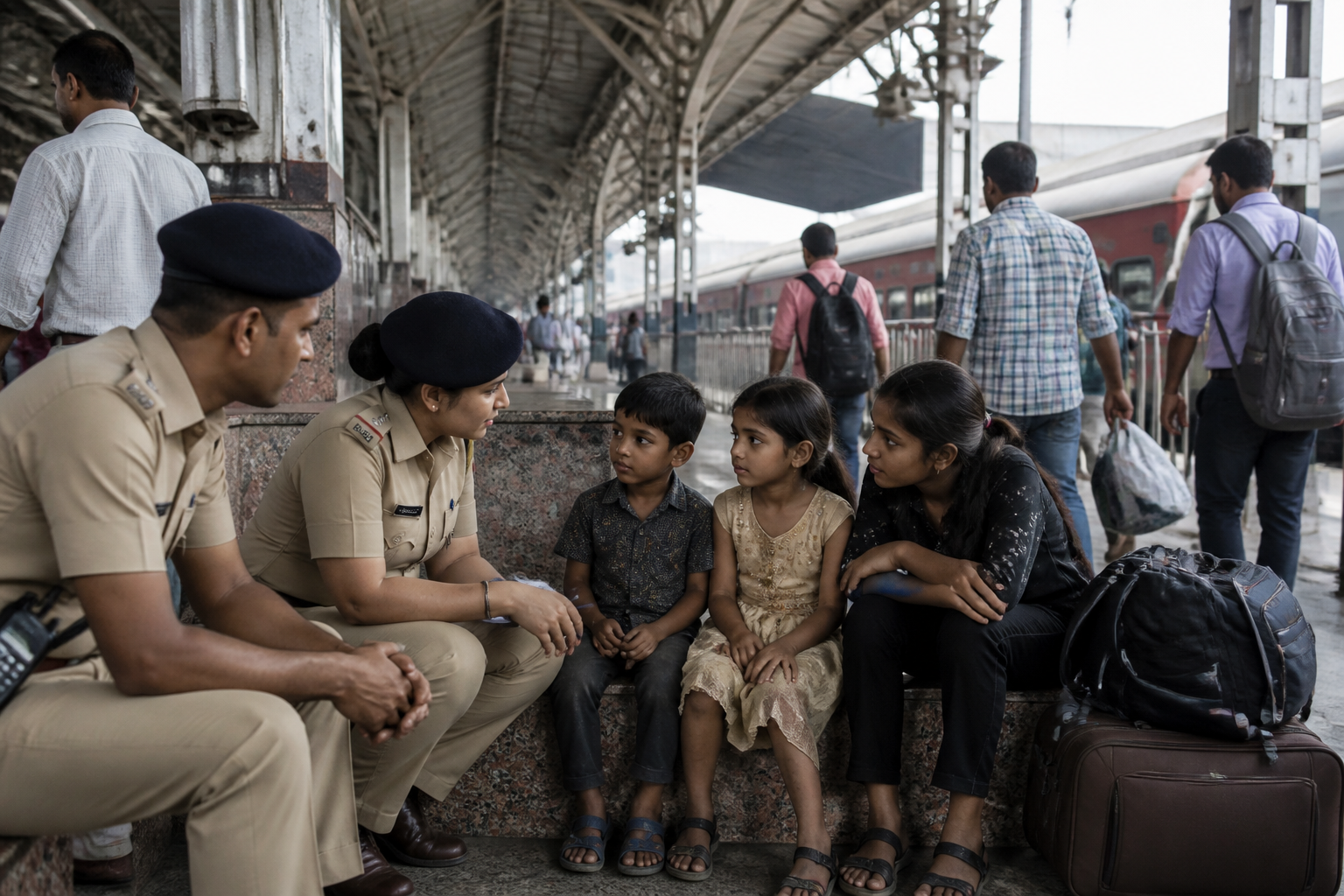
The rescue of 824 children from Eastern Railway’s Howrah division between January and August has brought a hidden dimension of railway safety into view: major stations are not only places where passengers arrive and depart, but also points where children who have left home, become separated from families or are at risk of trafficking can quickly disappear into wider transport networks.
According to a Railway Protection Force officer cited by the Times of India, the rescued children included 477 boys and 347 girls. Most were rescued from Howrah station. The cases involved children below 18 who had left home after arguments with parents, travelled in pursuit of romantic relationships, become separated from family members during journeys or were allegedly about to be trafficked.
The figures do not describe one single pattern of vulnerability. They show how several forms of risk converge inside a large railway system. A child who leaves home after a dispute may use the same platforms, ticketing areas and train services as a child being moved for exploitation. A child separated from relatives during travel may appear indistinguishable from an unaccompanied minor. At a station with trains arriving from and departing towards multiple destinations, the first point of intervention can therefore be decisive.
The RPF said it reunited the children with their families wherever possible. It also reported that 35 children rescued between January and August were allegedly about to be trafficked, with nine people arrested by the anti-trafficking unit. The supplied report does not provide details of the arrests, the identities of those detained, the legal sections applied or the final outcome of the cases. Those distinctions matter because rescue, prevention, investigation and prosecution are separate stages of the child-protection system.
The Howrah case demonstrates why railway security cannot be understood only through conventional measures such as preventing theft, managing crowds or responding to accidents. Stations are also social infrastructure. They connect neighbourhoods, cities and states, and that connectivity can help families travel safely. But the same connectivity can make it easier for vulnerable children to move quickly beyond the reach of relatives, local authorities and community networks.
Howrah station’s role is central to the pattern identified by the RPF. The officer described it as an important railway station receiving trains from various destinations and sending services along different routes. Children leaving their homes may reach Howrah or other major railway stations before their families know where they are. Once a child boards another train, the physical distance from home can increase rapidly, while the available information for intervention may remain limited.
This creates an institutional challenge. The RPF is positioned inside the railway environment, where officers can observe platforms, trains and passenger movement. The anti-trafficking unit provides a more specialised response when a case indicates organised movement or exploitation. Family reunification, however, requires a further layer of coordination involving relatives and, depending on the circumstances, child-protection authorities and other agencies. The report confirms the role of the RPF and its anti-trafficking unit, but does not establish how the wider coordination process is organised in each case.
The 824 rescues also need to be read carefully. They represent children whom railway personnel or associated teams identified and rescued; they do not establish the total number of vulnerable children who passed through the Howrah division during the period. Nor do they show how many cases were detected before a child boarded a train, how many involved repeat incidents or how many children could not be reunited with families. Without those details, the figure is an important warning signal rather than a complete measure of the scale of the problem.
The gender breakdown provides one clear indication of the volume and diversity of cases. Boys accounted for 477 of the rescued children, while girls accounted for 347. The report does not provide an explanation for the difference, and no conclusion about relative risk can be drawn from the numbers alone. The categories mentioned by the RPF—family conflict, romantic relationships, separation during travel and suspected trafficking—also overlap with wider questions about age, supervision, household stress and the availability of safe support for children in transit.
The distinction between children who have left home voluntarily and children who may be trafficked is especially important for public institutions. A child travelling without an adult is not automatically a trafficking victim. At the same time, an apparently voluntary journey can still expose a minor to exploitation, coercion or unsafe onward movement. This is why the first contact at a station has to establish more than whether a child possesses a ticket or can name a destination. The supplied report does not detail the RPF’s screening procedures, but the rescue figures show that such encounters are already taking place at significant scale.
The report also raises a question about the design of safety systems in large transport hubs. Railway stations are built for movement: passengers are expected to enter, change trains and leave with minimum friction. Child protection often requires the opposite approach—time to ask questions, verify identity, contact family members and assess whether a child is acting under pressure. The tension between rapid passenger flows and careful safeguarding is therefore built into the operating environment of a major station.
That tension cannot be resolved through surveillance or enforcement alone. The reported arrests in 35 suspected trafficking-related cases show the importance of criminal investigation, but the other cases underline the need for early identification and support. Children who leave home after a dispute or in pursuit of a relationship may not describe themselves as missing. They may resist immediate contact with relatives. Children separated during travel may need quick assistance without being treated as offenders. Each situation requires a response that protects the child while establishing what happened.
The available information does not specify how many of the 824 children were reunited with families, how long the reunification process took or what happened when reunion was not possible. It also does not identify the locations from which the children originated or the destinations towards which they were travelling. These gaps prevent a more detailed assessment of the routes, communities or circumstances most associated with the rescues. They also point to the value of transparent, anonymised public reporting on child-safety interventions at major stations.
For railway administrations, the broader issue is that passenger infrastructure functions as a network rather than as a collection of isolated buildings. A child located at Howrah may have arrived from another division and may be planning to travel onward. Effective protection consequently depends on information moving across stations and jurisdictions as quickly as trains do. The report establishes that Howrah’s connectivity creates access to onward transportation; it does not establish how information is shared between the relevant agencies or divisions.
For families, the figures are a reminder that a child can reach a major station soon after leaving home, including after what may initially appear to be a domestic disagreement. For railway staff and security personnel, they show the importance of recognising vulnerability among ordinary passenger flows. For policymakers, they place child protection within the infrastructure conversation: the safety performance of a transport hub includes not only physical security but also its ability to identify and assist people who cannot safely navigate the network alone.
The evidence currently confirms three facts: 824 children were rescued in the Howrah division in eight months; 35 cases were identified by the RPF as involving children about to be trafficked; and nine people were arrested by the anti-trafficking unit. It also confirms that the cases arose from different circumstances, including family disputes, romantic relationships, separation during travel and suspected trafficking. What remains unclear is the outcome of each case and the full institutional pathway after rescue. Those details will determine whether the reported interventions were isolated saves or part of a wider, coordinated child-protection system across India’s railway network.
