


The death of Sudhakar Nadkarni in Mumbai on October 20 closes the life of a teacher who helped move Indian design education beyond the question of appearance. His work, as described by his students, collaborators and institutions, treated design as a way to understand how products, systems and everyday environments serve people. That approach connected art with engineering, technology with social use, and professional practice with the ordinary details of daily life.
Nadkarni was 90. He is survived by his wife, two sons and a daughter. His significance lies less in a single object than in the institutional and intellectual influence he exerted across six decades. At a time when industrial design was still establishing its place in post-Independence India, he helped create a vocabulary for asking what products were for, who used them and whether they could be made more useful, accessible and humane.
That history matters because India’s built environment has often been shaped by the separation of disciplines. Engineering has generally dealt with technical performance, while art and craft have been treated as separate domains. Nadkarni’s career challenged that division. His teaching and institutional work placed design in conversation with engineering and technology, making the design process part of how India could think about products, public systems and everyday infrastructure.
He trained at Mumbai’s Sir J J School of Art and at Germany’s Ulm School of Design before returning to India. The experience at Ulm gave him a conviction that creativity required intellectual discipline. The solution, in this framework, could not come before an understanding of the problem. That principle is simple, but it has substantial consequences for the design of objects used by millions of people. It shifts attention from novelty to use, from visual form to function, and from the designer’s intention to the user’s experience.
Nadkarni’s career became closely associated with the growth of Indian design institutions. At the National Institute of Design and later at IIT Bombay’s Industrial Design Centre, he helped establish design as a serious field of inquiry. This was not merely a matter of adding a creative subject to an engineering campus. It meant creating a setting in which observation, experimentation and human needs could influence technical decisions.
The institutional shift was particularly visible in 1997, when Nadkarni founded the Department of Design at IIT Guwahati. The department brought design education into an institutional landscape largely dominated by engineering. Its creation represented an expansion of what a technical institution could consider valuable knowledge. Products and systems could be assessed not only for whether they worked, but also for how they were understood, handled and experienced by the people who depended on them.
The available account does not provide enrolment figures, budgets or a detailed institutional history of the departments Nadkarni worked with. It does, however, identify the direction of his contribution: design was to be treated as a form of inquiry rather than as surface decoration. That distinction is relevant to cities, where residents encounter the consequences of design through transport systems, public equipment, household products, medical devices, streetscapes and civic services.
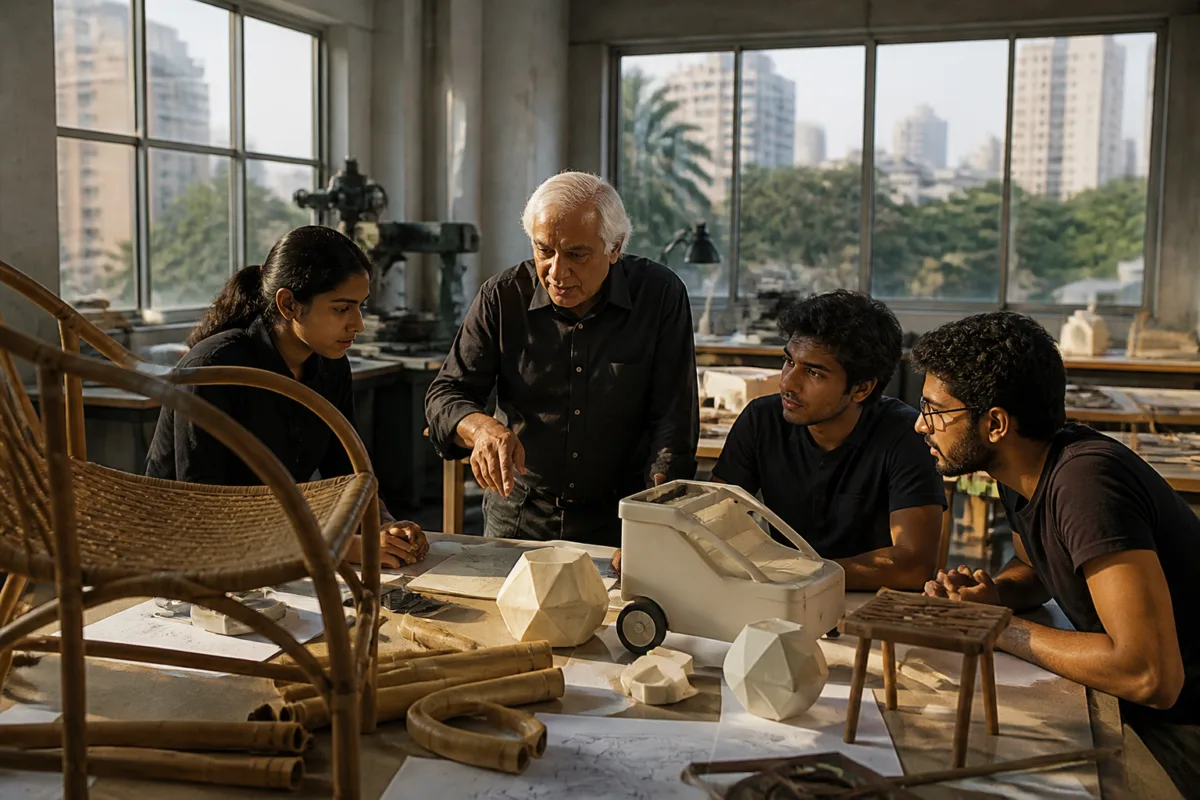
Nadkarni’s professional work ranged from household appliances to public exhibitions. His experiments with bamboo furniture and medical equipment showed another part of his approach: innovation did not have to begin with sophisticated technology. Materials and methods could be reconsidered by beginning with the problem to be solved. In a country where resources, affordability and local conditions shape the usefulness of products, that principle has direct relevance to the built environment.
Bamboo furniture, as described in the source, was not presented as a nostalgic return to traditional material. It formed part of an experiment in how a familiar material could support functional design. Medical equipment, meanwhile, placed the question of usability in a more consequential setting. The source does not provide technical specifications for either body of work, so their precise performance cannot be assessed here. What can be established is that both reflected Nadkarni’s belief that design should respond to real conditions rather than simply demonstrate technical sophistication.
The clearest measure of his influence may be found in the work of his students. Their contributions included the Indian rupee symbol, the electronic voting machine, modern petrol pumps and everyday household products. These examples span identity, public administration, energy retail and domestic life. They also show why design education cannot be confined to luxury goods or visual branding. A symbol used in daily transactions, a machine involved in elections and equipment encountered at fuel stations all require decisions about comprehension, interaction and public use.
The source does not claim that Nadkarni designed each of these contributions himself. Instead, it places them within the wider impact of his students and teaching. That distinction is important. His legacy was not only a portfolio of objects but a method passed through institutions and professional generations. A teacher’s influence often operates indirectly: through the questions students ask, the standards they apply and the problems they consider worthy of attention.
His daughter Suhita Nadkarni told the Times of India that students valued his belief that no work was lesser than any other. Whether painting a wall, laying a stone or undertaking work of national importance, she said, he approached each task with the same seriousness and commitment. The statement offers an insight into the ethics behind his design practice. It suggests that the value of a project was not determined only by its scale or prestige, but by the care with which it addressed its purpose.
That attitude has a particular urban dimension. Cities are made not only through major bridges, stations and towers but also through thousands of small interfaces: a handle, sign, control panel, payment symbol, public fixture or piece of street furniture. When these details fail, residents experience inconvenience, exclusion or wasted time. When they work well, they often disappear into routine. A design education that treats ordinary tasks seriously is therefore relevant to the entire urban system, even when its graduates are not working directly on buildings or transport networks.
Nadkarni also encouraged students to question conventions, experiment and recognise failure as part of discovery. The source presents this as a central feature of his teaching. In institutional terms, it points to a model of education that values testing before finalisation. For products and public systems, that sequence can help identify problems that are invisible in drawings or specifications but become apparent when people use an object in real conditions.
The policy and institutional landscape around design in the source is represented primarily by educational institutions rather than by a government programme or regulatory framework. NID, IIT Bombay and IIT Guwahati each provided settings in which design could develop alongside art, science and engineering. Nadkarni’s work indicates how institutional design can influence the kinds of professionals a country produces. When design is housed within a technical institution, the relationship between creativity and infrastructure becomes part of formal education rather than an informal collaboration.
The source does not establish the current structure, funding or performance of these departments, nor does it provide comparative data on Indian design education. It would therefore be inaccurate to claim that Nadkarni’s institutional interventions solved the country’s design challenges. What the evidence does show is that he helped widen the institutional space available to design at a time when engineering dominated the technical imagination.
His later work continued this engagement with design history. His book, ‘by design’, published in 2026, gathered lessons from a lifetime spent examining how things work and how they might work better. The book places documentation alongside teaching as part of his final contribution. Recording design history is significant in a country where the development of products, institutions and visual systems can easily be separated from the people and debates that shaped them.
Architect Charles Correa described Nadkarni as one of the most versatile designers India had produced in the decades since Independence and called it an honour to have been his collaborator and friend. Correa’s statement is a personal assessment, not an independent ranking, but it reinforces the breadth of Nadkarni’s professional relationships and interests.
The evidence supplied about Nadkarni’s life does not permit a complete assessment of his influence on Indian cities, industry or public institutions. It does establish a coherent thread. He helped make design education more rigorous, connected it to engineering and technology, supported experimentation with materials and equipment, and influenced students whose work entered public and everyday life.
The larger urban question raised by his career is whether cities can be designed only through large-scale technical decisions. Nadkarni’s method suggests that the answer must also include the experience of the person using each system. That does not replace engineering, planning or administration. It adds another test: whether an object, service or environment makes sense to the people expected to live with it.
Institutions endure, products become obsolete and technologies change. Nadkarni’s legacy, as reflected in the source, rests on a habit of questioning inherited forms and taking ordinary work seriously. The next generation of designers will determine how far that habit travels through India’s products, public systems and built environment. What remains clear is that his most consequential work was not limited to what he made, but extended to how he taught others to see and improve the world around them.

