


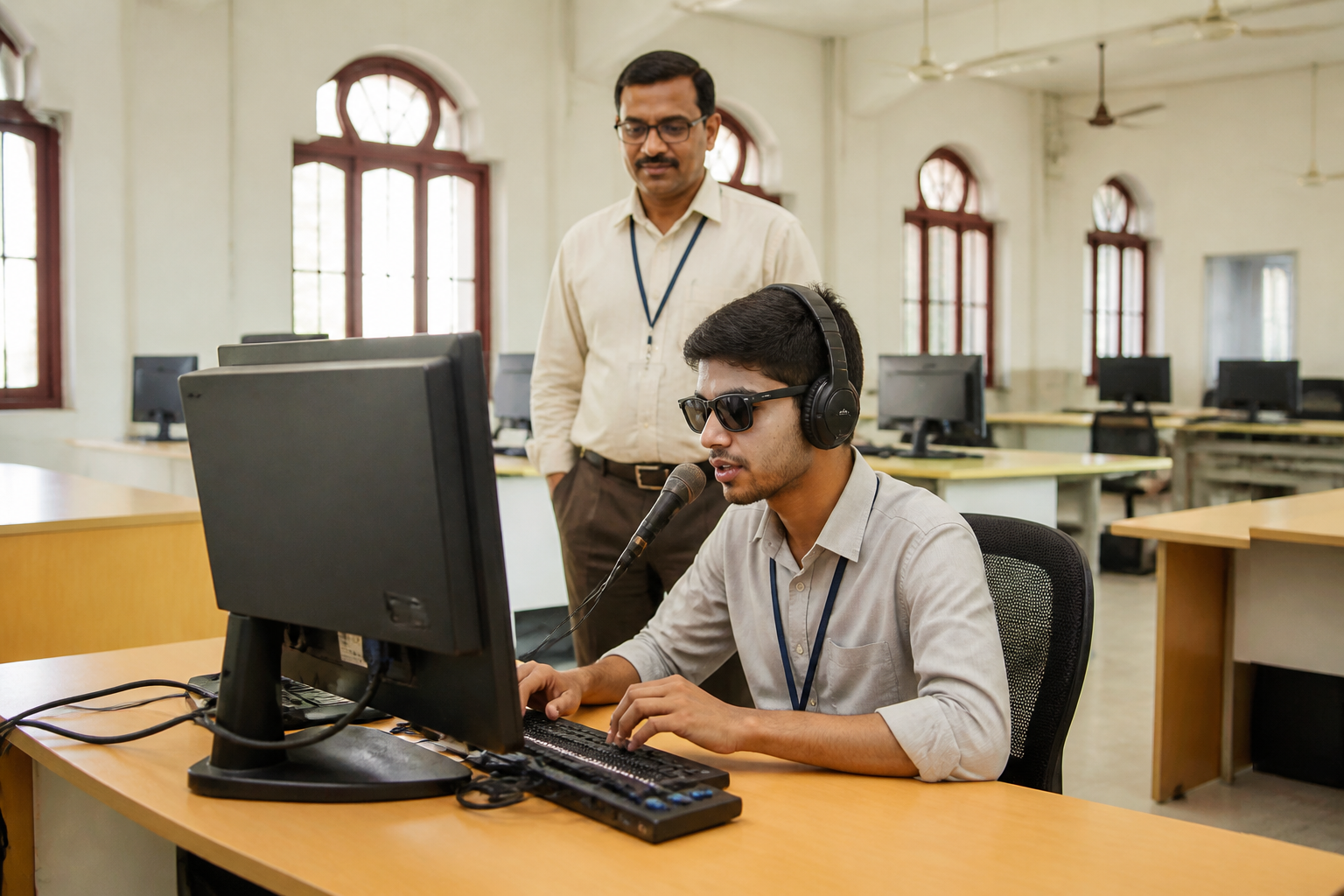
Madras Christian College’s decision to introduce an indigenous AI voice scribe for visually challenged students is more than a technology upgrade to its examination process. It is an attempt to redesign a basic institutional dependency: the need for another person to convert a student’s spoken answers into written examination responses. By shifting that function to a voice-to-text platform, the college is testing whether assessment systems can become more independent, accurate and responsive to the way students communicate.
The system, called Voice Chat Scribe, is being developed in-house with support from the MCC-MRF Innovation Park in Tambaram. Madras Christian College is expected to introduce it during the third internal continuous assessment, ahead of the November 2026 semester examinations. Training sessions and dry runs for visually challenged students and departmental nodal officers are planned before the formal assessments scheduled for next month, according to the college as reported by DT Next.
The immediate trigger is operational as well as educational. MCC Principal Prof Dr P Wilson said the number of volunteers available to act as scribes had been declining. The college also identified limitations in the manual arrangement, including transcription errors and the possibility that assistants could unintentionally influence how students’ answers were recorded.
Those limitations reveal the larger institutional issue. A scribe is not merely a person who writes on behalf of a candidate. The scribe becomes part of the examination interface, interpreting speech, maintaining pace and translating a student’s articulation into a written response. When that process is dependent on volunteer availability and another person’s transcription, the student’s performance can be affected by factors outside the subject knowledge being assessed.
## The problem the AI voice scribe is designed to address
MCC said the new platform will allow students to dictate answers in English directly into a secure system without depending on another person to transcribe their thoughts. Students will be able to move through questions, repeat audio prompts and check word counts through voice commands or keyboard shortcuts.
The software is also designed to support formatting functions. Students will be able to use spoken commands to bold or underline text, rearrange paragraphs and insert subheadings. These features matter because examination writing is not limited to producing words. Candidates must organise, revise and format their answers, often under time pressure. A platform that recognises both dictation and editing commands attempts to reproduce those functions without requiring a separate intermediary.
The college said the command-and-dictation mechanism has been built to distinguish software instructions from the candidate’s answers. That distinction is central to the credibility of the system. If a spoken command is treated as part of an answer, or if an answer is interpreted as an instruction, the technology could introduce a new form of examination error while trying to solve an existing one.
MCC also said the system is designed for high-accuracy voice recognition in English and Tamil. However, the college’s description of direct dictation specifies English. The supplied information therefore establishes bilingual recognition capability but does not establish whether examination answers can be dictated in Tamil under the initial implementation. That distinction will matter when the platform moves from testing to wider use.
## From assistive service to institutional infrastructure
The college has described the software as another feature within its Student Services for the Differently Abled ecosystem and its skill-development initiatives, supported by the Help the Blind Foundation. This places the project within an existing institutional support structure rather than presenting it as a standalone software experiment.
The distinction is important. Accessibility is often treated as a supplementary service activated for a small number of students. MCC’s approach, as described in the report, links the new platform to the Office of the Controller of Examinations, deans, heads of departments and the student support team for differently abled students. The decision to implement the system therefore involves the academic, administrative and examination arms of the institution.
That coordination is necessary because an examination tool has to meet several requirements at once. It must be usable by students, workable for departments, acceptable to exam authorities and secure enough to protect assessment integrity. A technically functional voice-to-text engine alone cannot resolve those institutional questions.
MCC said the software will operate on a restricted and confidential server environment to prevent malpractice and protect the integrity of assessments. The security design is consequently part of the accessibility design. Students cannot gain independence in an examination if the system is considered too open, too difficult to monitor or too vulnerable to unauthorised access.
## Why the implementation phase will matter more than the announcement
The planned dry runs are likely to be the most consequential stage before formal adoption. They will allow students and departmental nodal officers to become familiar with the system and expose problems that may not be visible during software development. The supplied report does not provide details on the number of students who will participate, the duration of testing, the error rate recorded so far or the procedure for handling technical failure.
Those details will shape whether the system can function as a dependable examination facility. Voice recognition performance can affect punctuation, names, technical terms and the separation of commands from answers. In an examination setting, even a small transcription problem can change meaning. The college’s stated objective of higher accuracy is significant, but the available information does not include a measured accuracy rate or a comparison with the existing manual process.
The college will also have to retain an alternative arrangement for students if the system becomes unavailable or cannot adequately capture a particular answer. The source material confirms that MCC is moving towards implementation, but it does not specify the contingency protocol. That is an important operational question because independence should expand a student’s options, not create a new single point of failure.
The same applies to training. MCC has said that students and departmental nodal officers will be trained, but the report does not establish whether training will cover only basic commands or also troubleshooting, answer review, data handling and escalation during an examination. The platform’s success will depend on the entire examination workflow, including what happens when a student disputes a transcription or when the software fails to recognise an instruction.
## The governance of an inclusive examination system
The project also demonstrates that accessible technology requires governance rules. The Controller of Examinations will have to oversee how answers are recorded, reviewed and stored. Deans and heads of departments will have to ensure that academic processes accommodate the system. The student support team will remain responsible for understanding the practical needs of users.
MCC’s statement indicates that these groups were involved in discussions before the implementation decision. That is a useful institutional signal because it places students’ examination access within the formal chain of responsibility. It also reduces the risk that assistive technology is treated only as an innovation-project deliverable rather than as part of the college’s core academic administration.
The use of a restricted server environment introduces another governance layer. The college has identified examination security and malpractice prevention as priorities, but the supplied material does not explain how recordings, transcripts or system logs will be retained, who can access them or how long they will remain available. Those questions are especially relevant when students’ spoken answers are converted into digital data.
The immediate project is therefore not simply about replacing a manual scribe. It is about defining a controlled interface between the student, the examination question, the institution and the final written answer. Every part of that interface—from voice recognition to answer review and secure storage—can affect the credibility of the assessment.
## The larger urban inclusion question
For cities, colleges and other public-facing institutions, the MCC initiative reflects a broader shift in how accessibility can be delivered. Physical access remains essential, but participation also depends on whether institutional processes are designed around different ways of reading, writing, communicating and demonstrating knowledge.
Higher education institutions are complex urban systems. They bring together buildings, classrooms, examination offices, technology infrastructure and student-support services. When one part of that system depends on informal volunteer support, access may vary with availability. A digital platform can make support more consistent, but only if it is reliable, secure and integrated into everyday administration.
MCC’s decision is significant because it attempts to address both sides of that challenge. It offers students a more direct method of producing answers while requiring the institution to redesign part of its examination infrastructure. The college’s own account establishes the intended benefits—reduced dependence on manual scribes, fewer transcription problems and greater control for students—but the actual impact will become clear only after the assessments and semester examinations.
The evidence currently confirms an important transition: Madras Christian College is moving from a volunteer-dependent scribe model towards an institutionally managed AI voice scribe platform. It does not yet establish the system’s measured accuracy, adoption scale, failure-handling process or long-term cost. The next milestones are the training sessions, dry runs, the third internal continuous assessment and the planned November 2026 semester examinations. Those stages will determine whether the technology can move from an inclusive promise to dependable examination infrastructure.
