


Tamil Nadu’s new AI assistive devices scheme places advanced disability aids inside the state’s welfare and procurement system, but its first phase will also show how far a subsidy-led model can translate technology into everyday independence. The government has allocated Rs. 125 crore for the broader first phase of assistance, while a specific implementation order provides support for 1,000 beneficiaries and separately creates a programme for 400 people of short stature to receive specially designed scooters or battery-powered equipment.
The announcements were made during the Social Welfare Minister’s demand for grants speech in the Tamil Nadu Assembly in August 2026. The Welfare of the Differently-Abled department subsequently issued an order detailing the devices, subsidy ceiling, eligibility conditions and selection process. The scheme therefore moves beyond a general announcement: it identifies the public departments and committees that will decide who receives support, the conditions attached to applications and the agencies involved in procurement.
That administrative detail is important because assistive devices are not simply consumer products. A sports prosthesis, an upper-limb prosthesis operated by electrical signals, a cochlear implant battery and a bed equipped with a commode facility serve different needs and require different forms of fitting, maintenance and use. The order, as reported, groups them within a common assistance framework, with the government covering 50% of the cost or Rs. 30,000, whichever is applicable under the stated limit.
The first phase of the AI-assisted devices scheme is intended to cover 1,000 beneficiaries at a cost of Rs. 3 crore. The larger Rs. 125-crore allocation described in the minister’s speech indicates the scale of the government’s broader commitment, but the reported order provides specific operational numbers only for the initial 1,000-beneficiary phase. The difference between an announced allocation and an implemented tranche will matter as the programme moves from budgetary intent to applications, purchases and delivery.
The scheme gives preference to students with disabilities and persons with disabilities below the age of 50. Applicants must apply for the concession within 60 days of purchasing the device and must possess a Unique Disability ID card. These conditions create a clear administrative route, but they also make timing and documentation central to access. The requirement that a person purchase the device before applying for the concession means that the beneficiary or family may initially have to arrange the purchase cost, subject to the assistance later being sanctioned.
The reported provisions do not establish whether the subsidy is paid in advance, reimbursed after verification or routed through an authorised supplier. That distinction is significant for households with limited ability to pay upfront. The supplied government order, as reported, specifies the subsidy ceiling and the application deadline but does not provide further details on payment sequencing or the process for assessing whether a device meets the scheme’s AI-assisted category.
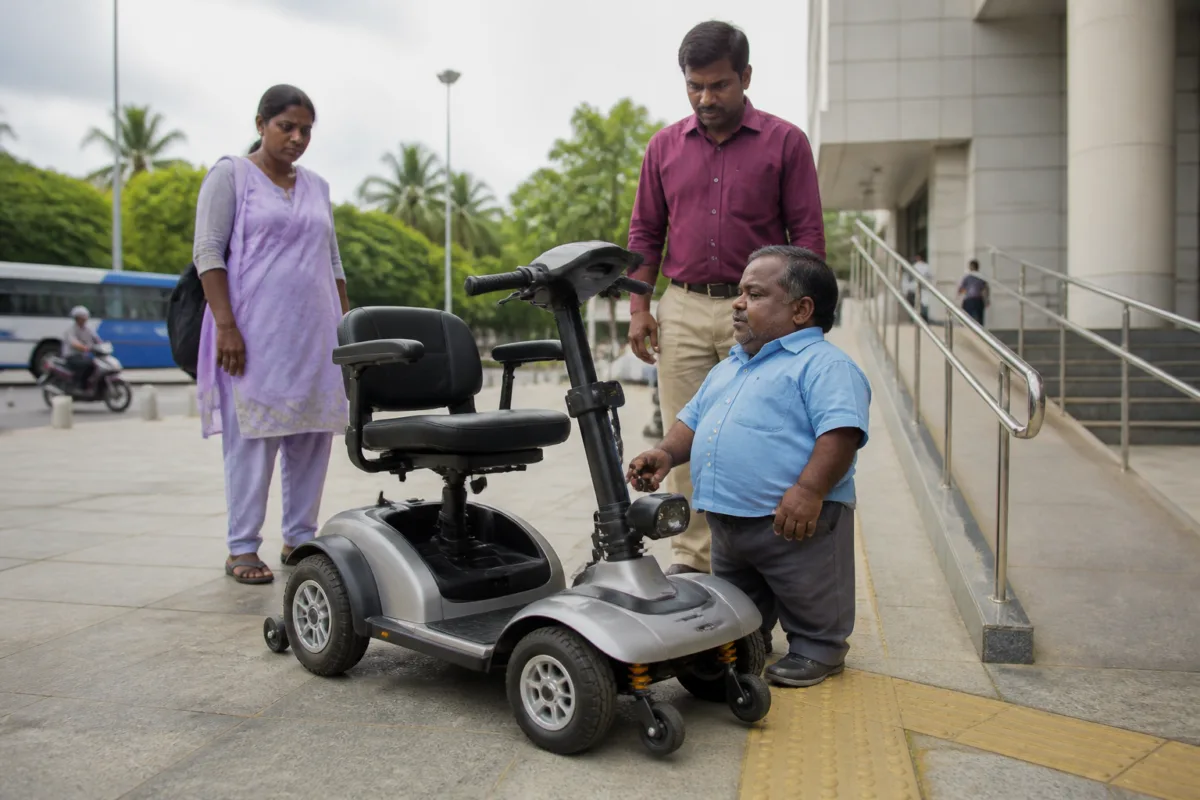
The separate scooter scheme addresses a more specific mobility requirement. In its first phase, 400 people of short stature will be selected across Tamil Nadu. The equipment will be procured through the Tamil Nadu Medical Services Corporation, creating a central procurement role for an agency that is also connected to the state’s medical supply system. This arrangement is intended to organise the purchase of specially designed petrol scooters or battery-powered equipment with coupling wheels rather than leaving beneficiaries to navigate the market individually.
The order gives priority to students of short stature who are above 18 years of age. The remaining scooters are to be provided to working and self-employed persons. Beneficiaries receiving a petrol scooter equipped with articulated wheels must be between 18 and 65 years of age, have good hand strength and be of short stature. These criteria show that the programme is designed around both physical characteristics and the ability to operate the equipment.
Selection will be carried out by a committee comprising the District Collector, District Disabled Welfare Officer and Regional Transport Officer. The composition brings together district administration, disability welfare and transport regulation. It also means that delivery is not the responsibility of a single welfare office. The committee must connect beneficiary identification with the practical requirements of operating a vehicle on public roads.
This institutional structure reflects a broader issue in inclusive mobility: access depends on more than owning a device. A scooter designed for a particular physical requirement must be procured to an appropriate specification, delivered to the correct beneficiary and compatible with the user’s ability to operate it. The presence of the Regional Transport Officer on the selection committee suggests that road-use considerations form part of the administrative process, although the supplied report does not specify the licensing, registration, training or after-sales support arrangements.
The scooter scheme is budgeted at Rs. 4 crore for the equipment described in the announcement. Taken together with the Rs. 3-crore first phase for 1,000 advanced assistive-device beneficiaries, the reported programme commitments identify at least Rs. 7 crore in specific first-phase costs across the two interventions. These figures should not be treated as the full value of the broader Rs. 125-crore allocation, which the report presents as the government’s larger first-phase allocation for modern assistive devices.
The numbers also reveal two different approaches to public support. The AI-assisted devices programme is framed as a subsidy for a range of aids, with assistance limited to 50% of cost or Rs. 30,000. The scooter programme is framed as a state-procured distribution model, with 400 beneficiaries selected through a committee and equipment purchased through TNMSC. One model relies on individual purchase and reimbursement conditions; the other relies on institutional procurement and selection.
That distinction may shape who can use each programme. A reimbursement-based scheme can offer flexibility because beneficiaries may obtain different devices suited to their needs, but it can also place greater responsibility on applicants to identify, purchase and document the device. A centrally procured scooter scheme can standardise specifications and purchasing, but it may offer fewer choices if the equipment does not fit different users’ needs. The reported order does not state how these trade-offs will be managed, making implementation details important to monitor.
The Unique Disability ID requirement provides a common identification condition for both schemes. It can help the department establish eligibility and reduce duplication in beneficiary records, but the supplied material does not explain how applicants without the card will be supported or how long verification will take. Since the concession application must be made within 60 days of purchase, the relationship between documentation, purchase and departmental processing will be especially important for the first phase.
The government has also appointed Ajay Yadav as the State Commissioner for Persons with Disabilities. The appointment places a named state-level official within the institutional landscape at the same time as the new schemes are being rolled out. The report does not specify the commissioner’s role in approving applications, monitoring procurement or reviewing complaints, so the exact relationship between the commissioner’s office and the Welfare of the Differently-Abled department remains to be established.
The policy significance of the announcement lies in the state’s attempt to treat assistive technology as part of public service delivery rather than as a purely private purchase. The devices listed in the order range from prostheses and cochlear implant batteries to a commode-equipped bed. Their uses extend across mobility, communication, daily care and participation in education or work. The scheme’s eligibility preferences for students, younger persons, working people and self-employed people indicate that the government is linking assistance to independence and participation, although the order does not set out outcome measures.
The first phase is therefore also a test of administrative capacity. The reported figures are specific: 1,000 beneficiaries for the advanced devices scheme, 400 people of short stature for the scooter programme, Rs. 3 crore for the initial AI-assisted device implementation, Rs. 4 crore for the scooter intervention and a 50% or Rs. 30,000 assistance limit for eligible devices. What remains unclear is how many applications the state expects, how beneficiaries will be assessed, how device quality will be verified and whether maintenance or replacement costs are covered.
Those unanswered questions do not diminish the importance of the announcement; they define the next stage of scrutiny. For citizens, the practical test will be whether the application process, ID requirement, 60-day deadline and selection committees result in timely access. For administrators, it will be whether procurement and subsidy rules can accommodate devices that must be fitted to individual needs. For Tamil Nadu’s urban and regional mobility systems, the scooter component will show whether a targeted vehicle programme can connect welfare support with everyday travel for education, employment and self-employment.
The government’s next steps are set by the reported orders: applications must be processed under the stated eligibility conditions, equipment for the scooter scheme must be procured through TNMSC and beneficiaries must be selected through district-level committees. The implementation of these first-phase targets, along with the role of the newly appointed State Commissioner for Persons with Disabilities, will determine how the announced commitment becomes an operating public programme.

