


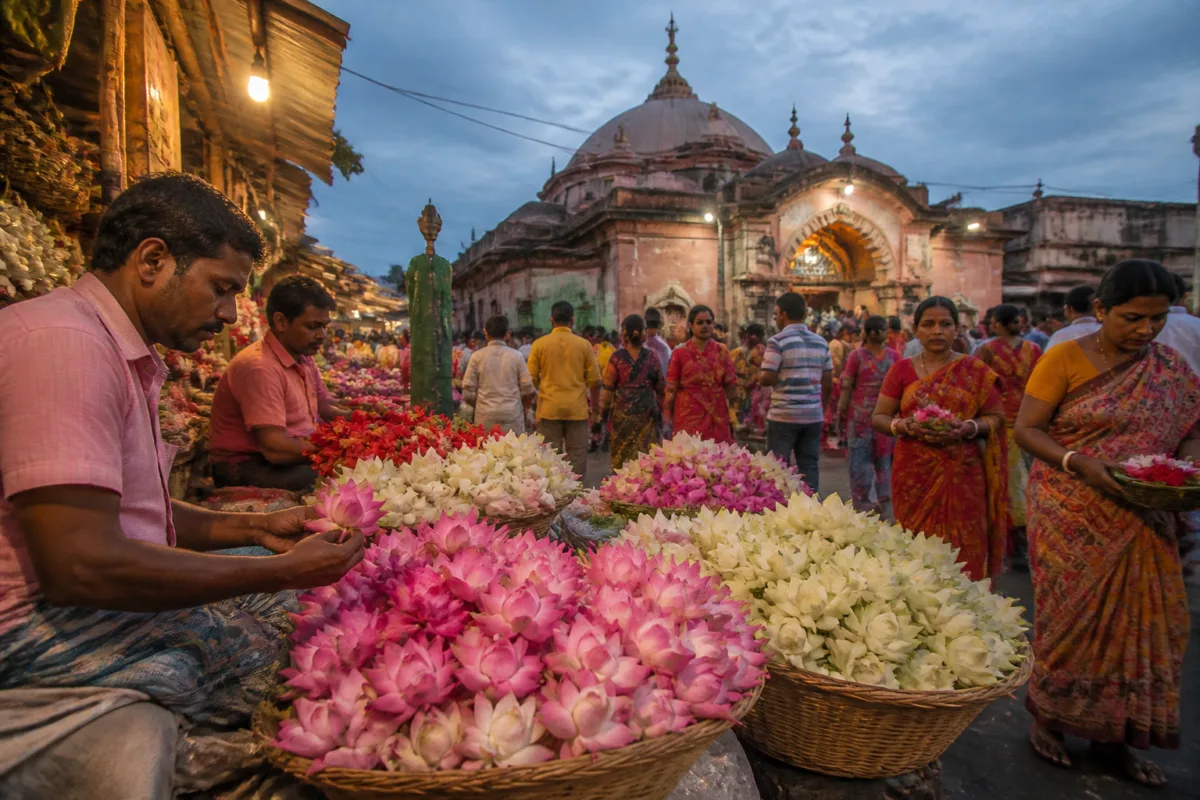
The growing use of lotus flowers at Bengal’s Kali temples is not only a change in ritual preference. It reflects how agricultural supply, market prices, temple commerce and political organisation can combine to reshape a visible part of the urban religious economy. As lotus production rises across several districts and prices fall, the flower is moving from a symbolic offering to a commercially attractive product for temples, devotees and puja organisers.
The shift is being reported at prominent sites including Dakshineswar, Kalighat, Bishnupur and Kankalitala. Priests and devotees are increasingly bringing lotus flowers to Kali temples, where red hibiscus, or jaba, has traditionally occupied a central place in offerings. The change has gathered pace over the past few months, according to the Times of India report, and has become especially visible during the Kali Puja season.
The immediate economic explanation is straightforward. Bengal’s lotus growers have reported a bumper crop in districts including Bankura, Hooghly, Birbhum, East Midnapore and North 24 Parganas. The All Bengal Flower Growers and Flower Traders Association attributed the higher production to the absence of widespread flooding in flower-growing areas this year. Increased supply has pushed down prices and made lotus more accessible to buyers who previously relied more heavily on hibiscus.
At Dakshineswar, dala seller Sanjay Dutta described the price difference that is influencing the market. A lotus, which is a larger flower and gives an offering basket a fuller appearance, is being sold for Rs 2-Rs 3 apiece. By comparison, a packet of 100 hibiscuses costs around Rs 50. Dutta said the increase in demand had prompted sellers at the temple to make lotus a permanent part of their offerings, with some customers asking for baskets consisting mostly of lotuses.
That comparison shows how ritual consumption is also shaped by price, volume and presentation. The lotus does not merely substitute for hibiscus as an individual flower. Its larger size allows sellers to create a visually fuller offering with fewer units, while a plentiful harvest keeps the per-flower price relatively low. In a temple economy where devotees buy prepared offerings, these characteristics can influence both what vendors stock and what customers are encouraged to purchase.
The supply chain behind the change extends well beyond the temple premises. Lotus sellers in Bankura source flowers from Pokaband in Bishnupur and Ramsagar in the district. Pandua in Hooghly is another major production centre, supplying flowers transported to Kolkata. This network links ponds and farms in rural districts to large temples, neighbourhood shrines, urban flower markets and community pujas.
Mullickghat flower market, one of Kolkata’s important trading points, has also recorded the commercial impact of the shift. Vendor Asit Santra said demand for lotus increased immediately after the change in government, when BJP workers and supporters bought large quantities for rallies and decoration. The report also said that with several pujas now controlled by BJP functionaries, lotus is expected to become a significant offering at a number of community Kali pujas.
This is where the story moves beyond a simple account of seasonal demand. The flower’s economic journey is being shaped by both ordinary market conditions and organised political activity. Higher production created availability. Lower prices reduced the barrier to purchase. Temple sellers responded to demand. Political workers and supporters added a new source of bulk consumption. Community puja organisers then became part of a wider process in which the lotus acquired greater visibility.
The reported change has also opened a debate among priests about whether the shift is primarily religious or carries a political overtone. Some priests have linked the growing emphasis on lotus to a willingness to align with Bengal’s new governing party. The Times of India report connects this discussion to the BJP’s victory in the April assembly elections, while also recording that some priests regard lotus as a legitimate traditional offering rather than a new political symbol.
The distinction is important because religious practice is not controlled by a single institution. Offerings are influenced by priestly advice, the preferences of devotees, the availability of flowers, the pricing decisions of sellers and the organisational choices of puja committees. In this case, these factors are moving in the same direction, but they do not necessarily have the same motivation.
The history of the two flowers further complicates the idea of a sharp break with tradition. Asim Mukhopadhyay, a priest at a Kali temple in Tarakeswar, said the practice of worshipping Kali with red hibiscus became established during the time of the 18th-century Shakta poet and devotee Ramprasad Sen. He added that many pandits later advised the use of lotus. This account presents the current change less as the introduction of an entirely unfamiliar offering and more as a rebalancing between two established religious forms.
Priestly recommendations can nevertheless influence consumer behaviour. In Bishnupur, priest Bapi Banerjee said devotees were being advised to offer lotus because gods and goddesses like it. At Kankalitala in Birbhum, visitor Anuradha Banerjee said she was surprised to see worshippers carrying stacks of lotuses instead of the hibiscus garlands commonly seen at the shrine. Such observations illustrate how quickly a change in supply and recommendation can become visible in the experience of worshippers.
The wider horticultural economy is another part of the story. Former joint director of horticulture in Bengal Samarendranath Khara said the state is the country’s highest producer of lotus. The supplied report does not provide a production figure or a statewide value for the lotus trade, but the geographic spread of the named production districts indicates that the crop has a substantial rural-to-urban distribution network. Farmers, transporters, wholesale vendors, temple sellers and puja organisers all participate in moving the flower from cultivation areas to consumers.
For growers, the bumper crop has reportedly brought a significant improvement in returns. Farmers in Bankura, Hooghly, Birbhum, East Midnapore and North 24 Parganas reported that profits had almost doubled compared with the previous year. That rise cannot be attributed to price alone: the report links it to higher production and stronger demand. The same conditions that benefit growers can also make the flower cheaper for devotees and more attractive to sellers.
The reported absence of widespread flooding is a reminder that seasonal agricultural output remains closely tied to local environmental conditions. In this instance, better production helped create the supply necessary for a change in consumption. The source does not establish whether the improved harvest will continue in future years, but it shows how weather-related disruption or stability can affect even highly symbolic urban markets.
The political dimension has added another layer to the flower’s public visibility. The Salt Lake BF Block Kali Puja, previously known as former Trinamool MLA Sabyasachi Dutta’s puja, is described in the report as being controlled this year by a new political configuration. Organiser Raja Chakraborty said the committee would follow all rituals and described lotus as an important item in any sanatani puja. The puja was scheduled to be inaugurated by Chief Minister Suvendu Adhikari and state panchayat minister Dilip Ghosh.
This does not establish that every lotus offering is politically motivated. It does show, however, how community pujas can become points where religious symbolism, political presence and commercial demand intersect. When political groups buy flowers for rallies and decoration, and when organisers associated with those groups oversee public pujas, a market preference can acquire a wider cultural meaning.
The urban significance lies in the way Kolkata’s temples and flower markets function as endpoints of a dispersed production system. A devotee purchasing a dala at Dakshineswar is participating in a chain that includes farmers in Bankura or Hooghly, traders at markets such as Mullickghat, transport routes into the city and the ritual decisions of priests and organisers. The offering is local at the moment of worship, but its economy is regional.
The lotus’s rise therefore reveals how urban religious spaces respond to changes that begin outside the city. A successful harvest can alter retail prices. Lower prices can alter the composition of offerings. Temple sellers can reinforce the change by stocking more of the flower. Priests can legitimise it through advice. Political organisations can amplify demand through bulk purchases and public events. Together, these forces can make a seasonal market adjustment appear like a cultural transformation.
What the available evidence confirms is that lotus production has increased, prices have fallen, profits for reported growers have risen, and lotus offerings are becoming more visible at several Bengal temples. It also confirms that political activity has contributed to demand and that the change has prompted debate among priests. What remains unclear is how durable the shift will be after the current season, whether hibiscus demand will recover, and how much of the increase is driven by long-term preference rather than this year’s harvest and political activity. The next indication will come from whether temples, vendors and puja committees continue to treat lotus as a regular offering once the present supply conditions change.

