


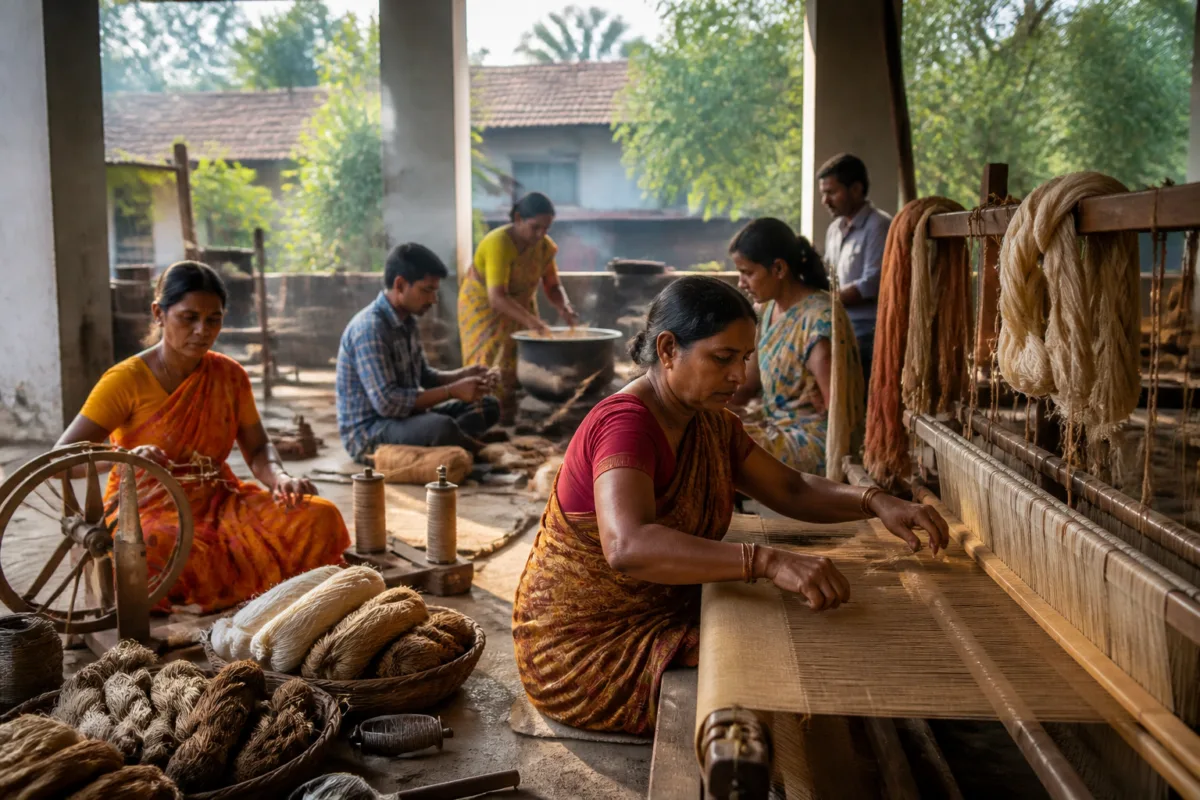
Kosala’s expansion from 750 artisans a year ago to more than 1,100 across 18-20 villages in Chhattisgarh shows how a traditional craft can be repositioned as an organised livelihood network rather than treated only as cultural heritage. The initiative, which works with the Dewangan community and other participants in reeling, weaving, embroidery, dyeing and stitching, is linking village production to Raipur, online buyers and overseas orders.
The development was announced during the annual pre-Diwali Tana Bana ceremony, held in Raipur for the first time after the Kosala Foundation shifted its office to the state capital. The event also saw the launch of a Kosala Experience Centre in Raipur, intended to show visitors the process of making Kosa silk, from reeling to weaving.
The immediate numbers are significant because they describe a production chain rather than a single workshop. Kosala says its work now extends across the Champa-Raigarh belt, with artisans earning directly through activities at different points in the chain. The foundation’s model therefore covers more than the final handloom product: it includes the labour and skills needed to prepare, transform and finish the material.
According to Saurabh Khedekar, CEO of Hindalco’s Alumina Business and director of the Kosala Foundation, between Rs 75 lakh and Rs 1 crore is channelled into the community annually, excluding thread, fabric and operating costs. Cumulative payments to artisans run into several crores. The figures supplied by the foundation indicate a system in which craft income is being treated as a continuing economic activity, although the available account does not provide a village-wise or occupation-wise breakdown of earnings.
That distinction matters. A craft revival programme can increase visibility without necessarily creating stable income. In Kosala’s case, the reported expansion combines market access with financial and social support. Artisans receive life and medical insurance, health check-ups, advances, working-capital assistance and training. Payments are transferred directly after KYC verification, according to the foundation. These arrangements place administrative processes around the craft economy, reducing the distance between the organisation placing an order and the person carrying out the work.
The evidence does not establish that incomes are uniform or that all participating artisans receive the same volume of work. It does, however, show an attempt to address some of the practical constraints that affect distributed production: access to working capital, health-related insecurity, skills development and payment verification. Those mechanisms are as important to the livelihood model as the sale of a saree or other Kosa product.
## From heritage to market access
The initiative began with traditional Kosa weavers from the Dewangan community and has expanded into a wider network of villages and activities. Its market strategy has also moved beyond physical retail. Kosala’s website went international six to seven months before the report, and the foundation says it now receives regular orders from the Middle East, Europe and the United States. More than half of its sales come online, driven in part by corporate gifting brochures.
This is a notable shift in the geography of demand. Production remains rooted in villages in the Champa-Raigarh belt, while ordering and customer discovery increasingly take place through digital channels and institutional buyers. Raipur adds another layer to this system by functioning as the location of the foundation’s office, a public-facing experience centre and a point from which the craft can be presented to visitors and potential buyers.
The available information does not provide export values, order volumes, margins or the proportion of sales going to each craft activity. It therefore cannot establish the scale of the international business in commercial terms. What it does indicate is that Kosala is using online sales and corporate gifting to create channels beyond local or seasonal demand.
The organisation’s physical expansion follows a similar pattern. A centre located 18-20 kilometres from Champa employs 20 women, while training has begun at another centre in Jaijaipur. The foundation has requested that the chief minister inaugurate the Jaijaipur centre. These locations suggest an effort to bring production and training closer to participating communities rather than concentrating every activity in a single urban facility.
At the same time, the model remains selective. Bastar is not currently part of the initiative. Khedekar said the foundation could explore the region once it reaches the required scale, noting that handloom activity there remains largely unorganised. This is an important qualification: geographic expansion depends not only on the existence of a craft tradition but also on the organisational capacity to train, aggregate, verify and market production.
## The institutional layer behind the craft
Kosala’s experience points to an institutional question that is often missing from discussions of handloom revival: who carries the recurring responsibilities that make a dispersed craft economy function? The foundation is not only promoting products. It is coordinating artisans, arranging training, supporting working capital, managing KYC-linked payments, building retail and online channels, and providing welfare-linked benefits.
The initiative is also connecting livelihood support with education. Scholarships have been provided for higher education, including design courses at institutions such as NID Ahmedabad. The stated aim is to help artisans’ children gain new skills and experiences before returning to their communities. The available material does not say how many students have received scholarships or how many have returned, but the approach recognises that the continuity of a craft depends partly on the opportunities available to the next generation.
This is where the urban connection becomes clearer. Raipur is not merely the venue for a ceremony. It is becoming a coordination and market-facing node for a production network located largely outside the city. The office shift, the experience centre and the online business together give the capital a role in translating a regional craft into a wider consumer and institutional market.
The Delhi store in Greater Kailash performs a similar function at another scale. It featured a live craft demonstration and was inaugurated in the presence of actor Yami Gautam and Rajshree Birla. Such retail spaces can make production more visible to consumers, although the supplied material does not provide data on store sales or the effect of demonstrations on artisan earnings.
Recognition is another part of the institutional strategy. Two Kosala artisans have received the President’s Award, while nominations for national honours have been underway for the past two to three years. The foundation also presents its own Kosala Bhushan award. These forms of recognition help establish the public identity of the craft and its makers, but they do not by themselves demonstrate whether the wider artisan base is receiving stable returns. That question remains tied to order continuity, payment levels and the distribution of work.
## What the numbers establish—and what they do not
The reported figures provide a clear account of expansion. Artisan participation has risen by more than 350 from the previous year, from 750 to over 1,100. The network covers 18-20 villages, annual community payments are estimated at Rs 75 lakh to Rs 1 crore excluding specified production and operating costs, and more than half of sales are reported to come online. One centre near Champa employs 20 women, while training has begun in Jaijaipur.
These numbers describe reach, financial circulation, digital sales and institutional growth. They do not provide average earnings per artisan, the number of working days, the share of income derived from Kosala, rejection rates, production volumes or the value of overseas orders. Nor is there information on how many artisans are involved in each stage of the process or how much of the annual allocation is received directly by each group.
That gap is important for assessing livelihood durability. A larger network is not automatically a more secure one. The central test is whether market access produces predictable and adequately remunerated work while preserving control and recognition for artisans. The source material records several mechanisms intended to support that objective, but it does not yet provide the outcome data needed to measure it fully.
The experience centre may help address a different challenge: the distance between the finished product and the labour that creates it. By presenting reeling and weaving alongside the final product, it can make the production process part of the consumer’s understanding of Kosa silk. Whether that translates into higher demand or better returns is not established in the available account, but the centre creates a public platform for explaining the craft’s value.
Kosala’s expansion also illustrates the limits of replication. The foundation has indicated that Bastar may be considered only after it reaches the scale required to support the work. This suggests that a livelihood network needs more than local skill. It needs a functioning system for training, production coordination, payments, market access and ongoing support. Expanding too quickly without those systems could weaken the very model the initiative is trying to build.
The larger urban question is how cities such as Raipur can serve as economic bridges for dispersed rural production. A capital city can provide visibility, institutional access, retail space, logistics connections and digital-market coordination without relocating the craft away from its communities of origin. The Kosala model is attempting to use those urban functions while keeping production distributed across villages.
Its progress will ultimately be measured not only by the number of artisans reached or the number of markets entered, but by the quality and durability of the livelihoods created. The current evidence confirms a growing network, direct payment systems, welfare and training support, new physical centres and expanding digital access. It leaves open the questions of average artisan earnings, long-term order stability, market margins and whether the model can be extended to less organised craft regions such as Bastar. Those are the indicators that will show whether Kosa silk has been preserved as a tradition or rebuilt as a durable economic system.

