


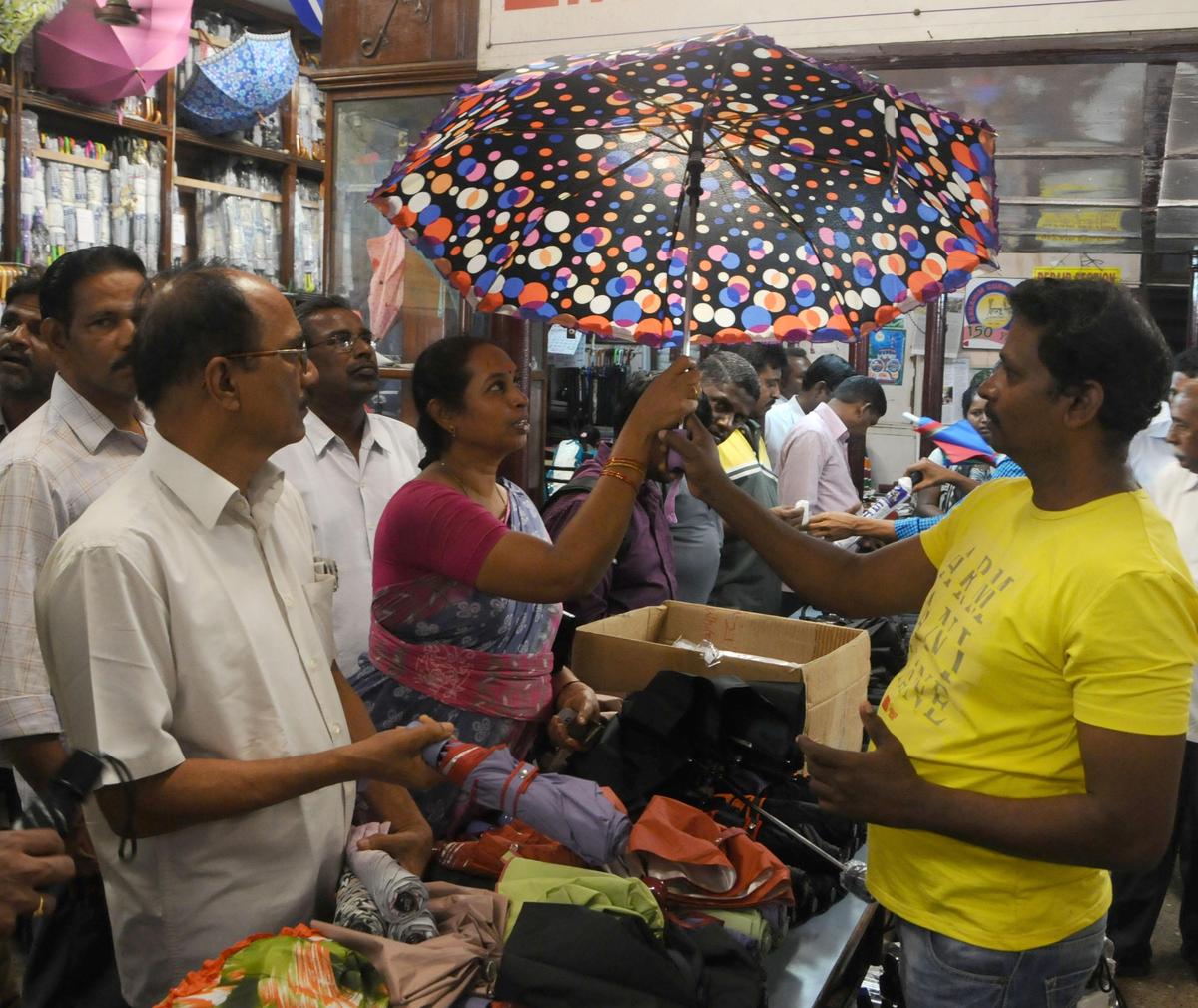
George Town Chennai is not a rainwear district in the formal sense. There is no single street devoted exclusively to umbrellas, raincoats and winterwear, and no obvious signboard directing shoppers to a rainwear market. Yet, ahead of the Northeast monsoon, the historic commercial quarter becomes the city’s most dependable destination for products designed for rain, travel and colder climates. Its importance lies not in a concentrated market, but in a dispersed trading network built around inherited knowledge, wholesale connections and the ability to convert seasonal demand into year-round business.
That pattern reveals something important about how older commercial districts function. George Town’s streets are organised less by a planned retail centre than by accumulated specialisation. Stringer Street is associated with bags, Anderson Street with wedding cards and Godown Street with clothing. Rainwear shopping is more difficult to map because the relevant businesses are scattered across NSC Bose Road, Malayaperumal Street, Mangammal Street, Rattan Bazaar Road and nearby areas. The district’s retail identity is therefore created by memory and reputation as much as by physical concentration.
For customers, this makes George Town a destination rather than a single-stop market. The area requires shoppers to know where to look, or to consult a local directory of businesses. That apparent lack of spatial definition is also part of its strength. Multiple enterprises can operate within the same wider ecosystem while serving different product categories, customer groups and stages of the supply chain.
The businesses identified in the area include Ebrahim Currim & Sons, known for manufacturing and selling Stag umbrellas; MS Rahim Stores, which specialises in raincoats; New Jothi Stores LLP on Malayaperumal Street; Hindustan Industries in the Seven Wells area; and Joonus Sait & Sons on Rattan Bazaar Road. Roadside vendors add another layer to the network, selling umbrellas and lower-priced raincoats when the monsoon becomes active.
This is not simply a story about seasonal shopping. It is a story about how enterprises in a traditional market manage uncertainty. Rainwear demand rises and falls with the monsoon, while Chennai’s winter is too limited to sustain a large winterwear market on local demand alone. The businesses that have survived have done so by combining seasonal products with other lines, widening their customer base and using manufacturing, sourcing and wholesale distribution to reduce their dependence on one city’s weather.
New Jothi Stores illustrates this model particularly clearly. Established in 1968 by Hajji Jamal Mohideen, the business began with a product mix that included bags, luggage bags and cases, raincoats and umbrellas. It is now managed by the founder’s grandsons, Muhammed Mohideen and his cousin Muhammed Sirajudeen, after the business passed through the founder’s sons, Hajji Ajmal Khan and Hajji Mujibur Rahman.
The George Town store is supported by manufacturing units in Mint Street, Athipet and Maharashtra. Each unit is dedicated to manufacturing a specific product, while the business also sources products from elsewhere, including imports. This combination gives the enterprise more control over its range than a purely retail business would have. It also allows the store to respond to demand for different designs and price points without relying on one production location.
The store’s umbrellas range from traditional models to reversible umbrellas, torchlight umbrellas and designs that change colour when wet. The product variety shows how a utilitarian object can be repositioned as a lifestyle or novelty product. Social media influencers have helped amplify some of these designs, according to the account of the business. The underlying commercial logic is straightforward: when a product is useful only in certain weather, design and customisation can help it remain attractive even when the skies are clear.
Political-party-coloured umbrellas offer an especially distinctive example of this strategy. Muhammed Mohideen said such umbrellas sell through the year, with party workers able to display their political allegiance. Legislators place orders for umbrellas in party colours with their names printed on them, he said. The product is therefore not being sold only as protection from rain. It also functions as a customised object for organised groups and political networks.
New Jothi Stores has also extended its market beyond Chennai’s monsoon cycle. As a wholesaler, it supplies raincoats and umbrellas to retailers in Kerala and Karnataka, where the South-west Monsoon creates a different seasonal demand pattern. This regional connection helps turn rainwear into a more continuous business. The store’s bags and luggage segment provides another stabilising line, remaining comparatively steady through the year while umbrella and raincoat sales respond more directly to rainfall intensity.
The structure is different at Joonus Sait & Sons, which was established in 1905 on Rattan Bazaar Road. The business began with rayon, silks and judges’ gowns before woollens and rainwear became its defining products. Its continued presence in Chennai demonstrates how a traditional retailer can preserve a product category that does not correspond neatly to the local climate.
The explanation lies in mobility. The store sells woollen clothing not only to Chennai residents but also to people travelling abroad for education, work and holidays, as well as to those visiting colder parts of India. Its products include brands such as Monte Carlo, sourced from Ludhiana. The store also advises customers on selecting clothing according to their destination and travel duration, and on preserving the items after purchase. Corporate bulk orders form another important part of the business.
Joonus Sait & Sons has expanded to Purasaiwalkam and Adyar, while Usman Sait manages the George Town enterprise with his wife Zulekha and sons Naumaan Sait and Safwaan Sait. The family’s account of the business places continuity at the centre of its operating model. Usman recalls accompanying his father to the store after school and later applying the principles he learned there. His father’s advice — that honesty with customers brings them back — is presented as the family’s guiding rule.
The two businesses represent different versions of legacy retail. New Jothi Stores combines manufacturing, imports, design variation and regional wholesale distribution. Joonus Sait & Sons combines specialist advice, inherited customer relationships, travel-linked demand and a long-established product range. Both, however, depend on more than the physical act of selling goods. Their value lies in knowing what customers need, where products come from, how they should be used and which markets can sustain them when local demand weakens.
That knowledge is embedded in George Town’s urban form. The district’s commercial character has developed through clusters of related trades, family businesses, suppliers, roadside sellers and customers who arrive with a specific purpose. It is not a modern retail park with uniform signage or a single management structure. Its coordination is informal and accumulated over time. The result can be difficult for a first-time visitor to navigate, but it also permits businesses to specialise without losing their connection to a broader marketplace.
The evidence in these enterprises also points to the limits of describing markets only through formal infrastructure. A market can be commercially coherent even when it is spatially dispersed. Its identity may be sustained by reputation, family histories, manufacturing links and repeat customers rather than by a clearly demarcated boundary. In George Town, the rainwear trade exists as a network that shoppers recognise even though it does not occupy one dedicated street.
The district’s future significance will depend on whether such networks can continue to operate amid changing consumer habits and seasonal uncertainty. The supplied account does not establish how rents, traffic, redevelopment, online commerce or changes in wholesale distribution are affecting these businesses. It does show, however, that the enterprises remain adaptable: one has manufacturing units across several locations and supplies two other States, while the other has added branches and serves customers whose destinations may be thousands of kilometres away.
George Town’s rainwear hub therefore offers a grounded view of Chennai’s urban economy. It demonstrates how legacy commercial districts support livelihoods by converting local knowledge into specialised services, how businesses manage climate-dependent demand and how a city’s retail geography can be understood through relationships rather than formal boundaries. Ahead of the Northeast monsoon, shoppers may visit for umbrellas and raincoats. The larger story is how an old market keeps making seasonal products commercially relevant throughout the year.

