


The delay in resuming Krishna water supply to Chennai has given the Water Resources Department an opportunity to intensify maintenance of the canals that carry the water into the city’s reservoir system. But the work also exposes how dependent Chennai’s water security is on a chain of reservoirs and channels whose performance can be affected by storage conditions, silt, vegetation, erosion and the timing of the Northeast monsoon.
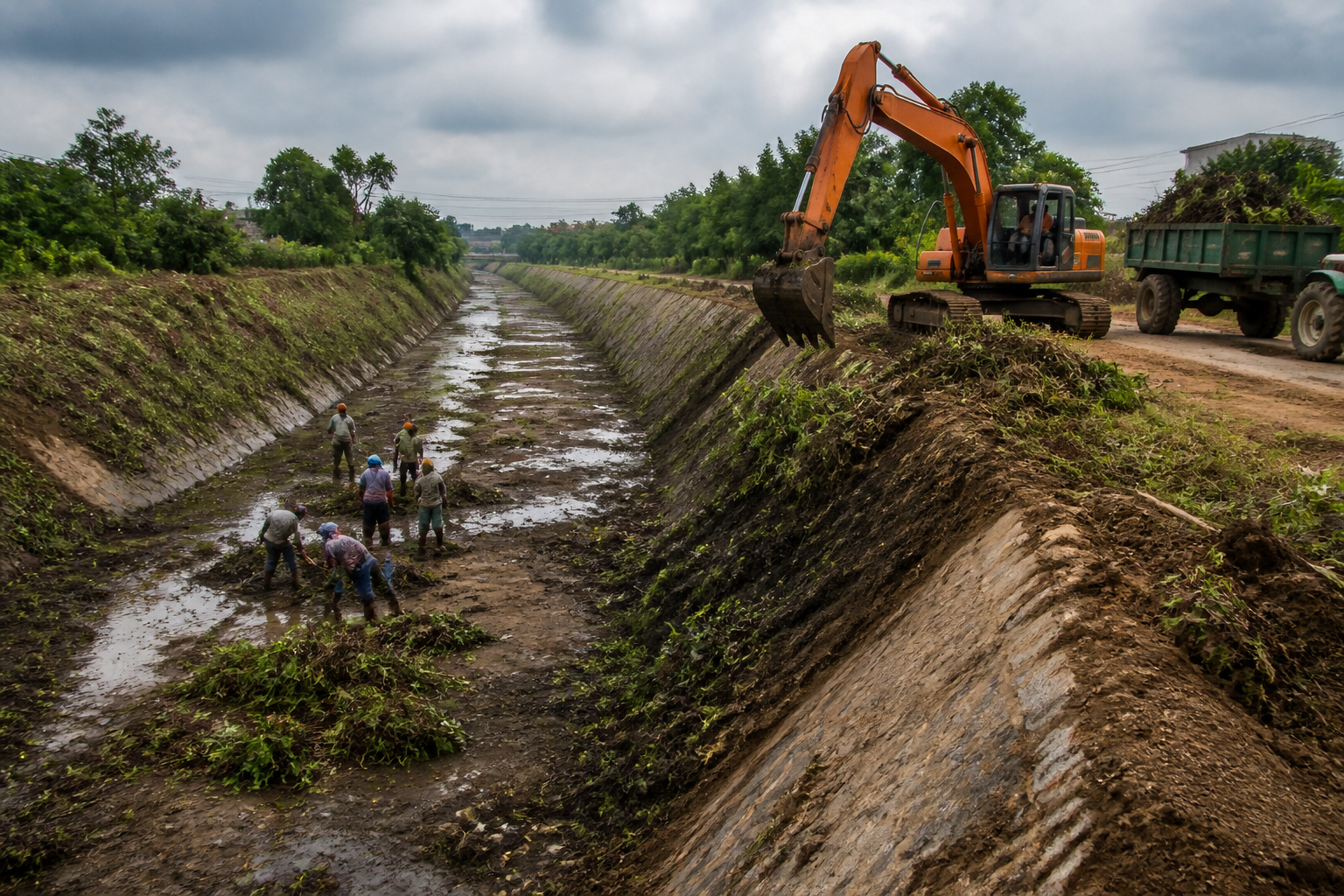
Supply from the Kandaleru reservoir in Andhra Pradesh was halted last month because of inadequate storage in reservoirs in the State. Poondi reservoir, the principal storage point for Krishna water after it enters Tamil Nadu, received nearly 2,250 million cubic feet between July and September this year. With the Kandaleru-Poondi (KP) canal now almost dry, the WRD has accelerated desilting and cleaning in vulnerable sections of the 25-km canal between the entry point at Uthukottai in Tiruvallur district and Poondi reservoir.
The immediate administrative response is practical: use the interruption in water flow to carry out work that would be more difficult once the canal is carrying water. Officials told The Hindu that silt deposits and vegetation are being removed, while sections of the canal bank eroded during heavy rainfall last year are being strengthened. The work is estimated to cost ₹99 lakh and forms part of the department’s preparations for the Northeast monsoon.
An official said the maintenance could improve the free flow of water through the canal by a minimum of 10%. That figure is an operational estimate linked to the removal of obstructions; it does not mean that the city’s overall water availability will rise by the same proportion. The distinction matters because the canal can transport water only when water is available upstream and released through the wider system.
The Krishna water arrangement is therefore not simply a pipeline or a single reservoir project. It is a linked network. Water enters Tamil Nadu through the KP canal, reaches Poondi, and can then be moved through other channels and reservoirs, including Chembarambakkam and Red Hills. Any interruption or constraint at one point affects the timing and management of water movement across the system.
The present maintenance programme illustrates that dependence. Work is under way on the Link canal, which runs for 25 km between Poondi and Chembarambakkam. Desilting of the channel was completed until earlier this week, but further work has stopped because water is being released from Poondi to Chembarambakkam and Red Hills to increase their storage. In other words, maintenance has had to be sequenced around the operational needs of the reservoirs.
This is a familiar challenge in urban water infrastructure: the same channel has to function both as a conveyance system and as a piece of infrastructure requiring periodic intervention. When it is dry, workers can remove silt, clear vegetation and repair damaged banks. When water is released, the immediate priority shifts to moving and storing that water. The department must therefore fit maintenance into short windows created by changes in supply and demand.
The timing is particularly important because Chennai’s water system is approaching the Northeast monsoon, when rainfall can rapidly change reservoir levels and channel conditions. The WRD is clearing vegetation and floating waste from the channels and is continuing this work through the monsoon. At the same time, improvement works on portions of the KP and Feeder canals have been suspended because of the approaching rainy season and are planned to resume in January.
The decision to stop some improvement works before the monsoon suggests that not all maintenance tasks can be treated in the same way. Removing obstructions is being continued where feasible, while larger or more disruptive improvements are being deferred until weather conditions permit. This creates a two-stage preparedness programme: immediate cleaning and flow management before and during the rains, followed by more extensive work after the monsoon.
The Feeder canal, which carries water to Red Hills reservoir, is also being worked on in two reaches. Officials said nearly 70% of the work had been completed. The remaining clearance of floating waste and vegetation is expected to continue until the end of the Northeast monsoon. These parallel works show that the urban water network is being managed as a connected system rather than through a single intervention at Poondi.
The arrangement also reveals the administrative limits of local control. Chennai’s water managers can desilt canals, strengthen eroded banks and regulate the movement of water among reservoirs. They cannot, however, create water in the Kandaleru reservoir or determine storage conditions in Andhra Pradesh. The delay in resuming supply is therefore linked to conditions outside the immediate jurisdiction of the agency responsible for the receiving infrastructure.
That makes the quality of the Tamil Nadu-side network especially important. When upstream supply is uncertain, the city needs its canals and reservoirs to perform efficiently whenever water becomes available. Silted beds, dense vegetation and damaged banks can reduce the effective capacity of the system or slow the movement of water. Maintenance cannot eliminate the risks created by low upstream storage, but it can reduce avoidable losses and operational constraints within the receiving network.
The reported 10% improvement in free flow is significant in that narrower sense. It indicates the potential gain from restoring the designed functioning of an existing canal, rather than expanding the system with a new project. Yet the benefit will depend on whether the canal remains clear, whether repaired banks withstand heavy rainfall and whether releases from upstream are sufficient to use the available conveyance capacity.
The figures supplied in the report also show the difference between storage and distribution. Poondi received nearly 2,250 million cubic feet from July to September, but the continuation of supply was affected by inadequate storage in Andhra Pradesh. Water availability at the receiving reservoir is therefore shaped by both the quantity previously transferred and the capacity to sustain further releases. A three-month inflow figure cannot, on its own, establish how long the city’s wider reservoir system can meet demand.
The same caution applies to the progress figure of 70%. Completion of most of the cleaning work does not mean that the entire water network is insulated from monsoon-related disruption. Floating waste and vegetation will continue to require attention, and some improvement works have been postponed until January. The condition of the channels will therefore remain a moving operational issue through the rainy season.
For Chennai, the larger urban question is whether water resilience can depend on periodic interventions made during brief gaps in the movement of water. The current work is necessary, but its timing shows that the system is often maintained around the availability of water rather than through a fully separate maintenance schedule. That is a consequence of operating a network in which canals, reservoirs and releases are closely interdependent.
The episode also places the Northeast monsoon at the centre of water management. Rainfall can replenish storage, but it can also erode banks, carry waste into channels and complicate construction activity. The WRD’s decision to strengthen sections damaged by last year’s heavy rainfall reflects the need to prepare not only for water scarcity, but also for the physical impacts of intense rain on conveyance infrastructure.
The evidence currently establishes three facts. Krishna water supply to Chennai has been delayed because of low storage conditions in Andhra Pradesh; the Tamil Nadu-side canals are being cleaned and repaired while parts of the system are free of water; and work is being coordinated with releases to Poondi, Chembarambakkam and Red Hills ahead of the Northeast monsoon. It does not establish when Krishna water will resume, how much water will ultimately be released, or what the reservoir levels will be after the monsoon.
Those are the developments that will determine the next phase of Chennai’s water position. For now, the WRD plans to continue clearing floating waste and vegetation through the end of the Northeast monsoon, while improvement works suspended on parts of the KP and Feeder canals are scheduled to resume in January. The maintenance window has improved the readiness of the network, but the city’s water security still depends on the larger chain of storage, release and conveyance across two States.
