


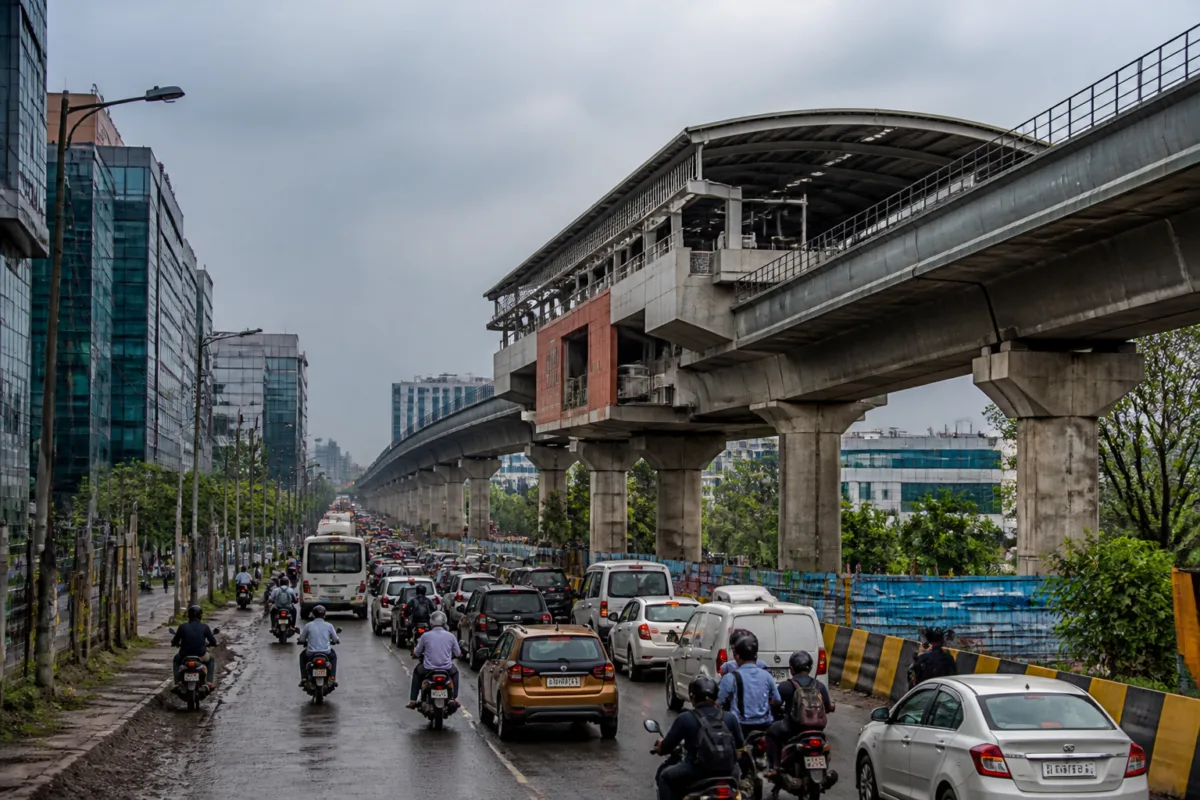
The delayed launch of the Hinjewadi-Shivajinagar Metro is no longer only an inauguration story. It is a test of whether Pune’s transport institutions can convert completed infrastructure into usable public service while thousands of employees in the city’s largest technology corridor continue to lose time, money and mobility to congested roads.
The 23.3-km Metro Line 3 is largely ready, according to the report by the Times of India – Pune, but passenger operations have not begun. Clearance has been secured for 17 of its 23 stations, inspections of two more stations near Balewadi have been completed, and approvals for those stations are expected soon. Four stations remain pending approval. The line’s public launch was also delayed after October because of the Maharashtra Legislative Council election model code of conduct in Pune division.
That combination of near-completion and non-operation creates a distinctive urban problem. A project can be physically advanced but functionally unavailable. For commuters, the difference between a train standing ready and a train carrying passengers is not technical. It determines whether public transport can compete with private vehicles on a daily journey.
The reported delay became more uncertain after Prime Minister Narendra Modi’s proposed visit to Baramati on November 3 was deferred. Expectations had risen that the visit could be linked to the Metro launch. The report says no fresh launch date has been set, while Maharashtra Chief Minister Devendra Fadnavis had said he invited the Prime Minister to inaugurate the line.
This is the first institutional question raised by the delay: who controls the transition from project completion to public operation? The available information points to several dependencies rather than a single missing decision. Station clearances are incomplete, inspections are still being processed, the election model code affected the earlier launch window, and the expected political event that may have provided the inauguration occasion has been deferred. Each condition may be understandable in isolation. Together, they leave commuters without a clear operational timeline.
For a city, that gap matters because transport infrastructure only produces value when it is integrated into everyday movement. Hinjewadi’s employment district generates large commuter flows, and the people quoted in the report describe a daily road environment marked by bottlenecks, narrow underpasses, potholes and heavy traffic. The Metro is therefore being judged not as an abstract infrastructure asset but against the time and stress of reaching the IT park.
The reported commuter experiences show how delay changes household decisions. Anita Jangid, who travels from Baner to Hinjewadi Phase 3, said she bought a car after waiting eight to nine months for the Metro to begin. She said she would have used public transport if the service had started. Her account illustrates how a postponed transit service can strengthen dependence on private vehicles even when a mass-transit alternative is visibly being built.
That is an important distinction in assessing transport projects. The question is not only how much a Metro line costs to construct or how many stations it contains. It is also whether residents can rely on it when making decisions about where to live, how to travel and whether to purchase a vehicle. When the start date remains uncertain, commuters have to plan around the road system that already exists. Some may buy cars, others may continue using private buses or two-wheelers, and all remain exposed to the traffic conditions the Metro was intended to relieve. The supplied report documents the first of these responses but does not establish the scale of the wider shift.
The Line 3 project also shows why station-level approvals are operationally significant. The reported clearance for 17 of 23 stations indicates substantial progress, but the four stations still awaiting approval prevent the line from being treated as fully ready for passenger service. The two additional stations near Balewadi have undergone inspections, suggesting that the approval process is moving, but the report does not provide a confirmed date for their clearance or explain whether the remaining four stations are subject to the same process.
This distinction between construction completion, safety inspection, statutory clearance and inauguration is often blurred in public communication. To commuters, the phrase “ready for months” means that trains and stations appear capable of serving passengers. To operating authorities, readiness may depend on a sequence of formal permissions and safety requirements. The delay becomes politically frustrating when those different meanings are not explained through a public, dated commissioning schedule.
The reported comments from Pavanjit Mane of the Forum for IT Employees capture that frustration. Mane said the Metro had been ready for months and questioned why a 12-km Hinjewadi stretch could not be inaugurated when a 14-km partial Metro stretch in Chennai had been inaugurated by the Prime Minister. He also argued that a public transport service should begin when it is ready rather than when a dignitary is available. These are stakeholder views, not independent proof that the line could legally or safely open immediately, but they identify the central public issue: whether ceremonial scheduling has become more visible than operational accountability.
The election model code adds another layer to the institutional picture. The report attributes the post-October stall to the code of conduct in Pune division. A model code can constrain the timing and form of public events, but the information supplied does not establish whether it prevented the Metro from commencing operations or only affected the launch programme. That distinction is crucial. If safety and statutory approvals were complete, the operational decision could be different from the ceremonial decision. If approvals remained pending, the code would be only one part of the delay.
The currently available station numbers provide a useful measure of progress but not of service readiness. Seventeen of 23 stations had clearance, with two more inspections completed and four still pending approval. Yet the report does not state whether trains have completed all required trial operations, whether staff deployment is complete, what fare structure will apply, or how feeder connectivity will work between the stations and office campuses. Those omissions do not invalidate the reported delay, but they limit what can be concluded about the exact distance between physical completion and passenger operations.
That missing operational information is particularly relevant in Hinjewadi, where the Metro’s usefulness will depend on more than its tracks and stations. The report identifies commuters travelling from Baner to Hinjewadi Phase 3 and describes road bottlenecks and narrow underpasses. It does not provide details of last-mile arrangements, parking, bus interchange or pedestrian access. Without such information, the public debate remains focused on the launch date rather than on whether the complete journey will be reliable.
The delay also reveals a broader policy tension in Indian urban infrastructure: projects are often evaluated at the moment of announcement, construction milestone or inauguration, while the commuter experiences them as a chain of daily services. A line that is opened but poorly connected may underperform. A line that is ready but not opened produces no mobility benefit at all. In both cases, the relevant public measure is not visibility of construction but usable access.
For Pune’s IT corridor, the immediate evidence points to a mismatch between infrastructure availability and administrative finalisation. The Metro has secured clearance for most stations, but not all. A proposed high-profile launch event has been deferred. The earlier launch window was affected by the election code. Commuters continue to report difficult road conditions, while at least one user cited in the report has responded by purchasing a car. These facts establish the shape of the problem without establishing a single cause or a final resolution.
The next meaningful milestone is therefore not another expectation of a VIP visit, but a clearly communicated operational sequence: completion of the remaining station approvals, confirmation of the safety and regulatory position, and publication of a definite passenger-service date. Until those steps are documented, the Hinjewadi Metro will remain a nearly usable asset rather than a functioning alternative to the road journey. Pune’s larger mobility challenge is visible in that gap: building the infrastructure is only one part of delivering public transport.

