


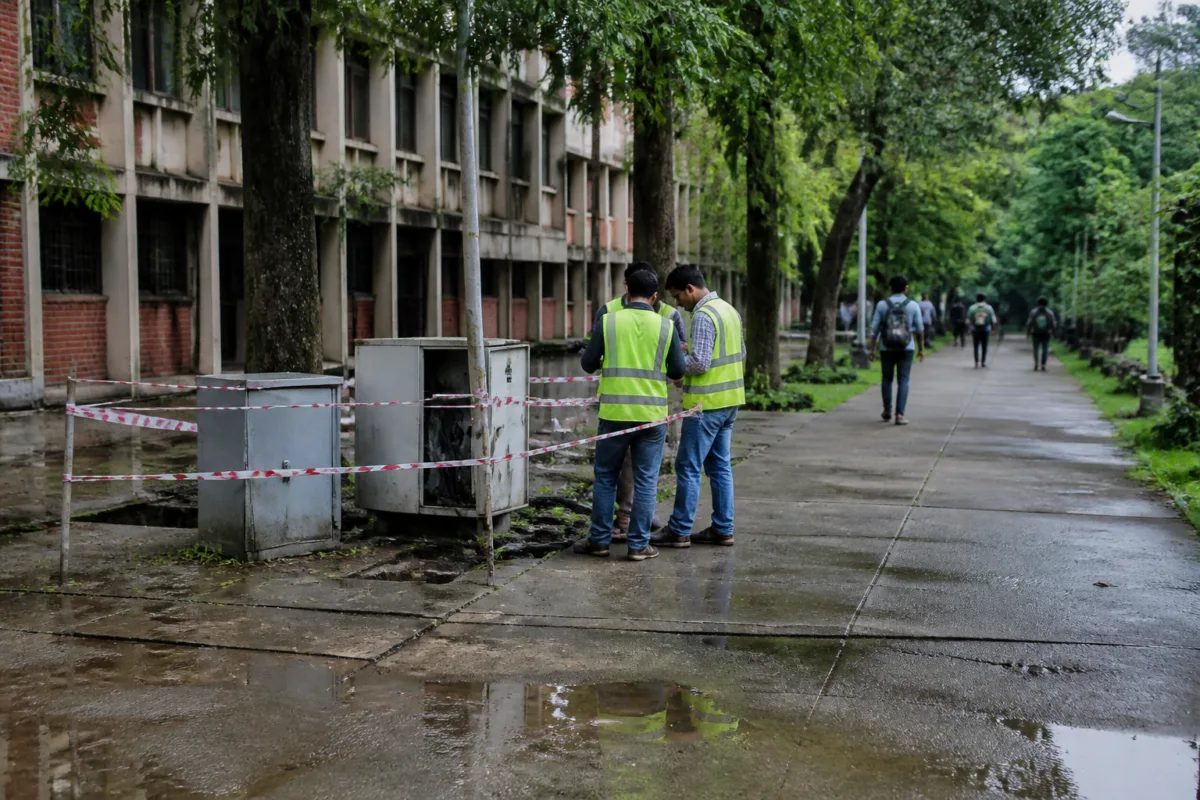
The delayed submission of a magisterial probe into the electrocution death of PhD scholar Jyoti at Panjab University has brought a broader institutional failure into focus: the gap between having electrical safety rules on paper and maintaining a campus where those rules work at ground level. The enquiry reportedly found a damaged low-tension cable running partially above ground at South Campus, recommended action against several engineering officials and called for a comprehensive electrical safety audit.
Jyoti, 28, a PhD scholar in microbiology, died on July 28 near Girls Hostel No. 8 at Panjab University’s South Campus. According to the Times of India report, the enquiry was conducted by a sub-divisional magistrate and submitted to Chandigarh deputy commissioner Nishant Yadav around October 6. More than two weeks later, the university was still awaiting the report, despite an assurance that it would be forwarded within two days.
The delay matters because the report is not limited to identifying a physical defect. It examines the chain of responsibility behind electrical inspection, maintenance and complaint handling. It recommends departmental action against the sub-divisional engineer, junior engineer and electrical inspector, while calling for individual responsibility to be fixed after examining duty-allocation orders, inspection registers and complaint records.
That approach is important in large institutional campuses, where responsibility for public safety is often distributed across several administrative levels. A dangerous cable may be the immediate hazard, but the risk can persist because inspection schedules, maintenance contracts, complaint registers and escalation procedures are treated as separate administrative tasks. When those systems are not connected, a visible defect can remain unresolved until it causes injury or death.
The report reportedly found a 400 sq mm low-tension cable with a damaged outer sheath and defective armouring. The cable was running partially above ground between pillar boxes and a footpath. This is not merely an engineering detail. Low-tension electrical infrastructure often occupies the spaces through which residents, students, workers and visitors move every day. Where wiring is exposed, damaged or insufficiently protected, the boundary between technical infrastructure and public space effectively disappears.
The location near a girls’ hostel also highlights the particular safety responsibilities of residential campuses. Hostels combine high pedestrian movement, round-the-clock occupancy and dependence on shared services. Students may use footpaths and open areas during rain, power interruptions or routine movement between buildings. A campus cannot be treated as a restricted industrial installation when its electrical assets are embedded in everyday public circulation.
The enquiry’s reference to waterlogging risks adds another layer to the safety problem. Electrical hazards become more difficult to detect and more dangerous to manage when rainwater accumulates around footpaths, cable routes, pillar boxes and drainage points. The report therefore recommends evaluating waterlogging risks alongside electrical repairs, rather than treating the two as unrelated maintenance issues.
The case also raises questions about the timing and effectiveness of inspections. The enquiry calls for mandatory pre-monsoon checks and immediate repair of exposed or damaged wiring. Such measures are meaningful only when they produce verifiable records: which assets were inspected, who inspected them, what defects were found, who was assigned the repair and when the work was closed. Without that chain, a pre-monsoon inspection can become a compliance exercise rather than a safety control.
The reported findings point to a need for campus-wide asset visibility. A large university may have cables, distribution boxes, electrical panels, earthing systems, generators and other equipment spread across academic buildings, laboratories, hostels, roads and open spaces. The risk profile changes when assets age, construction work shifts routes, drainage patterns change or temporary connections become permanent. A safety audit must therefore identify the location and condition of infrastructure, not simply confirm that inspections have taken place.
The enquiry has also reportedly urged strict implementation of the Central Electricity Authority’s 2013 safety regulations. Its recommendations include clearer staff accountability and emergency standard operating procedures. These provisions address two separate institutional weaknesses. Regulations establish the technical standard, while accountability and emergency procedures determine whether the standard is applied consistently and whether a hazard is acted upon before an incident escalates.
The reported reinstatement of two engineering officials who had been suspended after Jyoti’s death, before the probe concluded, further complicates the accountability question. The available account does not establish the basis for their reinstatement or whether it was subject to conditions. It does, however, show why disciplinary action and technical investigation can become difficult to separate in public institutions. A suspension may be an interim administrative measure, while responsibility requires examination of records, assigned duties and the sequence of decisions.
The report’s recommendation to examine duty-allocation orders, inspection registers and complaint records offers a document-based route to resolving that question. Those records can establish whether officials were assigned responsibility for the affected area, whether inspections were required, whether defects had been reported and whether any response was recorded. They can also reveal whether responsibility was concentrated in one office or fragmented across multiple units.
At the same time, the report reportedly states that the final medical cause of Jyoti’s death remained unconfirmed pending forensic results of sent samples. This distinction is essential. The enquiry may identify severe electrical safety lapses and recommend departmental action, but the final medical and legal conclusions depend on the completion of the relevant forensic process. Infrastructure failure, administrative responsibility and medical causation are connected parts of the case, but they are not interchangeable findings.
The episode illustrates a recurring governance challenge in institutional campuses: safety is often managed as a technical function even though its consequences are public and administrative. Engineering departments may control electrical assets, university authorities may control budgets and staffing, and district officials may conduct inquiries after an incident. If routine maintenance is not monitored at the level of the institution’s senior administration, defects can remain confined to technical registers while exposing thousands of people to risk.
A campus-wide electrical safety audit, as recommended by the enquiry, would shift the response from an incident-specific investigation to a system-wide assessment. Its value would depend on coverage and follow-through. The audit would need to include residential and academic areas, footpaths, exposed cable routes, drainage interfaces, pillar boxes and locations where students and staff regularly gather. It would also need a mechanism for recording urgent repairs and publicly accountable completion timelines within the university’s administrative structure.
The reported recommendations on emergency standard operating procedures are equally significant. Electrical incidents require rapid isolation of supply, access control, medical response and preservation of the site for investigation. In a residential campus, students and staff may be the first people to encounter a hazard. Clear procedures can reduce confusion, but only if the responsible personnel, contact channels and escalation hierarchy are known in advance and tested through routine preparedness.
The case therefore moves beyond the question of whether one cable was defective. It asks whether Panjab University had an operating safety system capable of detecting defects, assigning responsibility and correcting hazards before they became fatal. The answer will depend on the findings in the delayed report, the university’s response to its recommendations and the completion of the forensic process.
What the available account establishes is that the enquiry identified serious electrical safety deficiencies at South Campus, recommended action against engineering officials and called for a campus-wide audit, pre-monsoon inspections, repairs to damaged wiring and clearer accountability. What remains to be established is how the cable reached that condition, whether earlier complaints or inspections recorded the risk, why the report was delayed in reaching the university and what corrective action will now be completed. Those documents and implementation milestones will determine whether the case produces lasting safety reform or remains an isolated administrative response to a preventable death.

