


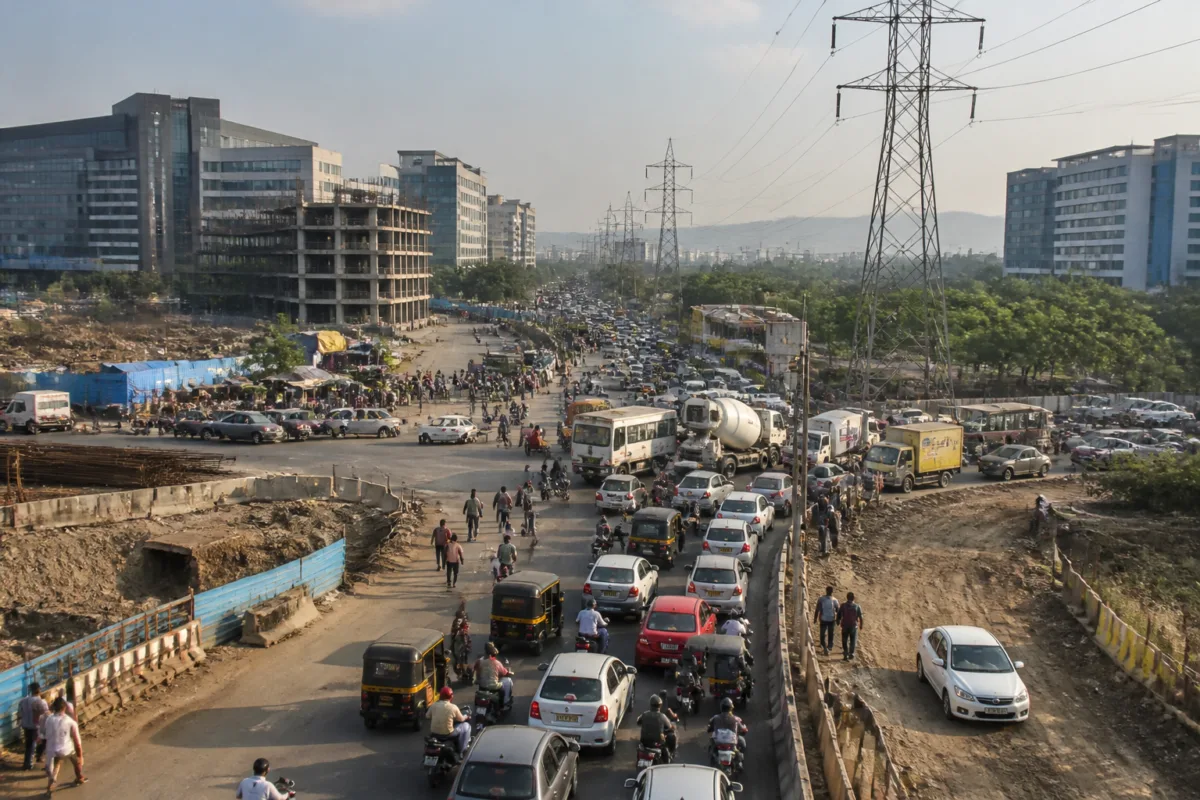
The move to accelerate land acquisition for six Development Plan (DP) roads in Hinjewadi-Maan-Marunji places Pune’s rapidly urbanising western edge at a critical implementation stage. District Collector Jitendra Dudi has directed officials to complete the Transferable Development Rights (TDR) process within a month and finish tendering and administrative preparations so that road works can begin from December, according to a report by Lokmat – Pune.
The directions followed a review meeting on November 2 covering traffic congestion, poor road conditions, water supply, civic services in the industrial area and infrastructure projects in the Hinjewadi-Maan-Marunji belt. Officials from the Pune Metropolitan Region Development Authority (PMRDA), Maharashtra Industrial Development Corporation (MIDC), Public Works Department, police, municipal administration and other departments attended the meeting.
The significance of the decision lies in the fact that the proposed roads are not being treated as isolated construction projects. Their progress depends first on land assembly, agreement with landowners, compensation or development-rights arrangements, administrative approvals, tendering and coordination between multiple public agencies. The collector’s instructions bring these linked processes into a single time-bound administrative framework, although the supplied report does not establish whether the deadlines will be met.
Land acquisition is the immediate bottleneck identified in the report. Officials have been instructed to obtain consent letters from landowners and complete the acquisition process for all six DP roads. Two of the roads have reportedly received consent from farmers through an FSI-based arrangement, allowing those cases to move ahead in the first phase. The report does not specify the length, alignment, estimated cost or carrying capacity of any of the six roads, so the precise mobility benefit cannot yet be assessed.
The use of FSI and TDR in the land process also shows how urban authorities are attempting to assemble land without relying only on a conventional cash-acquisition route. In the reported arrangement, farmers have agreed through an FSI mechanism for two roads, while the remaining roads require separate meetings with landowners. The process therefore combines planning permissions, landowner consent and development rights with the physical delivery of public infrastructure.
That sequence matters because a DP road exists first as a planning proposal and becomes useful to residents only when its land is secured, designed, funded, tendered and built. The collector has asked the concerned chief engineer and land acquisition officials to speed up the work and complete the TDR process within one month. A time-bound programme for acquisition of all six roads and a plan for starting construction are to be presented at the next meeting.
The road issue is part of a wider infrastructure deficit described in the review. The meeting also examined traffic congestion and deteriorated roads in the area, along with storm-water drainage and junction upgrades. Funding approval has been received for storm-water drainage, junction improvement and other infrastructure works in Hinjewadi, the report said. Departments have been asked to prepare the required proposals, estimates and tenders urgently and complete the approval process in preparation for starting physical works in December.
This makes the review significant beyond the six DP roads. Roads, junctions and storm-water systems function as a network. A new road without adequate junction capacity may shift congestion rather than resolve it. Similarly, road construction without drainage can leave the same corridor vulnerable to waterlogging or pavement damage. The supplied report does not provide engineering details or performance data, but the simultaneous review of roads, junctions and storm-water infrastructure indicates that the authorities are considering several connected components of the urban system.
The institutional structure is equally important. PMRDA, MIDC, the Public Works Department, police, municipal authorities and other departments have different responsibilities, jurisdictions and approval processes. The collector’s meeting attempts to align these agencies around common deadlines. PMRDA is relevant to regional planning and development, MIDC to the industrial-area context, the police to traffic management, and municipal and public-works agencies to civic infrastructure and construction responsibilities. The report does not identify the precise executing agency for each road or work package, leaving that as an important detail for subsequent planning documents and tenders.
Water planning formed another major part of the meeting. With the population and industrial demand in the area increasing, the Maharashtra Jeevan Authority has been asked to prepare a detailed presentation on planning for two TMC of water. The authority has also been asked to explain the current status of supply, available sources and future planning. The report does not state whether the two-TMC figure is an approved allocation, a proposed requirement, or a planning target. That distinction will be important when the detailed presentation is submitted.
The water direction connects the road programme to the larger question of how urban expansion is serviced. New roads can improve access and support development, but urban growth also increases demand for water, drainage, waste collection and other basic services. The review’s inclusion of water supply alongside transport infrastructure suggests that the administration is examining the area as a growing urban and industrial settlement rather than only as a traffic corridor.
Solid waste management was also placed on the agenda. The Pimpri-Chinchwad Municipal Corporation has been directed to enter into agreements with surrounding gram panchayats to collect waste from nearby villages and dispose of it according to prescribed procedures. The report says the administrative process should be completed and a regular and effective solid-waste-management system put in place.
This direction raises a governance question common to expanding urban regions: the built-up area and its daily service needs often extend across formal administrative boundaries. Waste generated in settlements near the municipal edge may not fit neatly within the existing service jurisdiction. The proposed agreements indicate an attempt to create an institutional arrangement for collection and disposal across those boundaries, although the report does not provide details on costs, facilities, service standards, monitoring or the number of villages involved.
The evidence supplied by the report therefore points to an implementation challenge rather than a single project announcement. The immediate milestones are clear: complete the TDR process for the two roads with farmer consent, hold separate discussions for the remaining roads, prepare a time-bound acquisition and construction schedule, complete proposals and tenders for drainage and junction works, and submit a detailed two-TMC water-planning presentation. These actions are administrative prerequisites; they are not themselves proof that construction or service improvements have been delivered.
For residents, workers and businesses in Hinjewadi-Maan-Marunji, the practical value of the announcement will depend on whether these processes move from meetings and approvals to visible work on the ground. The source report establishes official directions and deadlines, but it does not yet establish land acquisition completion, tender awards, construction progress, water augmentation or the functioning of a new waste-management arrangement.
The next review meeting will be the key checkpoint identified in the report. Officials are expected to present the time-bound programme for acquiring land for all six DP roads and the plan for beginning physical work. Until those documents and subsequent implementation updates are available, the development should be understood as a coordinated administrative push to unlock infrastructure in a congested and rapidly growing urban area, rather than as completed road or civic-service delivery.

