


The Haryana Human Rights Commission’s call for a time-bound safety audit of every school in the state has shifted attention from one alleged assault in a Panchkula government school to the systems that are supposed to prevent children from becoming unsupervised, unaccounted for or unable to access immediate medical care. Its order identifies possible failures in staffing, classroom supervision, CCTV monitoring, school safety planning and emergency response.
The order followed the alleged brutal assault of a six-year-old girl by an eight-year-old schoolmate inside an empty classroom. The commission has not recorded a final finding on the guilt of the child allegedly involved or the culpability of school officials. Its observations are prima facie and, according to the report, were based on newspaper reports. That distinction is important because the commission’s intervention is not a final adjudication of the incident. It is an examination of whether the school’s institutional safeguards functioned as required.
The central question raised by the case is not simply whether individual staff members should face action. It is whether a school can maintain safe operations when teacher shortages force multiple classes into a common room, when children can move between floors without being noticed, when CCTV coverage or monitoring is uncertain, and when an injured child is reportedly found only after nearly two hours.
## Haryana school safety audit and the staffing problem
The commission has asked for details of the sanctioned and working strength of teachers, student enrolment and class-wise deployment on the day of the incident. The report states that a shortage of teaching staff on October 28 resulted in children from Bal Vatika and Classes I, II and III being accommodated in a common classroom.
That detail reveals a distinction often lost in school administration: complying with a pupil-teacher ratio does not automatically mean that children from different classes can be placed together without a separate supervision plan. The commission referred to the prescribed 30:1 ratio under the Right to Education Act but clarified that the ratio cannot be treated as a justification for combining classes or leaving children without proper supervision.
Staffing, therefore, is not only a question of the total number of teachers on a school’s rolls. It also concerns how teachers are deployed during absences, how different age groups are managed, who supervises movement outside the classroom and whether responsibility remains clear when multiple classes are combined.
The order seeks information that could establish whether the school had an operational arrangement for that day. Without those details, the available account cannot establish whether the reported shortage was a one-off disruption or part of a wider staffing pattern. It does, however, show why a safety audit must examine deployment at classroom level rather than rely only on sanctioned posts or aggregate pupil-teacher ratios.
## Supervision is a movement system, not only a classroom duty
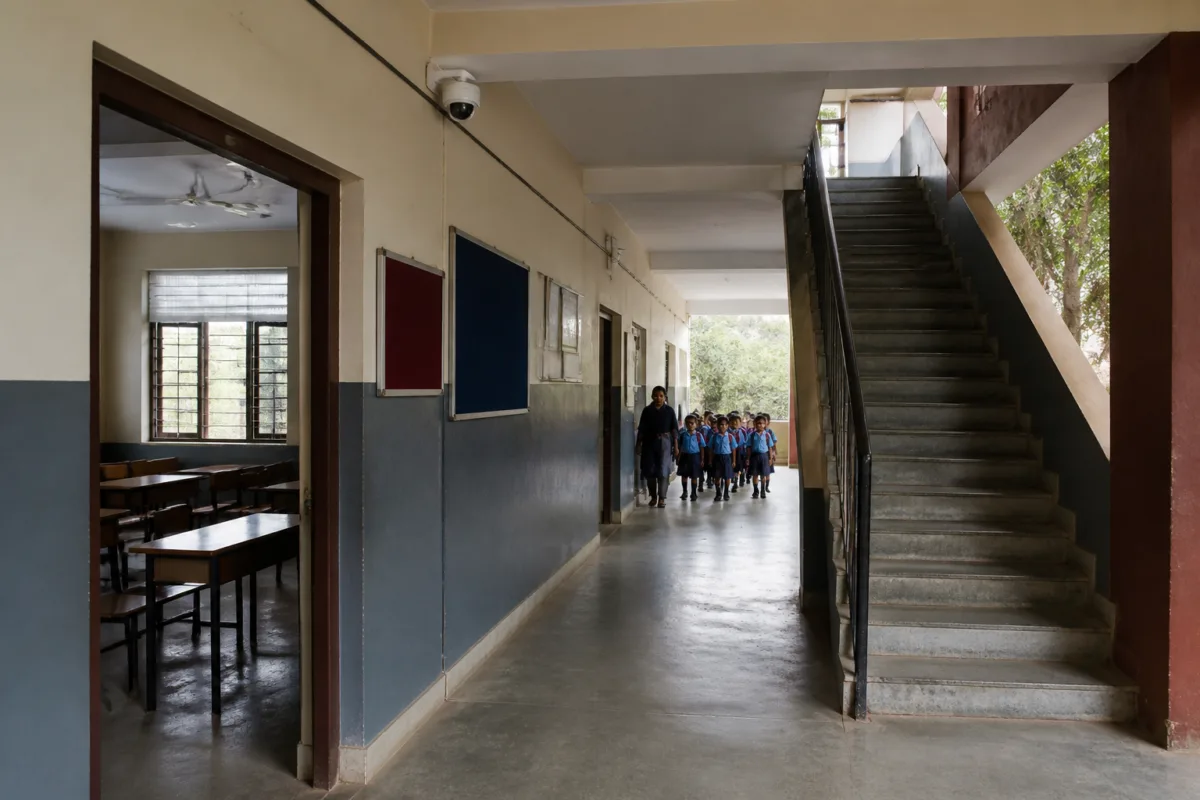
The commission also questioned how the girl could have moved from the common classroom to an empty classroom on the first floor without being noticed by teachers or other staff members. This focuses attention on a basic but frequently under-documented part of school safety: the movement of children through corridors, staircases and rooms outside their assigned classroom.
A safe school is not defined only by the condition of its buildings. It also requires a system that accounts for where children are expected to be, who is responsible for them during transitions and how an unexplained movement is detected. The order’s request for details about the sequence of events is significant because it seeks to reconstruct the chain of supervision rather than isolate the incident to the room where the alleged assault occurred.
The reported delay of nearly two hours before the injured child was found adds a second layer to the same problem. It raises questions about attendance checks, classroom visibility, staff rounds and procedures for responding when a child is missing from a group. The supplied report does not establish which specific safeguard failed, but the commission’s questions indicate that the response system itself requires examination.
## CCTV cannot substitute for accountable supervision
The commission has sought complete CCTV footage from the school, including coverage of corridors, staircases and the first-floor classroom. It has also asked for details of camera coverage, operational status and monitoring arrangements.
This is a reminder that installing cameras is not the same as creating a functioning surveillance system. Coverage must include the routes children use, equipment must be operational and footage must be monitored or retrievable when an incident occurs. A camera that does not cover a staircase, is not working or is not checked in time may provide little practical protection.
The commission has also sought verification of the allegation that the classroom door was bolted from outside and subsequently locked. The report cites the Haryana School Safety Regulations, 2017, which require classrooms to remain open and prohibit locking classroom doors. If the allegation is established, it would raise a direct compliance issue rather than merely a question of staff judgment.
The distinction between a safety rule on paper and an operating practice inside a school is at the heart of the proposed audit. The commission has asked the state government’s compliance report to identify deficiencies, corrective measures, responsible authorities and implementation timelines. That format could make it possible to distinguish between rules that exist, rules that are understood and rules that are actually followed.
## Medical response is part of school infrastructure
The commission has separately sought details of the time taken to provide medical assistance and to shift the child from a private hospital to Civil Hospital in Sector 6, Panchkula, and later to PGIMER, Chandigarh. Health authorities have been asked to examine allegations of delays in treatment and referral.
This expands the meaning of school safety beyond prevention. A school’s emergency system must also provide immediate assistance, communicate with families and authorities, and connect an injured child to appropriate medical care. The order does not establish that a delay occurred or identify its cause. It does establish that the sequence of treatment and transfers is considered material to the inquiry.
The inclusion of medical response in the safety audit is important for another reason. School safety responsibilities are distributed across departments and institutions. Education authorities manage school operations, police examine the circumstances of an incident, district officials coordinate administration and health authorities deal with treatment and referral. The commission’s request for reports from all these bodies reflects the fact that a child-safety failure can cross institutional boundaries within minutes.
## Haryana’s safety framework requires functioning documents
The commission referred to the Haryana School Safety Regulations, 2017, and emphasised the requirement for a functional school safety committee. It also listed mandatory documents, including a child protection document, movement plan, communication plan and crisis management plan.
These documents are not useful merely as records for inspection. A movement plan should clarify how children are supervised while moving through the school. A communication plan should identify how staff, parents and emergency services are contacted. A crisis management plan should set out responsibilities when a child is injured or cannot be located. The commission’s proposed audit will be meaningful only if it tests whether these plans are current, understood and used.
The order also calls for adequate CCTV coverage, regular monitoring, counselling facilities and immediate medical assistance. Taken together, the recommendations describe school safety as an operating network rather than a single facility or piece of equipment. Teacher deployment, supervision, surveillance, counselling and emergency care are connected controls. A weakness in one can place additional pressure on the others.
The commission has additionally recommended age-appropriate behavioural awareness programmes, counselling for children, identification of bullying and aggressive behaviour, and parent awareness on positive parenting and the responsible use of digital platforms, including exposure to violent online games and content. These recommendations extend the response into prevention and rehabilitation while avoiding a purely punitive approach.
The child allegedly involved in the assault, the commission stressed, is entitled to treatment under the juvenile justice framework, including appropriate assessment and rehabilitative intervention. That position separates institutional accountability from the rights of children involved in a serious incident.
## What the order establishes—and what it does not
The supplied report establishes that the commission has sought a state-wide, time-bound safety audit and detailed reports from the school education department, Panchkula police commissioner, deputy commissioner, PGIMER Chandigarh, the director general of health services in Haryana and the civil surgeon of Panchkula. It also establishes that the next hearing is scheduled for January 28.
It does not establish the final sequence of the incident, whether the classroom door was locked, whether CCTV equipment was functional, whether medical treatment was delayed or whether any particular official was responsible. Those questions remain subject to the reports and further proceedings requested by the commission.
That limitation is central to understanding the case. The order is not proof that every school in Haryana faces the same conditions, nor does it establish that all the alleged lapses occurred. Its significance lies in converting a local incident into a structured administrative inquiry covering every school in the state.
The larger urban and institutional question is whether public services protect children through documented rules alone or through daily systems that remain functional during staff shortages, irregular movement, emergencies and institutional handovers. For schools, safety is experienced at the level of a classroom, corridor, staircase, camera feed or hospital referral—not at the level of a policy document.
The next measure of the state’s response will therefore be the quality of its compliance report: whether it identifies school-level deficiencies, assigns responsibility, specifies corrective action and provides timelines. The commission’s January 28 hearing is the next formal point at which those answers are expected to be examined.

