


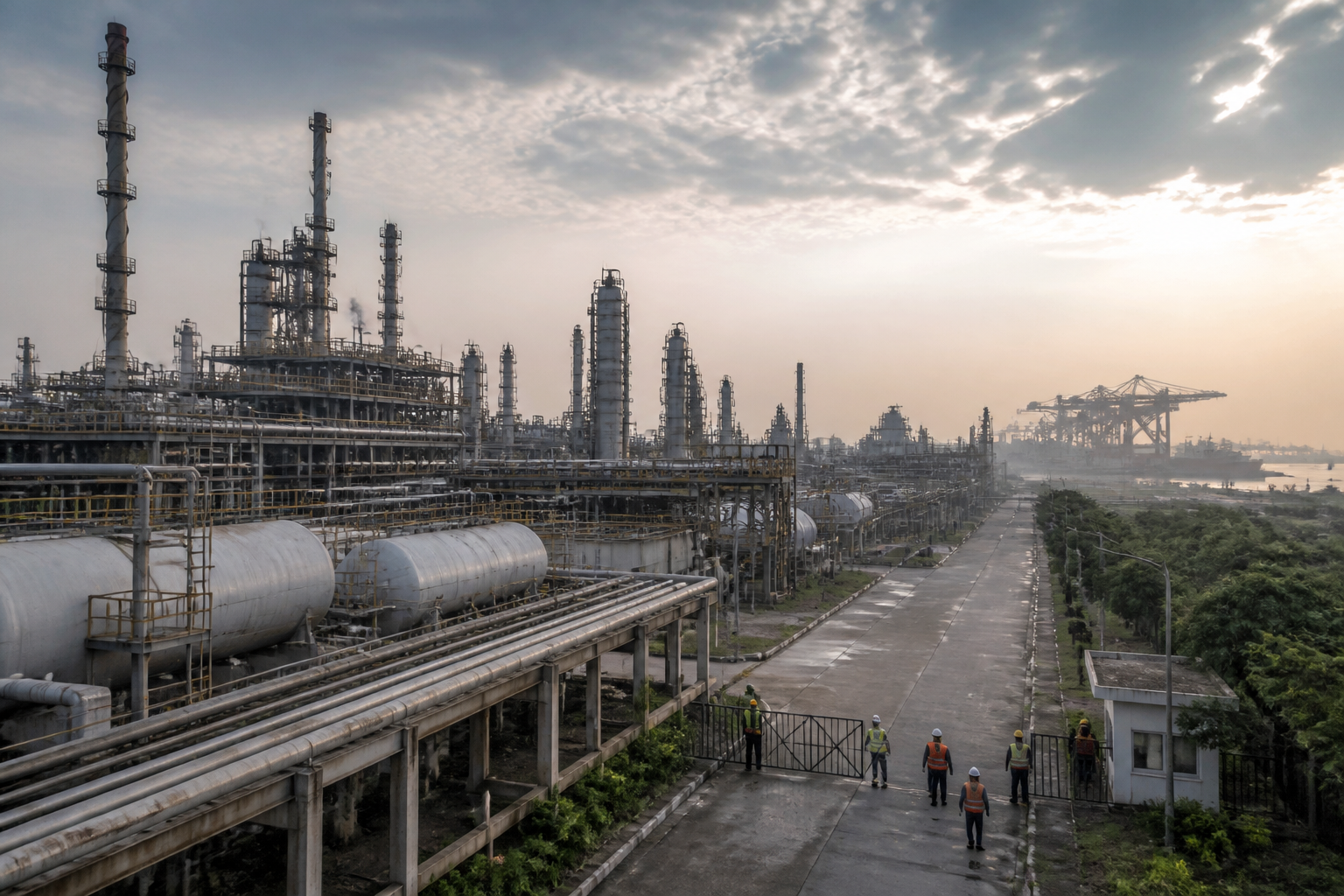
The reported inauguration of a Rs 6,000-crore phenol and acetone complex in Haldia has placed West Bengal’s industrial revival agenda back at the centre of the state’s economic debate. The project is being presented as a major step towards reducing India’s dependence on imported industrial chemicals, but its wider significance will depend on whether Haldia can convert a large anchor investment into sustained manufacturing, local employment, worker safety and better-connected industrial growth.
According to The Statesman, Bengal Chief Minister Suvendu Adhikari announced the facility at AdPerMa Private Limited, a wholly owned subsidiary of Haldia Petrochemicals Limited. The report describes the plant as India’s largest integrated phenol and acetone facility. The chief minister said the project would generate around 400 direct jobs and another 1,000 indirect jobs, while also announcing further industrial proposals and a new policy intended to attract investment into the state.
The immediate industrial case is straightforward. Phenol and acetone are important chemical inputs used across manufacturing, including pharmaceuticals, plastics, resins, coatings and other industrial applications. The report says the new complex is intended to end India’s dependence on imports of the two chemicals. That claim places the Haldia facility within a national manufacturing and supply-chain objective, rather than treating it as an isolated project.
Yet import substitution by itself does not establish an industrial ecosystem. A chemical plant can become a stronger regional economic asset when it is connected to downstream manufacturers, reliable utilities, logistics, skilled labour and emergency-response systems. It can also remain an enclave if the surrounding industrial land, transport links, training institutions and public services do not develop at the same pace. The Haldia announcements are therefore significant because they combine a large chemical investment with proposals for food manufacturing, medical equipment, data infrastructure and worker healthcare.
The report says the state government announced that a Pepsi manufacturing plant would come up on 98 acres in Haldia, with land already provided by the Haldia Development Authority. It also reported that 50 acres would be allotted to Truviss for a medical equipment manufacturing unit. The state Cabinet was expected to approve the Pepsi project, according to the chief minister’s announcement. These proposals indicate an attempt to broaden Haldia’s industrial base beyond petrochemicals, although the supplied material does not establish construction schedules, financing arrangements, production capacity or final approvals for either project.
That distinction matters for industrial planning. Announced investment, land allotment, Cabinet approval, construction and commercial production are separate administrative stages. Each requires different forms of documentation and coordination. Land availability may resolve one constraint, but it does not by itself guarantee environmental clearances, utility connections, access roads, financing, contractor mobilisation or operational viability. The proposed industrial policy, which the chief minister said would be unveiled before Diwali, is expected to contain investment incentives, land-allocation provisions and power tariffs. Its eventual design will reveal whether Bengal is offering a predictable framework or mainly a package of project-specific assurances.
Haldia’s existing institutional geography gives the announcement additional importance. The town combines a major industrial zone with port-related infrastructure and facilities associated with petrochemicals, oil and energy. The Statesman report says the chief minister described Haldia’s industrial and port infrastructure as crucial to the economic interests of West Bengal and neighbouring regions. This places the town within a wider logistics system in which raw materials, finished products and industrial equipment must move efficiently between factories, ports, markets and suppliers.
The industrial revival question is consequently also an infrastructure question. New plants create demand for power, water, waste management, roads, freight movement, warehousing and emergency services. Chemical manufacturing creates a particular need for strong safety systems and specialised response capacity. The planned trauma centre is relevant in this context not simply as a healthcare announcement, but as part of the public infrastructure required to support a high-risk industrial landscape.
The report says a 50-bed trauma centre with a burn unit will be opened in Haldia by June 2027. The proposed funding package includes Rs 18 crore from the Haldia Development Authority, Rs 5 crore from Indian Oil Corporation under its corporate social responsibility programme and Rs 5 crore under the National Health Mission. The announcement provides a clear example of multi-institutional financing: an urban development authority, a public-sector company and a national health programme are being brought together for a facility serving industrial workers.
This arrangement also raises questions about responsibility and continuity. A trauma centre requires more than a capital grant. It needs trained staff, equipment, maintenance, ambulance access, referral arrangements and operating funds. The supplied report does not provide details on staffing, management or integration with existing hospitals. Those details will matter when the project moves from announcement to delivery, particularly because industrial injuries can require specialised burn care and rapid transport.
The employment figures attached to the chemical complex are modest compared with the size of the investment: approximately 400 direct jobs and 1,000 indirect jobs, according to the chief minister. That does not diminish the project’s possible value, but it changes how its economic impact should be assessed. Large capital-intensive facilities may generate fewer direct jobs than labour-intensive factories, while creating demand in maintenance, logistics, services, contracting and downstream manufacturing. The quality, stability and local accessibility of those jobs will be as important as the headline investment figure.
The government’s proposed response is to link industrial expansion with local skills. The report says the chief minister called for closer coordination between companies and technical institutions, including CIPET and Durgachak ITI, to train fitters, welders, fire-safety personnel and other workers. Haldia Petrochemicals chairman Purnendu Chatterjee was also said to have expressed interest in employing locally trained young people.
This is an important institutional connection because industrial land and industrial labour markets do not automatically align. If local residents do not possess the qualifications required by new plants, companies may recruit from outside the region even when unemployment remains high nearby. Training programmes can reduce that mismatch, but only if course content, certification, placement and employer demand are coordinated. The reported focus on technical and fire-safety skills suggests that the proposed model is intended to respond to specific industrial requirements rather than provide general training alone.
The political explanation offered for Bengal’s industrial decline is more contested. The Statesman report says Adhikari blamed militant trade unionism during the 34-year Left Front regime, followed by what he described as flawed land policies, withdrawal of incentives and syndicate-related problems during the subsequent 15 years. He also claimed that more than 50,000 industrial units had shut during the Left Front years. These claims are presented in the report as political statements by the chief minister; the supplied material does not provide an independent dataset or official study to assess them.
That limitation is relevant because industrial policy is shaped not only by incentives but also by institutional credibility. Investors assess land access, labour relations, electricity costs, transport reliability, regulatory timelines and the consistency of government decisions. The proposed policy’s impact will therefore depend on how clearly these issues are addressed and whether the provisions apply consistently across projects. A business-friendly declaration has limited value if companies cannot predict the time and cost of obtaining approvals or connecting to essential infrastructure.
The reported pipeline of investment is substantial. The chief minister said a further Rs 10,000 crore was in the pipeline and referred to proposals involving Indian Oil Corporation and Haldia Energy. He also urged Haldia Petrochemicals’ chairman to establish a data centre in Bengal, promising government support. However, the report does not establish whether these proposals have reached formal approval, financing or construction stages. Treating them as a pipeline rather than completed investment is therefore essential.
The proposed data centre also shows how the state is seeking to connect traditional industrial infrastructure with newer digital demands. Data centres require reliable power, cooling systems, connectivity and land, and they may have limited direct employment compared with their capital requirements. Their wider value can arise from digital services and business infrastructure, but the supplied material does not provide details about the proposed facility’s capacity, location, power demand or development timeline.
Taken together, the Haldia announcements reveal a layered industrial strategy. The chemical complex is the anchor project. Food manufacturing and medical equipment are intended to diversify production. A possible data centre represents a digital infrastructure ambition. Skills training addresses labour supply, while the trauma centre addresses worker safety. The industrial policy is expected to provide the framework linking these components through incentives, land and electricity tariffs.
The central urban and regional question is whether these elements will be implemented as a coordinated system. Haldia’s future industrial performance will not be determined by investment value alone. It will also depend on the capacity of the Haldia Development Authority, state departments, industrial companies, technical institutions, health agencies and public-sector enterprises to work across institutional boundaries. The proposed trauma centre’s funding model already demonstrates how many actors may be involved in a single piece of industrial infrastructure.
The evidence currently confirms an ambitious set of announcements around a major chemical facility and a broader promise of industrial expansion. It does not yet establish the final status of every proposed project, the detailed provisions of the new industrial policy, or the implementation arrangements for the trauma centre and skills programme. Those milestones will determine whether Haldia’s new chemical complex becomes a standalone manufacturing investment or the foundation of a deeper industrial ecosystem in Bengal.

