


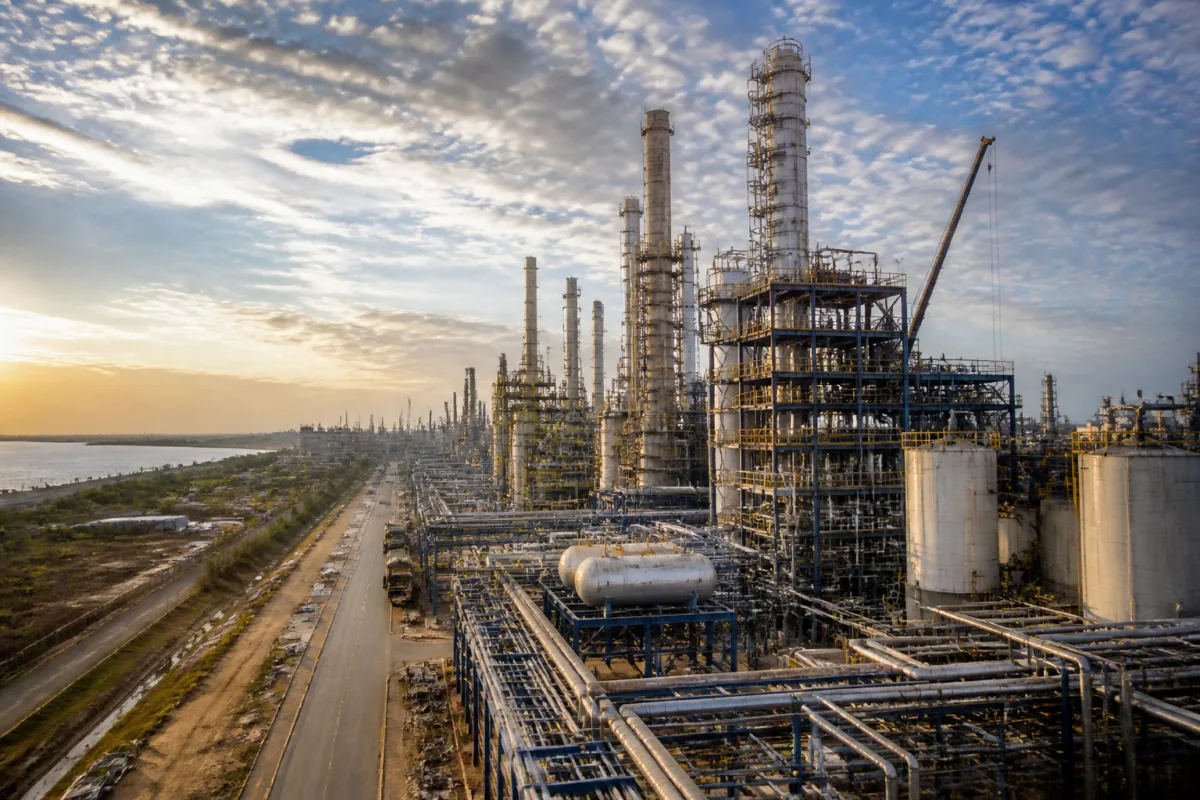
Deepak Fertilisers and Petrochemicals Corporation’s FY27 second-quarter results show a company gaining sharply in profitability while operating across several pressure points in India’s industrial and agricultural economy. Consolidated net profit rose 84.7% year on year to ₹393.8 crore, revenue increased 10.9% to ₹3,334 crore and EBITDA climbed 61.4% to ₹749 crore. But the more important development is not the headline profit increase alone. It is the way the company is trying to reduce its exposure to commodity cycles through an integrated value chain, higher-value products and new production capacity.
The results, released on 13 November, present DFPCL as a business linked to multiple urban and infrastructure systems. Its technical ammonium nitrate business serves mining and special projects, while its industrial and speciality chemicals businesses supply sectors including pharmaceuticals, solar chemicals, healthcare sanitation and other industrial applications. Its crop nutrition operations connect the company to agricultural demand and the availability of key raw materials. This spread gives the company more than one source of demand, but it also exposes it to different forms of disruption, from monsoon-dependent markets to supply-chain blockages and export restrictions.
The reported profit growth therefore needs to be read alongside the changing composition of revenue and margins. DFPCL’s EBITDA rose from ₹464 crore to ₹749 crore, while its EBITDA margin improved from 15.4% to 22.5%. Revenue growth was considerably slower than profit growth. That gap indicates that operational profitability, product mix or cost absorption made a major contribution to the quarter’s performance, although the supplied results do not provide a detailed bridge explaining the precise contribution of each factor.
The company’s management attributed its performance to an integrated chain running from LNG to ammonia and downstream products. Chairman and Managing Director S. C. Mehta said this structure helped reduce exposure to fluctuations in supply and costs and supported profitability across different market conditions. The statement is significant because it identifies supply-chain control, rather than only end-market demand, as a central part of DFPCL’s strategy.
For an industrial chemicals company, the distinction matters. A business dependent mainly on standard commodities can face sharp swings in prices, input costs and margins. DFPCL said it is moving towards solution-based products, with speciality products, Croptek and business-to-consumer products contributing more to the business. The stated aim is to strengthen customer relationships and make earnings more sustainable. The results show some movement in that direction, although the company has not supplied a full segment-level profitability breakdown in the material available.
The technical ammonium nitrate business illustrates both the opportunity and the limitation of the current model. Revenue from mining and special projects increased 25% year on year, but sales volume declined 8%. The company attributed the volume fall mainly to weaker demand during the monsoon and restrictions on exports. In other words, higher revenue did not come from greater volume in this part of the business. The performance reflects the importance of pricing, product mix or other commercial factors, while also showing that the physical demand environment remains uneven.
Technical ammonium nitrate is closely connected to mining activity and special projects, making the segment relevant to the infrastructure and construction ecosystem. Mining supplies feed industrial production and infrastructure materials, while special projects can create demand for controlled blasting inputs. However, the results do not establish a broader trend for India’s mining sector or quantify the effect of the company’s products on infrastructure delivery. What they do show is that DFPCL’s exposure to this market is commercially important and sensitive to weather and trade conditions.
The company’s business-to-consumer revenue grew 40% and accounted for 16% of total segment revenue, compared with 14% in the same quarter a year earlier. This remains a minority share, but the increase supports management’s stated effort to move beyond conventional commodity products. It also suggests an attempt to build more direct customer relationships instead of relying entirely on large industrial buyers or bulk channels.
In the pharma and speciality chemicals business, nitric acid sales volume increased 14% year on year to 80 kilotonnes. Isopropyl alcohol sales volume stood at 17 kilotonnes. The company also reported sequential improvement in RGP supplies despite continuing disruptions. DFPCL said it expanded its speciality product portfolio for solar chemicals, healthcare sanitation and pharmaceutical applications. These details point to a wider industrial strategy: use existing chemical capabilities to serve several specialised end markets rather than depend on a single demand cycle.
That strategy is being tested by the crop nutrition business. The company identified low rainfall in key markets, limited availability of phosphoric acid, higher raw-material costs and high industry inventory levels as major challenges. These pressures affect both demand and margins. Low rainfall can reduce farm application and purchasing, while expensive or constrained inputs can raise production costs. High inventory across the industry can further delay new orders as distributors and customers work through existing stocks.
DFPCL said it is focusing on irrigated and higher-potential markets to accelerate growth in crop nutrition. The supplied material does not quantify the size of these markets or set out a detailed implementation plan. Still, the response reveals a shift towards selective market allocation rather than uniform expansion. In a business influenced by weather, water availability and agricultural cycles, targeting irrigated regions may help reduce some demand volatility, although the results do not establish how effective that approach has been so far.
The next major test is capacity. DFPCL said two large development projects are close to completion: a nitric acid complex at Dahej and a technical ammonium nitrate project at Gopalpur. Both projects are approximately 98% complete, and the commissioning process is under way. The company expects them to begin operations in the fourth quarter of FY27.
These projects matter because they connect the company’s financial performance to physical industrial capacity. New plants can improve supply security, strengthen the company’s position in the relevant product segments and support additional growth. They can also change the balance between in-house supply and external procurement. Management said the projects would strengthen its position, ensure supply and support the next phase of growth, but the supplied report does not include project costs, planned capacity, financing details or expected revenue contribution.
The distinction between completion and commissioning is important. At 98% completion, the projects are near the operational stage, but they have not yet been described as fully commissioned. The company’s stated Q4 FY27 timeline is therefore the next milestone to monitor. The eventual contribution will depend on the commissioning process and the company’s ability to secure demand and inputs across the relevant markets. No independent assessment of construction progress or commissioning readiness is included in the source material.
The results also show why industrial expansion cannot be understood through earnings alone. DFPCL’s performance was delivered despite what Mehta described as volatility caused by the United States-Iran conflict and supply-chain disruptions. At the same time, the company faced monsoon-related weakness, export restrictions, limited phosphoric acid availability and higher raw-material costs in different parts of its portfolio. The company’s integrated structure may provide some protection against these pressures, but it does not eliminate exposure to them.
The larger urban question is how India’s industrial and infrastructure systems will secure reliable access to essential chemical inputs as demand becomes more specialised. DFPCL’s portfolio touches mining, crop nutrition, pharmaceuticals, sanitation, solar chemicals and industrial applications. Those links are not identical, but together they show how chemical manufacturing sits behind several systems that cities and industries depend on. Supply interruptions in these chains can affect project execution, agricultural markets and manufacturing operations, even when the disruption is not visible to end users.
The quarter confirms three things. DFPCL delivered substantial profit and EBITDA growth; higher-value and consumer-facing products are becoming more prominent in its stated strategy; and two major projects are nearing commissioning. It also leaves several issues unresolved: the exact drivers of margin expansion, the financial scale of the new projects, the duration of supply constraints and the recovery path for crop nutrition demand. The next evidence will come from the commissioning of the Dahej and Gopalpur projects and from whether the company can sustain stronger profitability while managing uneven volumes and continuing input-market volatility.

