


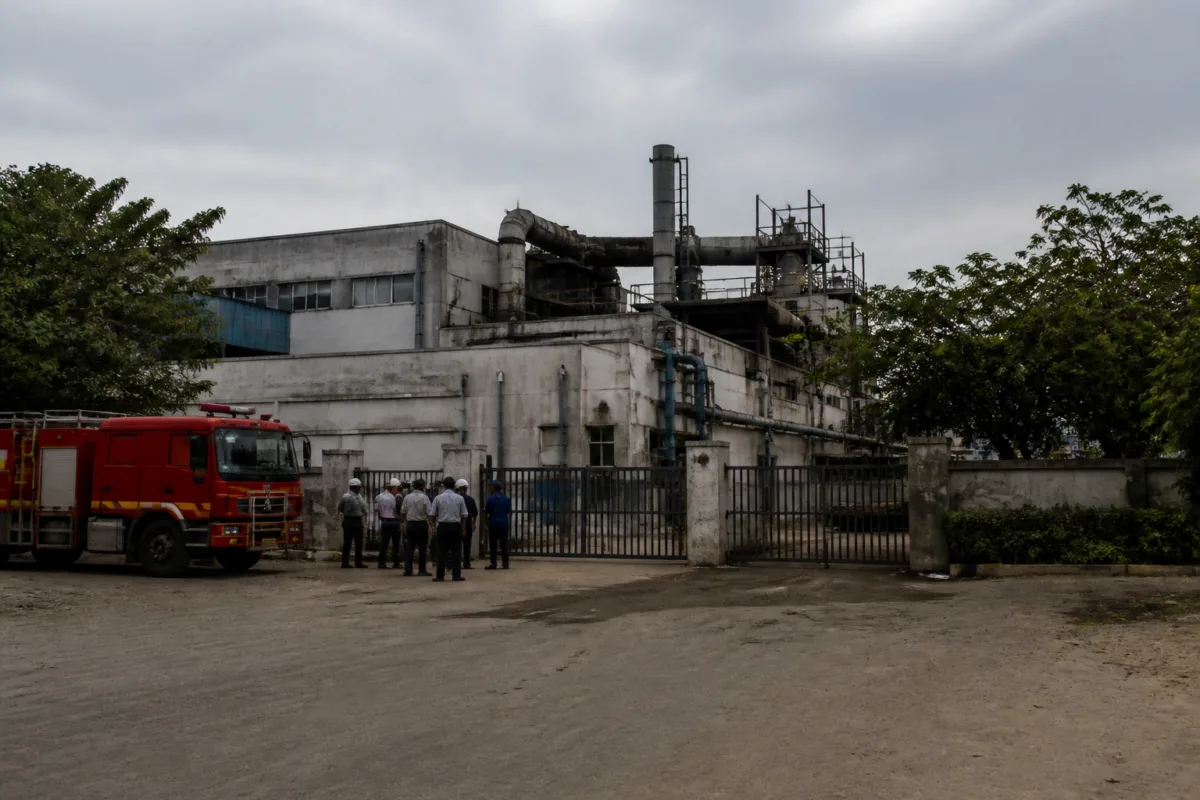
The Telangana Pollution Control Board’s closure of Saraca Laboratories’ Sangareddy unit after a chloroform vapour leak killed two workers has exposed a gap between regulatory permission to operate and the safeguards needed to control a hazardous industrial process. The board found that the bulk-drug and intermediates manufacturer lacked chloroform leak-detection alarms, had a broken venting arrangement and did not have equipment that could adequately arrest vapour emissions.
The order, issued on October 23, directed the unit at Gaddapotharam village in Jinnaram mandal to stop industrial activity immediately. It also ordered disconnection of power, citing safety failures, consent violations and risks to public health and the environment. The closure was ordered without a hearing, and the board sought compliance within 24 hours and power-disconnection compliance within 48 hours.
The immediate event occurred around 11.30 pm on October 22 in Production Block No. 2. According to the board’s order, chloroform vapours escaped during the separation of a layer from a first-floor reactor to a ground receiver. General manager Madhu and deputy general manager Yogeshwar Rao told inspectors that the vapours accumulated and spread rapidly. About 1,750 litres of chloroform separation layer were reportedly present in the reactor, although the order does not establish how much material escaped.
Two people became unconscious and were declared dead at Narayana Hospital. Police identified them as Sudarshan Rao, 27, and Balaji, 44, both from Andhra Pradesh. Police also said six other workers became seriously ill and began investigating the cause of the incident and the unit’s safety arrangements. The Telangana Human Rights Commission sought a report from the district collector by November 26.
The inspection findings are significant because they describe not only an accidental release but a chain of missing or damaged controls. Inspectors found that the scrubber’s high-density polyethylene vent line and valve were broken and had fallen. They also recorded spillages near the duct and a lingering chloroform smell. Volatile organic compound readings reached 20 parts per million at the incident point and 0.1 parts per million outside the block. The order did not identify these readings as chloroform-specific concentrations, an important limitation when assessing the precise scale of exposure.
The unit had a double-stage scrubber, but inspectors found no sub-cooler condenser followed by an activated charcoal bed. The board also found no leak alarms or sensors specifically capable of warning workers about chloroform emissions. These details indicate that the question was not limited to whether a leak occurred. It also concerned whether workers and supervisors had the means to detect the release early, contain it and prevent vapours from spreading through the production area.
That distinction matters in industrial safety. A consent to operate can establish that an installation has received permission under a regulatory framework, but the inspection described in the order shows that operating permission did not guarantee that every physical safeguard was available or functioning at the time of the incident. The unit’s consent for operation had been auto-renewed in March 2026 until March 31, 2031. The same record also cites complaint-related and non-compliance directions issued between 2020 and August 2026.
The juxtaposition of those dates creates the central governance issue in the case. The facility had a valid operating consent for several years, yet the inspection after the deaths found a broken vent line, missing control equipment and no chloroform leak-detection alarms. The supplied report does not establish when the equipment failed, whether the missing systems had previously been installed, or how the auto-renewal process assessed the condition of safeguards. Those unanswered questions are now more important than the existence of the consent itself.
The board’s order also refers to previous requests to the collector for an inquiry into buffalo deaths in earlier incidents, including an assessment of compensation payable by industries. This places the Saraca episode within a wider record of complaints and industrial consequences in the area, although the available material does not establish whether those earlier incidents involved the same unit, the same substance or the same failure pattern.
The geography is also relevant. Saraca Laboratories’ unit is located in Gaddapotharam village in Jinnaram mandal, within the Sangareddy industrial belt. The incident occurred inside a production block, but the board’s decision cited risks to public health and the environment, making the matter broader than an internal workplace accident. The inspection recorded a lower VOC reading outside the block, but the report does not provide enough information to determine the extent of any off-site exposure or environmental impact.
The institutional response is divided across several authorities. The Pollution Control Board issued the closure and power-disconnection directions. The police began investigating the cause and safety arrangements after Patancheru deputy superintendent of police Prabhakar informed the board’s RC Puram office. The Human Rights Commission sought an inquiry report through the district collector. The order also directs the unit to stop industrial activities and warns that continued operation, including through generators, could attract prosecution.
This distribution of responsibility illustrates why industrial accidents often become governance tests. The pollution regulator examines consent conditions, emissions and environmental safeguards. Police investigate deaths and possible criminal liability. The district administration handles inquiries and compensation-related processes. The Human Rights Commission examines the rights and welfare implications. The available report does not say whether these investigations have been consolidated or whether any authority has issued a final finding on responsibility.
There is also an unresolved documentary inconsistency in the board’s directions. Instructions on wastewater and debris disposal refer to a “fire accident”, while the incident narrative describes a chloroform vapour leak and does not establish that a fire occurred. That wording may be an administrative reference to another part of the order, but the supplied material does not clarify it. Such inconsistencies matter because emergency response, waste handling and liability assessments depend on an accurate description of the event.
The case therefore reveals three distinct layers of risk. The first is process risk: chloroform was being handled during layer separation, and vapours reportedly accumulated rapidly. The second is equipment risk: the vent line and valve were broken, while additional control systems and leak alarms were absent. The third is oversight risk: the facility’s operating consent had been renewed even though the subsequent inspection identified serious safety deficiencies. The evidence does not show that the renewal directly caused the deaths, but it does show that permission to operate and actual safety conditions were not the same thing.
What remains uncertain is as important as what has been established. The board’s order does not quantify the leaked volume. The VOC readings were not identified as chloroform-specific. There is no implementation report accompanying the closure and power-disconnection directions. The police investigation is ongoing, and the Human Rights Commission has sought a collector’s report rather than issued a final determination. The material also does not establish whether the six workers who became seriously ill were exposed inside the production block, how long they remained there or what treatment they received.
The next stage will be to establish whether the closure was implemented, whether power was disconnected within the stipulated period and whether the unit stopped operations entirely. The police investigation, the collector’s report sought by the Human Rights Commission and any further Pollution Control Board findings will determine whether the incident is treated as an isolated equipment failure or as evidence of wider non-compliance. Until those records are available, the strongest conclusion supported by the evidence is that a valid operating consent did not prevent a hazardous process from being run with critical safeguards missing or damaged.

