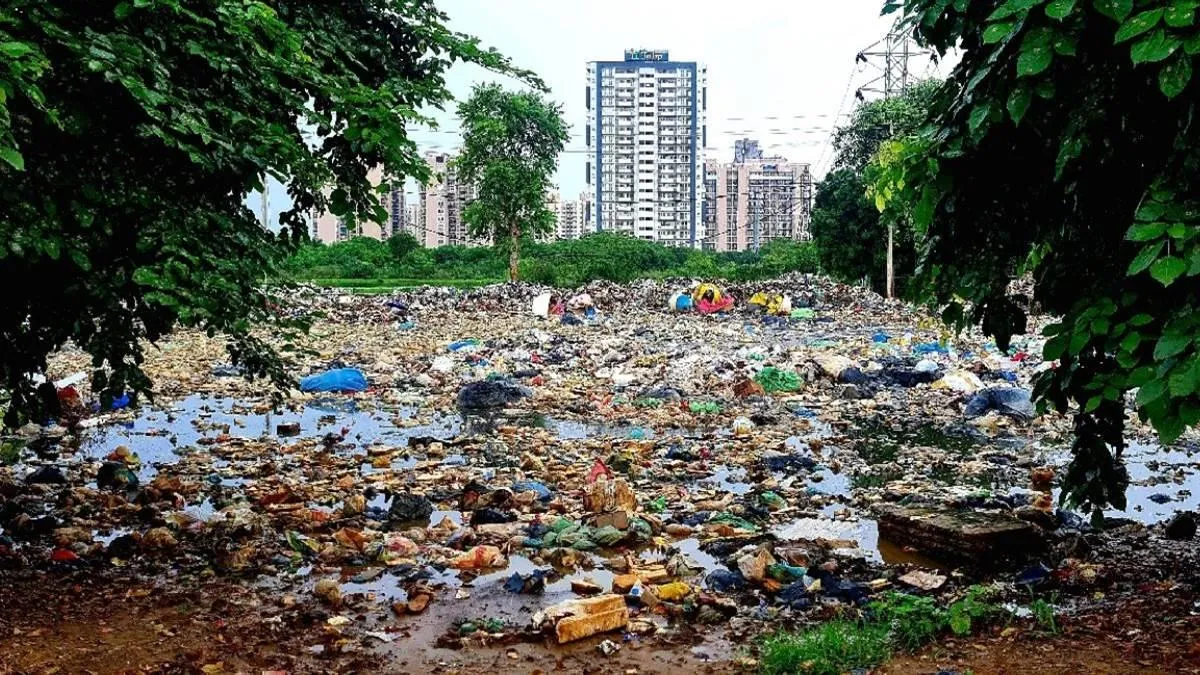
Gurugram’s urban sanitation network is facing mounting pressure as a prolonged municipal workers’ protest disrupts waste collection across several residential and commercial zones, exposing long-standing vulnerabilities in the city’s public service systems and labour management practices.
With waste accumulation reported in multiple sectors and market areas, the disruption has begun affecting neighbourhood hygiene, pedestrian movement and local business activity in parts of the Millennium City. The situation has also renewed questions around the sustainability of urban sanitation operations in rapidly expanding NCR cities where civic infrastructure growth has struggled to keep pace with population density and real estate expansion. The ongoing sanitation strike, led by municipal workforce groups, has entered its second week, with workers demanding employment protection, restoration of service continuity, and improved labour conditions for contractual staff engaged in city cleaning operations. A significant portion of the workforce involved in sanitation services has reportedly been operating on temporary arrangements for years, despite the city’s increasing waste generation and urban spread.
Residents from several sectors across Gurugram have reported irregular garbage lifting, overflowing collection points and reduced street sweeping activity. High-footfall public areas, including transport hubs and traditional market clusters, have also witnessed deteriorating cleanliness conditions over recent days. Urban governance experts say the disruption highlights the dependence of large Indian cities on underpaid contractual sanitation labour, particularly in regions experiencing rapid real estate growth and infrastructure-led urbanisation. They note that inconsistent workforce policies and staffing shortages can directly affect public health, climate resilience and environmental sustainability in dense urban centres. The Gurugram sanitation strike has also emerged at a sensitive time for the city’s civic administration, with national urban cleanliness assessments expected later this month. Analysts tracking municipal performance indicators say prolonged service interruptions could affect not only public perception but also broader efforts around waste segregation, landfill reduction and sustainable urban management.
Resident welfare associations in several neighbourhoods have reportedly begun arranging temporary private cleaning support in response to delayed municipal services. However, urban planners caution that ad hoc measures cannot replace a stable citywide sanitation framework, particularly in a metropolitan region generating significant volumes of mixed waste each day. Municipal officials have acknowledged operational disruptions and indicated that limited services are continuing through available workforce capacity while discussions remain underway with protesting groups. Civic administrators are also understood to be assessing contingency arrangements to prevent further deterioration in densely populated residential clusters. The Gurugram sanitation strike has once again underscored how labour instability within essential urban services can quickly evolve into a larger civic and environmental challenge. As NCR cities continue expanding through high-density housing, commercial corridors and transit-led development, experts argue that future-ready urban governance will require stronger investment in workforce welfare, decentralised waste systems and resilient public sanitation infrastructure.