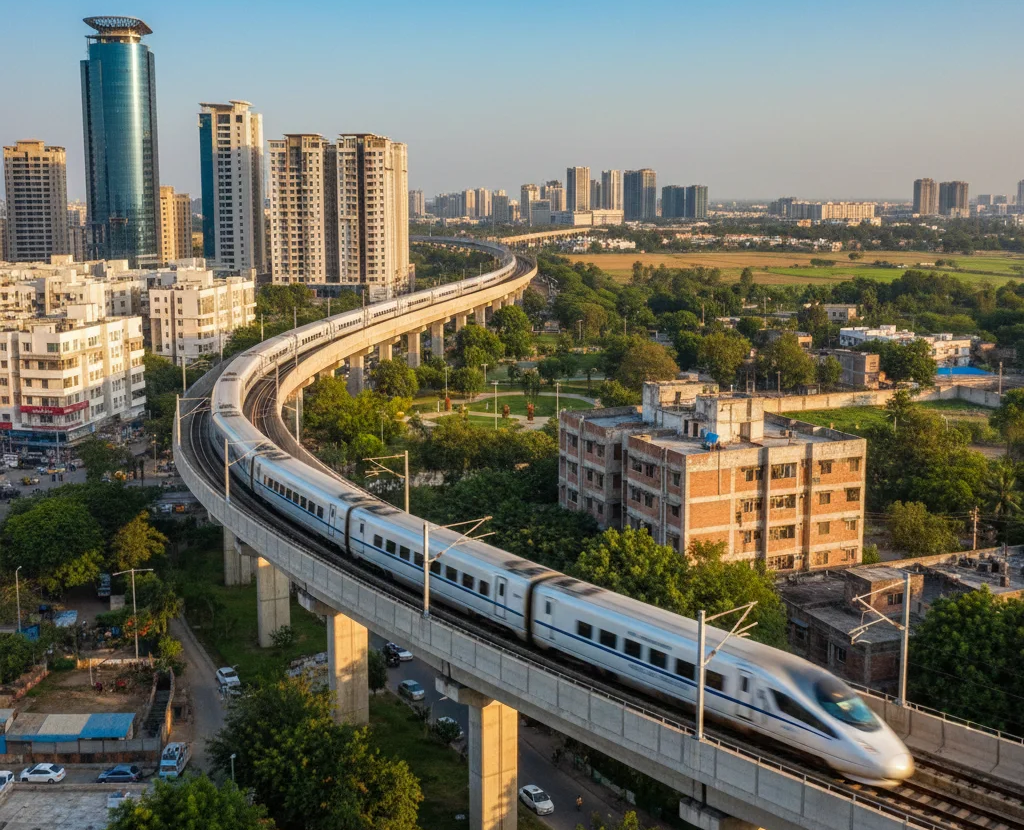
Gurugram RRTS Land Push Reshapes Regional Mobility
A major land transfer proposal linked to the Regional Rapid Transit System (RRTS) corridor is expected to accelerate high-speed regional mobility planning in Gurugram, reinforcing the National Capital Region’s push towards integrated and lower-emission public transport infrastructure. The move is being viewed as a significant step in reducing dependence on private vehicles while improving cross-city connectivity for daily commuters.
Officials familiar with the development said land parcels required for the proposed transit alignment are likely to be handed over to the implementing agency in phases, enabling survey work, utility relocation, and future construction activity to move forward. The corridor forms part of a broader regional transport strategy aimed at connecting economic clusters across Delhi-NCR through faster and more efficient rail-based systems. Urban planners believe the Gurugram segment could become a crucial mobility intervention as traffic congestion and long commute times continue to strain productivity across the NCR. Large volumes of office commuters currently rely on road transport between Gurugram, Delhi, and neighbouring districts, resulting in rising vehicular emissions and pressure on urban infrastructure. The proposed RRTS corridor is expected to improve travel efficiency while supporting transit-oriented urban growth around future stations. Experts note that such projects can help cities reduce unplanned sprawl if integrated carefully with affordable housing, pedestrian infrastructure, and mixed-use development policies.
Recent weather fluctuations across NCR, including unseasonal rain and cooler conditions recorded during April, have also renewed conversations around climate-responsive urban infrastructure. Environmental observers argue that investment in mass transit systems such as the RRTS corridor is becoming increasingly critical as cities confront worsening air pollution, heat stress, and transport-related carbon emissions. Meteorological data from the region showed that intermittent rainfall during early April helped moderate temperatures temporarily, delaying the onset of extreme heat conditions. However, transport and climate experts caution that episodic weather relief cannot offset long-term urban environmental pressures driven by rapid construction activity and rising vehicle density. Industry analysts say improved regional rail systems could influence future real estate patterns in Gurugram by shifting demand towards mobility-linked growth corridors.
Commercial and residential development near proposed transit nodes often attracts investor interest, though planners warn that infrastructure-led expansion must remain aligned with environmental safeguards and public service capacity. The RRTS corridor is also expected to support labour mobility across NCR by reducing travel uncertainty for workers commuting between employment hubs. For many residents, reliable public transport remains closely tied to access to jobs, education, and healthcare. Authorities are expected to finalise additional procedural clearances and coordination mechanisms before full-scale implementation advances. Urban policy observers say the long-term success of the project will depend not only on engineering execution but also on how effectively the corridor integrates with existing metro, bus, and non-motorised transport systems across the region.