


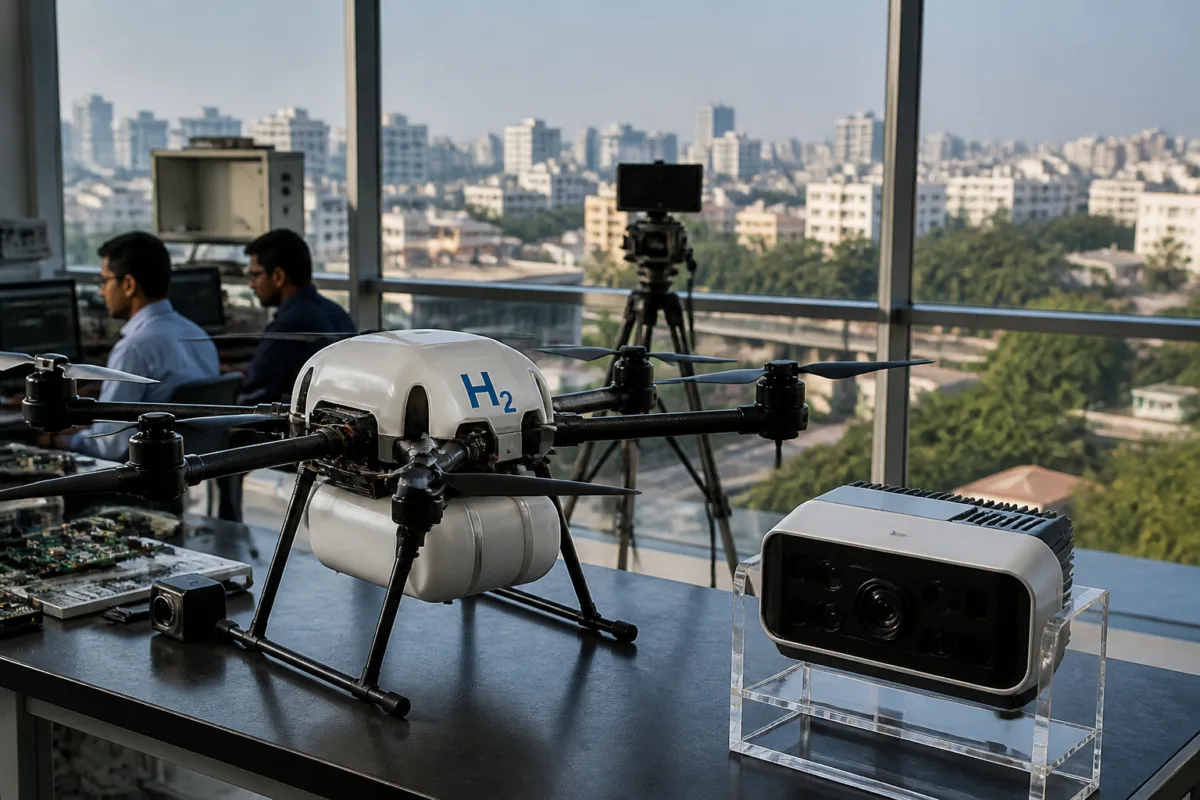
Gujarat startup funding has crossed Rs 287 crore across six ventures in four months, but the more important signal is where that capital is going. The companies are working on hydrogen-powered drones, space imaging, edge artificial intelligence for vehicle safety, lunar mobility, climate-risk insurance and specialised travel platforms. Together, they suggest that the state’s startup economy is moving beyond software-led growth towards technologies that interact directly with transport, industrial systems, public safety, resilience and physical infrastructure.
The funding figures, reported by the Times of India, span ventures at very different stages. The largest round went to Ahmedabad-headquartered insurtech company In Risk Labs, which raised $27 million, or about Rs 255.8 crore, in a Series A round co-led by Bessemer Venture Partners and Northpoint Capital. At the other end of the scale, Cellegant Energy Systems raised Rs 2.6 crore to develop hybrid hydrogen fuel-cell electric drivetrain systems for drones and unmanned aerial vehicles.
The combined amount is therefore not a uniform measure of startup performance. It reflects one substantial insurance-technology round alongside smaller seed and pre-seed investments in research-intensive companies. Yet the composition of the portfolio matters. Five of the six ventures are developing or applying specialised technology in areas where hardware, data, regulation and operational reliability are as important as software.
That distinction is significant for Gujarat’s urban and industrial economy. A software platform can often scale through digital distribution. A hydrogen drivetrain, space imaging sensor, rider-assistance system or lunar mobility platform must move through testing, engineering, manufacturing partnerships, institutional procurement and, in several cases, safety or regulatory processes. The funding announced in the report is consequently an indicator of attempts to build capabilities that connect laboratories and engineering teams to real-world systems.
The strongest example is Cellegant Energy Systems, founded by IIT Gandhinagar professor Dr Atul Bhargav. The company is developing indigenous hybrid hydrogen fuel-cell electric drivetrain systems intended to extend the endurance of drones and other unmanned aerial vehicles. The same technology, according to the report, may also be used in marine and underwater vehicles, autonomous vehicles, quadruped robots and stationary power systems.
Cellegant plans to advance its 35-kg drone programme from technology readiness level three to level six within six to 12 months. That proposed movement is important because it represents a shift from an early demonstration stage towards a system that is closer to operational validation. The report does not establish whether the target will be achieved, but it does show the type of development hurdle facing deep-tech companies: capital must finance a progression from technical concept to a reliable product that can function outside a controlled laboratory environment.
## Gujarat startup funding and the hardware challenge
The presence of GVFL Prarambh Fund Trust, Co Create Aarambh and the incubator at IIT Gandhinagar in Cellegant’s round also illustrates the layered financing often required by early-stage technology ventures. University-linked incubation can support the earliest phase, while seed funds can help companies build prototypes, recruit technical teams and conduct testing. The report identifies these institutions as investors in the company, but it does not provide a complete account of public funding, procurement support or later-stage capital available to such ventures.
GVFL also led a Rs 3.7 crore seed round in Ahmedabad-based Spectra Gaze Systems and invested Rs 3 crore in Edgeverse India. Spectra Gaze, founded by former Isro scientist Arup Banerjee, develops imaging sensors for the space and defence sectors. Its clients include Isro, PRL and Kaynes Technology, and it is developing an image sensor for Isro’s next-generation HRSAT programme in collaboration with AMETEK.
This case points to a different route to scale. Instead of creating a consumer-facing product, Spectra Gaze is working within a network of institutional and industrial users. Space and defence technologies typically require specialised components, long development cycles and high confidence in performance. A company’s ability to participate in such programmes depends not only on its own engineering capacity but also on access to anchor institutions and industrial partners.
Edgeverse India is applying edge AI, cameras and radar to vehicle safety. Its products include rider-assistance systems for two-wheelers and driver-monitoring solutions for commercial vehicles. These applications have a direct mobility and road-safety relevance because they are designed to process information close to the vehicle rather than rely entirely on remote data processing.
GVFL managing director Mihir Joshi said advances in hardware, semiconductor availability and edge AI are allowing systems to process large volumes of data and make decisions in real time. His statement identifies the technological foundation behind several of the investments, but it does not provide performance results, deployment numbers or evidence of adoption by vehicle manufacturers or transport operators. Those details will determine whether the technology moves beyond development into measurable safety outcomes.
The urban importance of these ventures lies in that gap between technical possibility and system-wide use. A rider-assistance device has value only when it works reliably in mixed traffic, different weather conditions and varied road environments. A driver-monitoring system becomes consequential when it is integrated into fleet operations and when its alerts lead to safer behaviour. The funding creates capacity for development, but the report does not yet establish the scale of deployment or the effect on road crashes.
## From lunar mobility to climate-risk insurance
Ahmedabad-based Cosmochute has raised $1.5 million, or around Rs 14.2 crore, in a pre-seed round led by Prosus Ventures. The company is developing LEAP, a modular lunar mobility platform intended to transport and deploy payloads on the Moon. The funds will be used for platform development, team expansion and commercialisation.
Cosmochute sits at the most specialised end of the group. Its immediate product is not an urban service, but the company’s inclusion in the funding pattern shows how Gujarat-linked ventures are entering high-technology markets where mobility, robotics and remote operations overlap. The available information does not establish a commercial deployment date or identify customers for LEAP. What it does establish is that investors are backing the platform at a pre-seed stage, before the company has reached the commercialisation phase described in its plans.
In Risk Labs represents a more immediate connection to the risks faced by cities, businesses and infrastructure operators. The company plans to expand its underwriting, actuarial, catastrophe modelling and AI capabilities, while widening coverage across climate risks, marine cargo and motor insurance. It also plans to develop parametric and structured reinsurance offerings, with part of the funding supporting its subsidiary EarthRe.
Insurance technology does not build a flood barrier, protect a warehouse or repair a damaged road. It can, however, influence how risks are measured, priced and transferred. Catastrophe modelling and climate-risk coverage become increasingly relevant when extreme events affect property, transport networks, supply chains and municipal services. The report does not quantify the company’s existing coverage, claims performance or exposure to specific climate events, so the practical scale of its impact remains unestablished.
The funding nevertheless places risk intelligence alongside hardware and mobility technologies in the state’s startup landscape. That combination is notable because urban resilience depends on both physical systems and financial mechanisms. Sensors and models can identify risks; insurance and reinsurance products can determine how losses are absorbed. The companies in this funding set operate at different points in that chain, although the supplied evidence does not show that they are working together.
## What the funding pattern reveals
The sixth company, travel-tech venture Bucketlistt.com, raised Rs 7.6 crore in seed funding with support from i Hub Gujarat. The platform connects travellers with verified experiences and helps operators reach a wider customer base. It plans to strengthen its platform, expand its operator network and enter new destinations across India.
Bucketlistt.com is more closely associated with services and local economic activity than with deep technology. Its relevance to the broader picture is that the funding group is not exclusively focused on laboratories or industrial systems. It also includes a platform attempting to organise fragmented tourism supply, verify experiences and connect smaller operators with demand.
Hiranmay Mahanta, chief executive officer of i Hub Gujarat, said the organisation initially supported the venture with a Rs 10 lakh grant and that the founder had raised up to Rs 7 crore within two years. He described adventure tourism as a growth opportunity as travel moves towards mass customisation. The reported progression from an early grant to later private funding illustrates the role incubators can play in helping a venture reach investors, although the report does not provide comparable outcomes for other companies supported by the organisation.
Taken together, the six fundraises point to three features of Gujarat’s current startup economy. First, the state is producing or attracting ventures built around specialised engineering and applied intelligence, rather than only general-purpose digital services. Second, institutional links are visible: IIT Gandhinagar, Isro, PRL, Kaynes Technology, AMETEK, GVFL and i Hub Gujarat appear in the reported company histories or funding rounds. Third, the ventures face different routes to scale, ranging from government-linked technology programmes and industrial clients to consumer platforms and insurance markets.
The Rs 287 crore total should therefore be read carefully. It is a snapshot of announced capital, not a measure of revenue, jobs, product adoption or public benefit. It also cannot by itself establish that Gujarat has solved the financing or commercialisation challenges faced by deep-tech startups. The funding rounds show investor interest and planned use of capital; they do not yet show final technology performance.
For cities and the built environment, the key question is whether these ventures can cross the distance between a promising system and dependable urban use. Hydrogen-powered drones could eventually support applications beyond conventional aviation, but their operating economics and safety requirements are not provided. Edge AI may improve vehicle safety, but the report contains no deployment or crash-reduction data. Climate-risk analytics may strengthen insurance markets, but its effect on resilience depends on coverage, pricing and claims. These limits are not weaknesses in the funding announcement; they are the next evidence that will be needed to assess impact.
Gujarat’s latest startup funding activity thus represents an early but clear shift towards technology that is more closely tied to physical systems. The state’s ecosystem is bringing together university research, former space-science expertise, venture capital, incubators and industrial relationships. Whether that combination produces durable companies will depend on the next stages: prototype validation, institutional adoption, manufacturing capacity, regulatory acceptance and commercially sustainable demand. For now, the funding provides evidence of a growing pipeline, not yet proof of completed transformation.

