


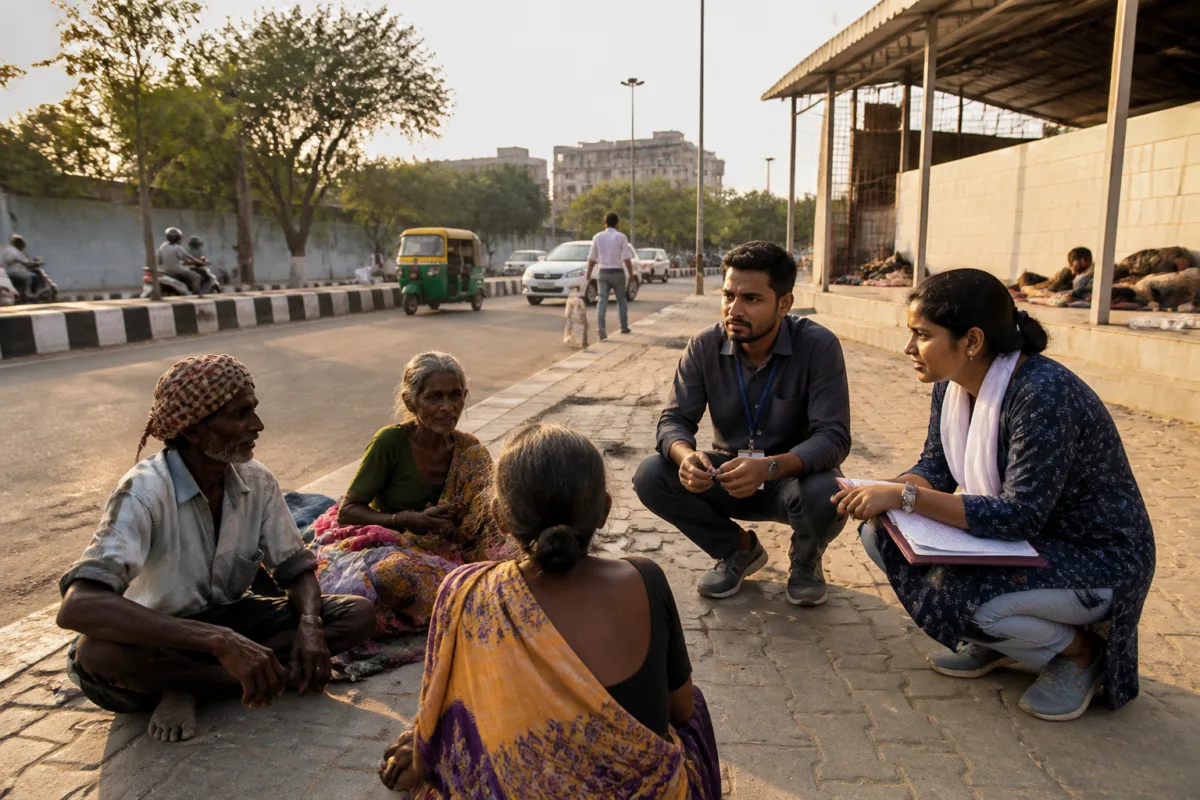
Ahmedabad’s plan to become beggar-free by 2030 places the city’s homelessness response at the intersection of welfare, public space management and policing. The Ahmedabad Municipal Corporation (AMC), city police and the social security department are working on a three-stage programme that includes street rescue, shelter, vocational training and public awareness. But the proposal to penalise people who give alms introduces a more contentious element: the attempt to manage visible poverty by regulating both those who beg and those who respond to them.
According to a report in the Times of India, authorities have identified 186 active begging spots through surveys conducted by three empanelled non-governmental organisations. Banners and boards have reportedly been installed at these locations warning that begging or giving alms is an offence. The exact penalty and punishment for giving alms, however, are still being decided, according to an AMC official quoted in the report. That distinction matters. A public warning may alter behaviour, but a punishable offence requires a clearly established legal and administrative framework.
The city’s stated objective is linked to a longer-term plan to make Ahmedabad beggar-free by 2030, the year it is expected to host the Commonwealth Games. The AMC’s 2025-26 budget included a provision for this goal, and the standing committee approved the plan under the Union Ministry of Social Justice and Empowerment’s SMILE project. The first-year central grant is expected to be Rs 55.80 lakh, followed by Rs 50 lakh annually in subsequent years.
The figures indicate a programme that is still being built rather than a fully operational system. The authorities have received 39 calls since the AMC added beggar rescue complaints to helpline 155303 on April 9, 2026. The report says 732 beggars have been rescued from different parts of the city. At the dedicated shelter home, the stated aim is to help 100 people leave begging through vocational skills. These numbers reveal both the scale of the intervention and its limited initial capacity: 732 rescues are reported, while the shelter-based vocational plan is designed around 100 beneficiaries.
That gap does not by itself establish failure. Rescue, identification, shelter and livelihood support are different administrative tasks, and the supplied information does not specify how many people have entered shelters, how many have received training, or how many have secured income. It does, however, show why a beggar-free target cannot be assessed only through the number of people removed from streets. A city may record more rescues without establishing whether people have stable shelter, access to documents, healthcare, family support or employment.
The programme’s three-phase design recognises some of this complexity. The first phase focuses on rescue. The second involves shelter and livelihood training. The third is intended to create awareness among citizens who give alms and take action against them. In administrative terms, this sequence moves from direct intervention to rehabilitation and then to behaviour regulation. The risk is that the most visible and enforceable part of the programme becomes the last one, while the less visible work of sustaining housing and livelihoods receives less public attention.
The helpline is an important part of this institutional structure because it gives residents a formal channel to report homeless people. It also changes the role of citizens. Instead of responding individually on the street, residents are encouraged to refer cases to the municipal system. That can help authorities identify people who need assistance, but it also turns homelessness into a matter of reporting and enforcement. The effectiveness of that model will depend on what happens after a call is received: whether the person is assessed, offered shelter and connected to services, or simply moved from one location to another.
The identification of 186 hotspots is similarly significant. It suggests that begging is being mapped as a spatial problem, concentrated in specific parts of the city. Such mapping may help coordinate outreach teams and shelter transport. It may also encourage authorities to treat certain junctions, roads or public spaces as zones requiring visual control before major events. The supplied report does not identify the locations or explain how the survey classified active begging spots. Without that information, the count is useful as an administrative indicator but not enough to measure the size of Ahmedabad’s homeless population.
The distinction between homelessness and begging is central to the policy. People who beg may include individuals without shelter, people with disabilities, older persons, migrants, children, people separated from families and those with no regular income. The report refers to both homeless people and beggars, but it does not provide a breakdown of these groups. That makes it difficult to know whether the programme is designed as a homelessness response, an anti-begging drive, or both. Each requires different forms of assessment and support.
The proposed action against almsgiving raises a related question about responsibility. Authorities appear to be arguing that street donations sustain begging and make it harder to move people into rehabilitation. That may be the administrative logic behind public warnings. Yet a ban or penalty would only be meaningful if residents can access a credible alternative for helping people in distress. The current material identifies a helpline and a shelter-based training plan, but it does not state whether emergency food, medical care, temporary accommodation or verified donation channels will be available at the city’s 186 identified spots.
The funding model also places limits on what the programme can immediately deliver. The first-year grant of Rs 55.80 lakh and annual grants of Rs 50 lakh thereafter are intended to support the plan under SMILE. The report does not specify the total cost of shelters, staffing, outreach, transport, training or long-term rehabilitation, nor does it clarify the AMC’s own contribution. Those details will determine whether the programme can move beyond periodic rescue operations. A target of helping 100 people leave begging requires sustained follow-up, not only one-time placement in a shelter or training course.
The Commonwealth Games deadline adds another layer to the policy. A city preparing to host a major international event often intensifies attention on streets, transport corridors and public spaces. Ahmedabad’s 2030 target therefore has an urban-management dimension alongside its welfare objective. The danger in such timelines is that the measurable outcome becomes the removal of visible poverty from high-profile areas, while the underlying conditions remain outside the frame. The supplied report does not say that this has happened, but the timing makes the distinction between rehabilitation and displacement particularly important.
The programme’s institutional arrangement is potentially stronger than an action led by a single agency. The police, social security department, AMC, NGOs and the central ministry all have different responsibilities. The police may handle enforcement and public order; the social security department may support welfare access; the AMC controls civic infrastructure and the helpline; NGOs are surveying locations; and the SMILE project provides the central funding framework. The success of the programme will depend on whether these roles are coordinated and whether information follows a person through the system instead of being divided between departments.
For citizens, the immediate change is likely to be the appearance of warnings and the possibility of action for giving alms. For people begging on the streets, the more important test will be whether rescue leads to a durable alternative. The current evidence confirms that authorities have begun mapping locations, receiving complaints, conducting rescues and planning vocational support. It does not establish the number of people rehabilitated, the outcomes of training, the legal basis of the proposed penalty, or the process for challenging an incorrect or coercive intervention.
Ahmedabad’s beggar-free plan therefore represents two policies at once. It is a welfare programme seeking to move people from streets into shelter and livelihoods, and it is a public-space programme seeking to change what residents encounter in visible urban locations. The first requires care, capacity and follow-through. The second can be implemented quickly through warnings, patrols and removals. The evidence supplied so far shows that the city has begun the first steps, but the balance between these two approaches remains unresolved.
The next milestones are the finalisation of penalties for giving alms, the operation of the dedicated shelter, the delivery of vocational training and the expansion of the helpline-led rescue system. Authorities will also need to show how the 732 rescued people are being supported and how the target of helping 100 people leave begging will be measured. Until those details are available, Ahmedabad’s 2030 promise is best understood not as a completed urban transformation but as an evolving test of whether a city can address visible poverty through rehabilitation rather than visibility management alone.

