


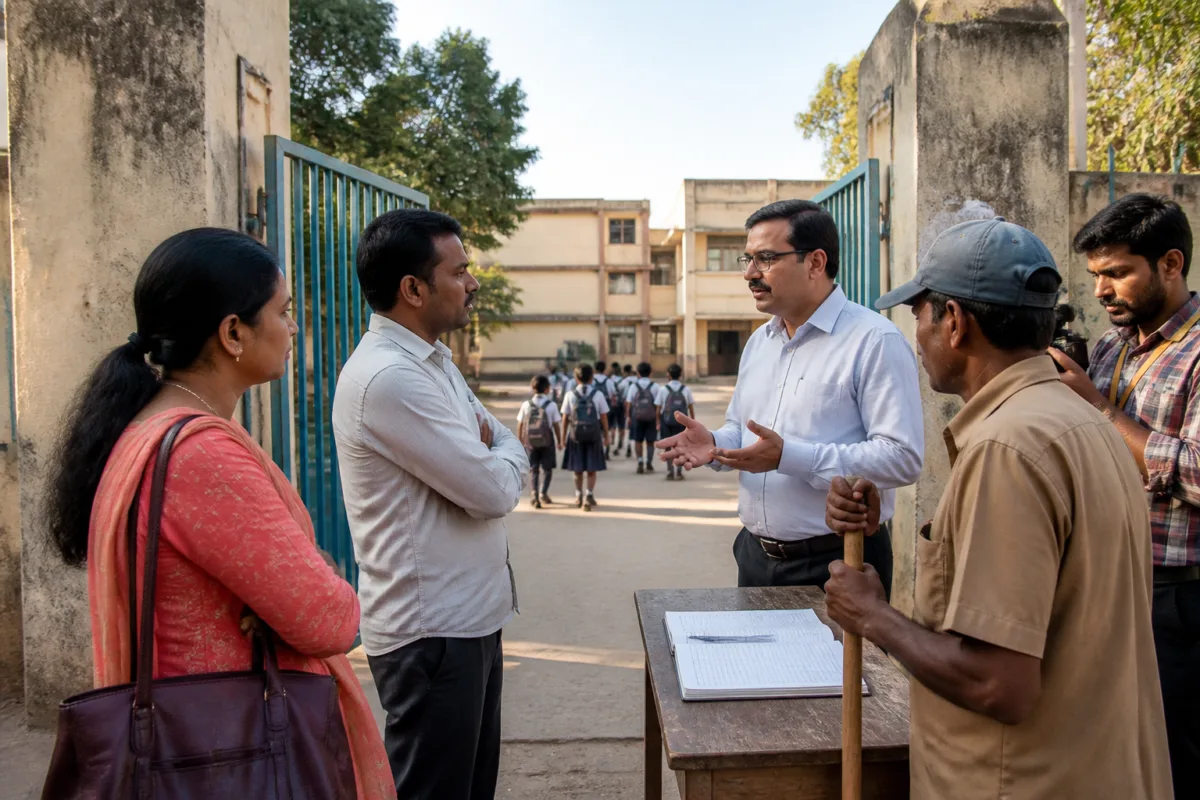
Gujarat’s school entry circular has turned a routine administrative control into a wider dispute over who can enter a government school, who can record what happens inside it and how public institutions should remain accountable. The circular requires visitors to obtain permission from the principal or head of the school, while the state government says it is intended to protect children’s privacy and prevent unauthorised video recording. Opposition parties argue that the measure could restrict scrutiny of government schools.
The dispute is significant because government schools are not only educational campuses. They are publicly funded institutions, staffed by public employees and used by children whose parents and communities have a legitimate interest in their functioning. At the same time, a school is also a place where minors spend much of their day. The competing claims around the circular show how difficult it is to design an access policy that protects children without making the institution inaccessible to parents, journalists, lawyers, civil-society groups or elected representatives.
According to the report by Divya Bhaskar, the Gujarat government’s circular makes permission from the principal mandatory for entry into government schools. The report says the measure followed concerns about political groups and other outsiders entering campuses, filming school activities and circulating videos on social media. Education Minister Pradyuman Vaja said the circular did not prohibit entry, but required it to take place with the approval of the school’s principal or head.
The minister’s explanation places the circular within the framework of privacy and child protection. He referred to the right to privacy recognised by the Supreme Court’s Puttaswamy judgment and said the government wanted to prevent incidents in which children were recorded and the footage was later distributed through the media. He also said that action under the Juvenile Justice Act, the Bharatiya Nyaya Sanhita and other laws would apply only when a person actually violated the law, and that entering a school by itself did not attract criminal provisions.
That clarification is central to the controversy. The report quotes advocate Zaki Sheikh, a member of the Bar Council of Gujarat, as questioning the use of the Protection of Children from Sexual Offences Act, or POCSO Act, in connection with unauthorised entry. Advocate Hardik Patel similarly said the circular did not clearly define who would be treated as an outsider and that POCSO did not contain a general provision covering entry by outsiders. Both lawyers raised concerns about the legal consequences of a broadly worded rule.
The distinction between unauthorised access and a child-safety offence matters administratively as well as legally. A school may need to regulate visitors, maintain records and prevent disruptive conduct. But a visitor-control rule does not automatically establish that a sexual offence or a child-protection offence has taken place. The lawyers quoted in the report therefore separate the legitimacy of controlling access from the question of which criminal law can be invoked when the rule is breached.
The circular also encounters the practical complexity of running a school. Advocate Hardik Patel pointed to plumbers, furniture repair workers, building contractors, doctors, lawyers and journalists as examples of people who may need to enter a campus for legitimate reasons. Parents may also visit schools to meet teachers or observe activities involving their children. A system that simply requires written permission without defining categories, procedures and response times could create uncertainty for both visitors and school staff.
The report also records a separate concern about parents taking photographs or videos during school activities. Patel said that footage showing one child could also capture other children, creating the possibility of complaints or misuse. This illustrates why consent, recording protocols and the handling of digital material are more precise tools than a general restriction alone. The supplied report, however, does not provide the full text of the circular or details of any standardised consent, visitor-register or grievance procedure.
The government’s stated objective is supported by school-management organisations and a teachers’ body quoted in the report. Rakesh Thakor, publicity secretary of the Akhil Bharatiya Rashtriya Shaikshik Mahasangh, welcomed the decision and said the organisation had written to the government on August 20 seeking action against unauthorised filming and the misleading circulation of videos. He said school activities, including cleanliness drives and campus programmes, could be presented out of context on social media.
Bhaskar Patel of the Gujarat State School Management Association also supported the circular, saying that the movement of outsiders in schools had increased and that political groups had entered campuses during disputes. He referred to allegations of vandalism, confrontations with school staff and complaints against principals. He nevertheless described the possibility of filing cases under POCSO as serious and called for that aspect to be removed, according to the report.
A. K. Bharwad of the Ahmedabad City School Management Association said the measure could prevent political visitors from disrupting schools or using examination-related visits for publicity. He referred to incidents in which political figures visited during board examinations, distributed roses to students and arranged photographs. These accounts point to a governance problem that is distinct from child protection: schools can become stages for political visibility, especially when access is informal and accountability for the visit is unclear.
Opposition leaders interpret the same rule differently. Aam Aadmi Party leader Isudan Gadhvi accused the BJP government of using the notification to hide the condition of government schools. He alleged that the state’s public education system had deteriorated over three decades and said parents and young people were being threatened with POCSO action when they questioned conditions. Congress chief spokesperson Manish Doshi made similar allegations and cited claims about shortages of classrooms, single-teacher schools and multiple grades being taught in one classroom.
Those figures and allegations are presented in the report as political statements, not as independently established findings within the supplied material. The report attributes to Doshi claims that Gujarat has around 42,000 deficient or dilapidated classrooms, about 3,000 schools operating with a single teacher and 14,562 schools where more than one grade is taught in a classroom. It also says he referred to a NITI Aayog report while arguing that Gujarat was falling behind in education. The supplied article does not reproduce the relevant report, methodology or date, so these claims require separate documentary examination before they can be treated as verified measures of the school system.
Congress leader Shaktisinh Gohil argued that schools and colleges should remain open to public scrutiny and contrasted the circular with an approach in which people are invited to inspect institutions and offer suggestions. His argument raises the larger democratic question at the centre of the dispute: whether protection of children’s privacy should be implemented through controlled transparency or through restricted access.
The policy challenge is not simply whether outsiders should be permitted to enter. It is how a public school can distinguish between a legitimate visitor, a disruptive political group, a parent, a journalist, a contractor, a government inspector and a person seeking access for an unlawful purpose. The circular, as described in the report, establishes principal-level permission but does not clarify whether the state has issued uniform forms, time limits, appeal mechanisms, visitor categories, recording rules or consequences proportionate to different violations.
That institutional detail will determine how the measure works in practice. If every decision is left to individual principals without clear guidance, schools may apply the rule inconsistently. A principal could face pressure from political groups while also being expected to protect children’s privacy and maintain normal operations. If the process is too open, campuses may remain vulnerable to disruption and unauthorised recording. If it is too restrictive, parents and the public may find it difficult to understand whether schools are functioning safely and adequately.
The report’s competing accounts also reveal an important difference between visibility and accountability. Filming children without safeguards can violate privacy and expose minors to harm. But recording, inspection or reporting about infrastructure, teaching conditions or administrative failures is not the same as recording children. A well-designed framework would need to distinguish between the two rather than treating all photography, videography and public access as a single category.
The state’s position, as reported, is that the circular does not close schools to visitors and that criminal action is applicable only when an actual legal violation occurs. The lawyers and opposition leaders quoted in the report remain concerned that references to POCSO and other laws could intimidate legitimate visitors even if the government’s stated intention is narrower. The school-management bodies support access controls but also question the use of child-protection law for ordinary entry violations.
What remains unresolved is the precise legal and administrative architecture of the circular. The supplied report does not establish whether the notification has been challenged in court, whether the government has published implementing guidelines or whether a formal review mechanism exists. It also does not provide independent verification of the opposition’s infrastructure claims or a statewide record of incidents that prompted the decision.
Gujarat’s school entry circular therefore represents more than a dispute between the government and opposition parties. It is a test of how public institutions manage the tension between child privacy, operational security and democratic oversight. The immediate question is whether permission-based entry can be implemented with enough clarity to protect students without preventing legitimate scrutiny. The next important developments will be the publication or examination of the circular’s full legal wording, any implementation guidelines issued to schools and any formal challenge to its provisions.

